
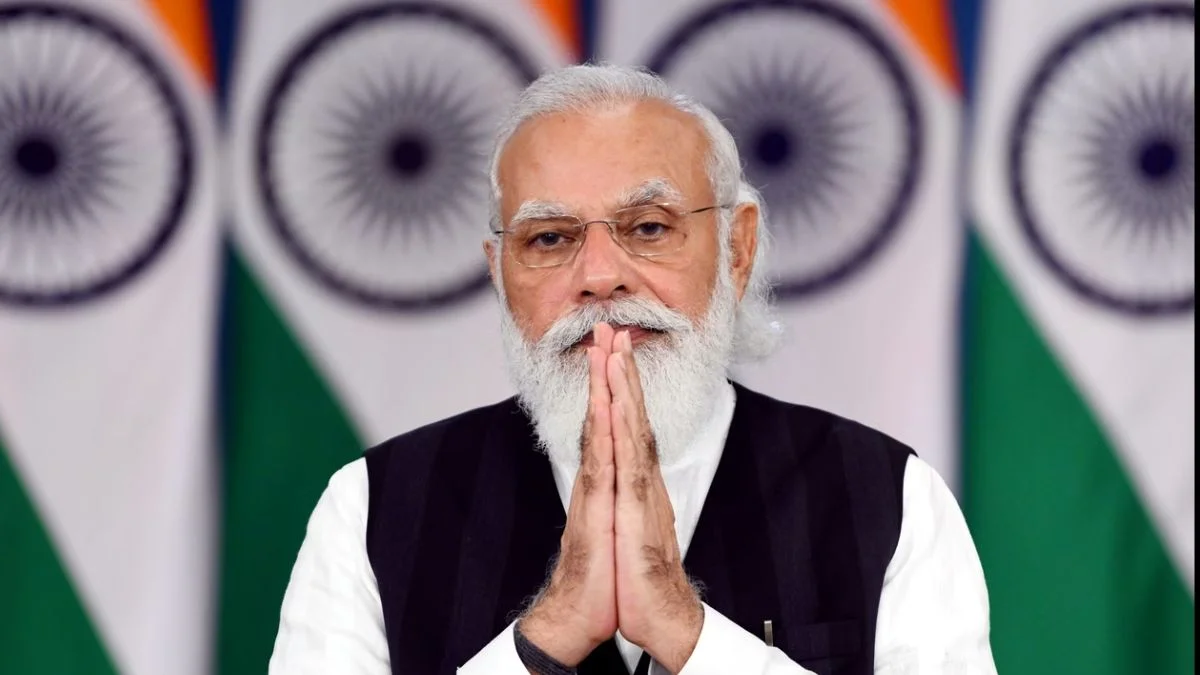

Prime Minister Narendra Modi on March 23, 2026 made what is arguably the most direct and consequential statement India has made since the West Asia conflict began, declaring in the Lok Sabha that the closure of the Strait of Hormuz is unacceptable. The statement marks a clear and deliberate escalation in the firmness of India’s public position on the conflict, moving beyond measured diplomatic language into an explicit declaration of national interest.
Until today, India had largely navigated the West Asia crisis through careful diplomatic balancing, maintaining lines of communication with both the United States and Iran while avoiding public statements that could be read as alignment with either side. The word unacceptable changes that calculus. It is not a word that leaves room for ambiguity. It is a word that signals a red line.
The Strait of Hormuz is a narrow waterway between Iran and Oman through which approximately one fifth of the world’s oil and liquefied natural gas supply passes every single day. For India specifically, the stakes are existential in energy terms. India imports over 85 percent of its crude oil requirements, and the Gulf region accounts for a substantial share of that import basket. The route through the Hormuz strait is not one of several options for India’s energy supply. For a significant portion of India’s crude imports, it is the only option.
Since Iran’s effective closure of the strait following the US and Israeli strikes in late February 2026, India has been conducting active diplomatic engagement to secure safe passage for Indian flagged vessels. Reports in the days before Modi’s statement indicated that Iran had approved safe passage for Indian LPG tankers and that at least one Indian oil tanker had successfully navigated out of the eastern side of the strait. But those were case by case arrangements, not a restoration of the free and open transit that India’s energy security requires on a sustained basis.
By declaring the closure unacceptable in Parliament, Modi is placing India’s position formally on the record for both Tehran and Washington to hear. India is not simply a concerned observer of the Hormuz situation. It is an affected party with a declared national interest in the strait’s reopening.
India’s statement carries weight precisely because of the position India has maintained throughout the conflict. Unlike Western nations that have aligned firmly with the US and Israeli position, India has neither condemned Iran nor endorsed the strikes. It has called for dialogue, de-escalation, and the protection of civilian infrastructure and shipping. That neutrality has given India access and credibility with Tehran that few other major economies currently possess.
Modi’s use of the word unacceptable is therefore a signal to Iran as much as a domestic political statement. India is telling Tehran, through the most visible possible forum, that the Hormuz closure is damaging Indian interests in a way that India will not accept indefinitely. Given India’s carefully maintained neutrality, that message carries considerably more weight in Tehran than the same statement from a Western government would.
India’s options for acting on that declaration are limited but not insignificant. Diplomatically, India has the relationships and the credibility to act as a channel between Tehran and the international community in ways that the United States and its allies cannot. Economically, India is one of Iran’s most important trading partners and one of the largest buyers of Iranian crude before US sanctions reduced those flows. India’s goodwill is something Tehran has historically valued.
Whether that leverage is sufficient to influence Iran’s decision on the Hormuz strait in the context of an active war with the United States and Israel is a different question. But by declaring the closure unacceptable in Parliament today, Prime Minister Modi has made clear that India intends to use whatever leverage it has, and that the West Asia conflict is no longer something India is merely watching from a safe distance.
The stakes, as Modi himself acknowledged in the same parliamentary session, include Indian lives, Indian trade routes, Indian energy security, and Indian household economics. When a Prime Minister uses the word unacceptable in Parliament about a global chokepoint, he is not making a rhetorical point. He is serving notice.

Comments are closed.