
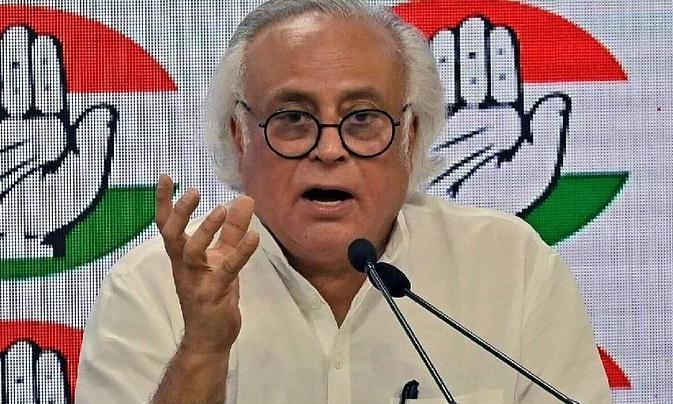

Congress on Saturday (February 21) demanded that Prime Minister Narendra Modi renegotiate the terms of the India-US interim trade while putting the trade agreement on hold. The development comes a day after the US Supreme Court struck down President Donald Trump’s global tariffs.
Congress general secretary in charge of communications, Jairam Ramesh, demanded that the Centre must make it clear that there would be no easing of import restrictions until the Trump administration sets the record straight. He further stated that the government must ensure the safeguarding of farmers’ interests.
Ramesh told reporters that the Prime Minister must clarify whether he agrees with Trump’s statement that nothing has changed in the trade deal with India. The Congress leader argued that the India-US interim agreement will adversely affect farmers, adding that the Centre should put this deal on hold till clarifications are made.
Demands clarification from PM
“We demand that the PM should categorically state that we will not carry out import liberalisation after the Supreme Court decision, as there is a rethink in India’s policy and we will not carry out import liberalisation till clarifications are made,” Ramesh said.
Also Read: India’s tariff cut to 10 pc as Trump issues proclamation on new levy
“On February 2, President Trump made the announcement of the deal, stating that he is happy that a deal has been reached, and on the request of the PM, this is effective immediately,” he said, adding that the chronology of events is important.
‘Why PM rushed the trade deal’
“The first question arises is why did the PM was in a hurry to announce this,” he said. Ramesh alleged that PM Modi requested Trump to make the announcement to divert public attention regarding Rahul Gandhi’s remarks in the Lok Sabha on former Army chief Naravane’s General (retired) Manoj Mukund Naravane’s memoir.
Also Read: US Supreme Court throws India a lifeline. Will Modi take it?
“We believe that this was connected with Rahul Gandhi’s remarks in the Lok Sabha, raising the issue of China and former Army chief Naravane’s book. We believe that in order to divert from that, PM Modi requested Trump to announce this,” Ramesh said.
‘Why trade deal despite chances of legal hurdles’
The US Supreme Court on Saturday struck down Trump’s global tariffs, saying it is against the American Constitution, Ramesh said.
“Our second question is that when the PM, the commerce minister (Piyush Goyal), knew from December that any time (now) the Supreme Court verdict could come, many believed that it could be struck down. Why did you hurriedly strike a deal when you knew the verdict could go against Trump,” Ramesh said.
Also Read: US Supreme Court strikes down Trump’s global tariffs
The 10 per cent tariff would be imposed on imports, and as per law this will be for 150 days, he said.
“Trump has also stated that nothing changes for the Indo-US trade deal. So we want to ask the PM, does he agree with his friend’s statement that the verdict will have no impact on the deal,” Ramesh said.
The backdrop
The framework states that in the event of any changes from either side, the US and India agree that they can modify their commitments, Ramesh pointed out.
After the US Supreme Court struck down President Donald Trump’s global tariffs, Congress leader Rahul Gandhi accused Prime Minister Narendra Modi of being “compromised”, saying his “betrayal” in the India-US interim trade deal stood exposed.
Also Read: Why SC Court order is not the end of Trump’s tariffs push? Expert decodes
The Congress has alleged that the trade deal had become an “ordeal” for the country subjected to by the prime minister’s “desperation and surrender”.
In a major setback to what was Trump’s pivotal economic agenda in his second term, the US Supreme Court, in a 6-3 verdict written by Chief Justice John Roberts, ruled that the tariffs imposed by Trump on nations around the world were illegal and that the president had exceeded his authority when he imposed the sweeping levies.
(With agency inputs)

Comments are closed.