
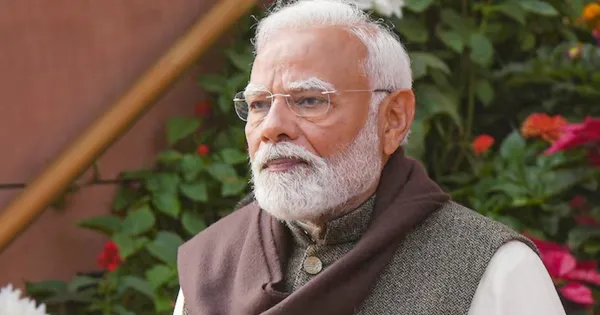
Prime Minister Modi said – Avoid populist measures in the budget, focus on employment generation and growth through capital expenditure.

New Delhi. Calling productive spending the hallmark of his government, Prime Minister Narendra Modi on Sunday said the recently presented Union Budget deliberately avoided short-term populist measures and invested in infrastructure through record capital expenditure to drive job creation and sustainable economic growth. Prime Minister Modi said in an exclusive interview that during his tenure, his government has worked to bridge the ‘structural gap’ left by the previous governments, carried out bold reforms and laid the foundation of a developed India.
He said the latest budget is the ‘next level’ of this journey. Describing the budget for the financial year 2026-27, starting from April 1, as a reflection of his governance style, he said that this document is ‘a good reflection of our governance style and priorities.’ The Prime Minister said, “This budget represents the next level in our journey and accelerates our ‘Reformation Express’. It is designed with the objective of preparing our youth for emerging opportunities in a rapidly changing world and accelerating the pace of development.”
Citing the economic review of 2025-26 presented before the budget, he said that capital accumulation, organized labor and digital public infrastructure together have taken India’s potential growth rate to seven percent. The Prime Minister said, “Productive expenditure has been the hallmark of our government. “The higher capital expenditure reflects our focus on infrastructure and capital investment, which are strong engines of long-term growth.”
Capital expenditure has been increased to Rs 12.2 lakh crore in the budget for financial year 2026-27, which is five times that of 2013. Through this, the government has strengthened its strategy to prioritize investment in infrastructure creation, logistics expansion and emerging sectors to drive long-term growth. The budget focuses on spending on rail, road, digital and energy infrastructure, as well as simplifying compliance and improving credit flows, to boost job creation and economic momentum.
“This is a conscious strategic choice to invest in assets that generate productivity, employment and future economic potential rather than short-term populist measures,” Modi said. This makes it clear that our focus is on improving the quality of life of the people, creating employment for the youth and taking the country forward towards a developed India.
The Prime Minister said that high-quality infrastructure was neglected for a long time, posing challenges to the common people and Indian businesses. “A dilapidated and outdated infrastructure is not suitable for a country that aspires to be a developed India,” he said.
He said that keeping this in mind, the government has focused on building speed, scale and next generation infrastructure and has also upgraded the existing infrastructure to revolutionize the sector. The past decade has witnessed the most massive infrastructure building campaign in India’s history, with an unprecedented emphasis on quality.
Underscoring the scale of the expansion, he said the number of airports has doubled, thousands of aircraft are being ordered, the number of cities with metro services has more than quadrupled, rural roads and internet connectivity are expanding rapidly and investments have been made in the transformational expansion of freight corridors, ports and coastal connectivity.
Referring to the sector-wise allocation, the Prime Minister said that a capital provision of about Rs 3 lakh crore has been made for Indian Railways, with priority given to high-speed connectivity, freight capacity and passenger safety. He informed that it is proposed to develop seven new high-speed rail corridors, including the Southern High-Speed Diamond Corridor, which will benefit Karnataka, Telangana, Andhra Pradesh, Tamil Nadu, Kerala and Puducherry.
Additionally, dedicated freight corridors are being expanded with the aim of reducing pressure on passenger routes and reducing logistics costs for the industry. Allocation for national highways has increased by nearly 500 percent compared to a decade ago. Highlighting investments in emerging sectors, Modi said investments are being made in emerging sectors like biopharma, semiconductor, electronics equipment manufacturing, rare mineral corridors and chemical parks. He said, “These will give a new impetus to employment and investment and will strengthen the future of India.”
Emphasizing on governance reforms, the Prime Minister said an important feature of the Budget is the continued emphasis on trust-based governance. “Paperwork is being reduced across sectors, ministries and processes, crimes are being decriminalized and compliance requirements are being reduced as the government views the state as an enabler and trust of citizens,” he said.
Modi said his government has created a framework of ‘inclusive, technology-driven but human-centric’ welfare, which reaches the last person and leaves no one behind. Recalling his call from the Red Fort, ‘This is the right time, this is the right time’, he said this sense of urgency has now become a ‘national belief’.
He said that India’s position in the global system is strengthening and the post-pandemic world is opening new opportunities for India. Keeping the budget in a long-term perspective, Prime Minister Modi said that it should not be considered only as the budget of 2026, but it is a document laying the foundation of a developed India by 2047. He said, “This is the first budget of the second quarter of the 21st century. “This Budget integrates the achievements made since 2014 and builds on them, providing new momentum for the next 25 years.”

Comments are closed.