
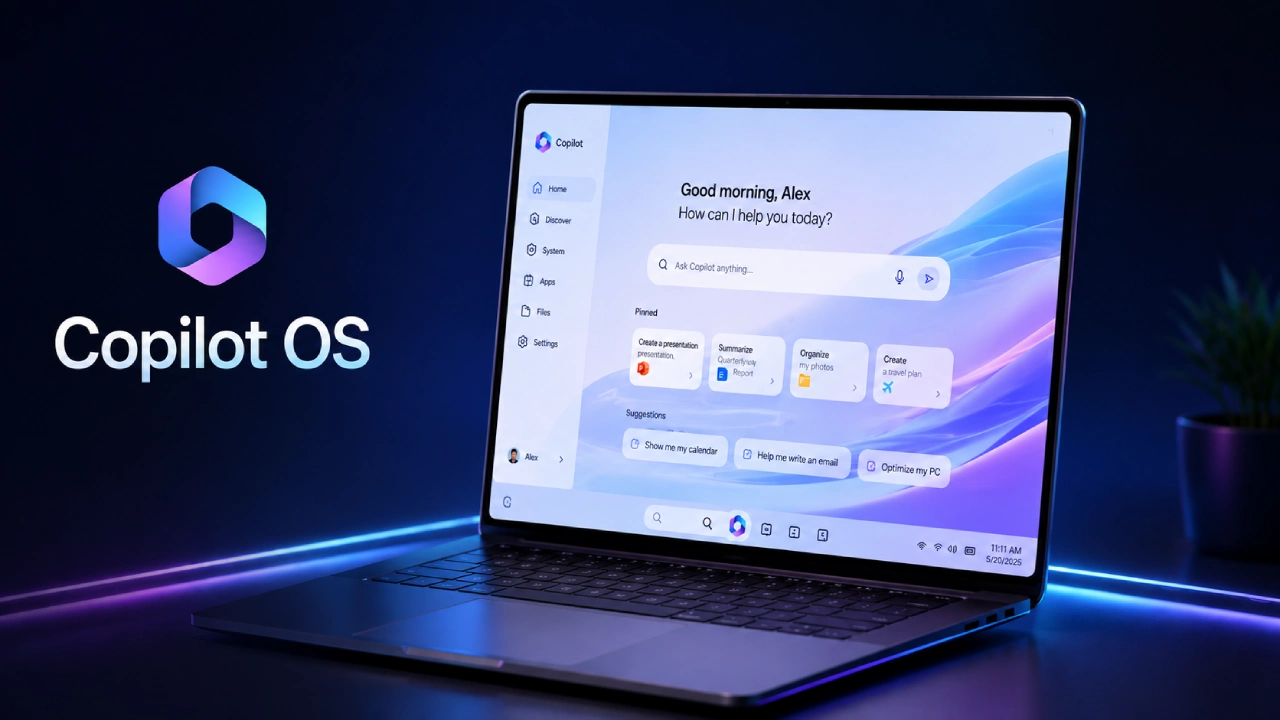

The leaked video everyone is sharing today is not a preview of Windows’ future. It is a two-year-old time capsule of an idea Microsoft has already moved past — into something that actually exists right now.
A leaked video first shared on Discord server BetaWiki has revealed Project Aion, an internal Microsoft effort exploring what a lightweight Windows OS could look like if built from the ground up around Copilot and agentic AI, rather than the traditional Start menu, taskbar, and desktop shell most Windows users have used for three decades. The three-minute clip, verified as authentic by sources speaking to Windows Centralis reportedly around two years old — meaning it predates almost everything Microsoft has publicly shipped or announced about agentic AI in Windows since.
That timing gap is the story most coverage today is missing. Aion is not a glimpse of what is coming. It is a glimpse of what came before what is already here.
What Project Aion Actually Shows
The Aion prototype runs on a lightweight, web-based Windows codebase called Win3, using Microsoft Edge and Chromium’s layout engine as its shell instead of the traditional Windows desktop environment. Since the prototype is based on web technologies, it does not support native Win32 applications directly — when users want to open a program like Microsoft Word, Aion instead provides a link to a Windows Cloud PC instance where the program runs remotely.
The interface drops the traditional Start menu entirely in favor of a multi-modal “Ask me anything” input box, which functions as the primary way to find files, open apps, and browse the web. Typing “techc” into the box, for example, autocompletes toward TechCrunch and opens it in a clean Edge browser window. Typing “to do” surfaces Microsoft To Do — not as a native Windows app, but as the web version running in an Edge picture-in-picture floating window.
“Aion is an example of a web-based agent OS that natively builds Copilot into the core of the shell,” the video’s narrator explains.
Spaces: The Feature That Reorganizes How You Think About Apps
The most distinctive concept inside Aion is called Spaces — a feature that automatically groups apps and websites together based on user goals rather than app type, powered by an engine called Silverstone.
Instead of grouping all your Word documents together and all your browser tabs together, Aion groups items by what you are trying to accomplish. These Spaces appear both in the taskbar and in the Copilot launcher, providing a one-click method of reopening multiple related items at once. Rich plugins let Copilot take direct action inside a Space — one demonstrated example shows the AI drafting and sending an Outlook email to a coworker based on content already present in that Space.
When the narrator asks Copilot for “best dining options in Maui,” the interface itself physically morphs — the launcher transforms into a floating chat window and begins listing specific restaurant results directly, rather than redirecting to a browser search. Ask a second, unrelated question — like upcoming meeting schedules — and Copilot opens a separate floating chat window alongside the first, with the taskbar dynamically generating distinct icons for each conversation based on context rather than showing duplicate generic Copilot icons.
There is also a hidden Context IQ trigger: typing a forward slash in the search box taps directly into Microsoft 365 data, letting users tag specific coworkers or files into a prompt instantly — a detail that signals Aion was built with enterprise workflows specifically in mind.
Why This Video Exists Now — And Why It Probably Will Never Ship
Sources describe the clip as likely a hackathon experiment rather than a confirmed product roadmap, and its current status inside Microsoft is unknown. Microsoft was reached for comment and declined to provide one.
The public reaction has skewed sharply negative. Reddit users on r/pcmasterrace raised concerns about a Copilot-powered operating system losing support for local applications without constant cloud dependence, privacy implications of an AI system capable of reading across all of a user’s Spaces, and a broader loss of user control compared to the traditional Windows desktop model. Users also noted that core OS functions in Aion would require a persistent internet connection to function at all.
That backlash context matters for understanding why Aion, specifically as shown in this leak, is unlikely to ship in this exact form. Given the sheer backlash around Copilot in Windows over the past year or two, Microsoft is likely already rethinking much of this approach — the aggressive, shell-replacing version of Copilot integration shown in the leak runs directly counter to the more measured, opt-in Copilot placement Microsoft has shipped in actual Windows 11 updates recently, including a movable taskbar and a dedicated Taskbar Size setting added specifically in response to user feedback about Copilot’s prominence.
The Part Nobody Is Connecting: Aion’s Ideas Already Shipped Somewhere Else
Here is what separates this story from a simple “old leak resurfaces” post. Microsoft has already announced Project Solara, an agentic OS experience that uses just-in-time UI to generate experiences on demand as a user asks for them, running on both AOSP and Windows — architecturally similar to Aion in its core ambition, if not its exact implementation.
More concretely: at Build 2026, Microsoft announced Aion 1.0, a 14-billion-parameter on-device reasoning model built directly into Windows, enabling local agentic workflows without cloud latency or ongoing API costs — a real, currently existing product that shares its name with the leaked prototype, whether coincidentally or as a direct lineage. Microsoft also introduced MXC, an OS-level sandbox specifically for AI agents, with OpenAI and Nvidia already confirmed as early partners.
| Aion Prototype Concept (2024, Leaked) | Where a Version of It Has Actually Shipped |
| Copilot replaces Start menu as primary interface | Copilot button and expanding agentic personas already in Windows 11 |
| Web-based shell powered by Edge | Edge already performs agentic browsing tasks independently |
| Spaces — goal-based app/site grouping | No direct shipping equivalent yet |
| Cloud PC for Win32 app support | Windows 365 already provides this separately |
| On-device reasoning tied to the shell | Aion 1.0 — 14B-parameter on-device model, announced at Build 2026 |
| Agent-native OS-level sandbox | MXC — announced Build 2026, with OpenAI and Nvidia on board |
That table is the actual news value in this story. The leaked video is not a leak of Microsoft’s future plans — it is a leak of Microsoft’s past thinking, several key pieces of which have already been publicly announced and, in the case of Aion 1.0’s on-device model, already shipped, under names and forms different enough that most coverage today has not drawn the connection.

What This Means for the Future of Windows
Even if this specific prototype never ships as shown, the ideas behind it are not dead. Copilot continues to expand into multiple agentic “personas” across Microsoft’s ecosystem, and Edge is already gaining native agentic browsing features that closely mirror what Aion demonstrated conceptually two years ago. Satya Nadella has previously stated that Copilot would eventually become the Start button — and the leaked Aion prototype appears to have been built directly along those lines.
The pattern suggests that even if Aion itself never becomes a shipping product under that name, its underlying design philosophy — an AI-first shell replacing app-centric navigation is already actively shaping Microsoft’s real, currently announced product roadmap for Windows. The leak is best understood not as a preview of what is coming, but as a confession of the direction Microsoft has been quietly building toward for at least two years, some of which has already arrived in different packaging.
“Perhaps Aion evolved into Solara?” — Zac Bowden, Senior Editor, Windows Central, July 2, 2026

Comments are closed.