
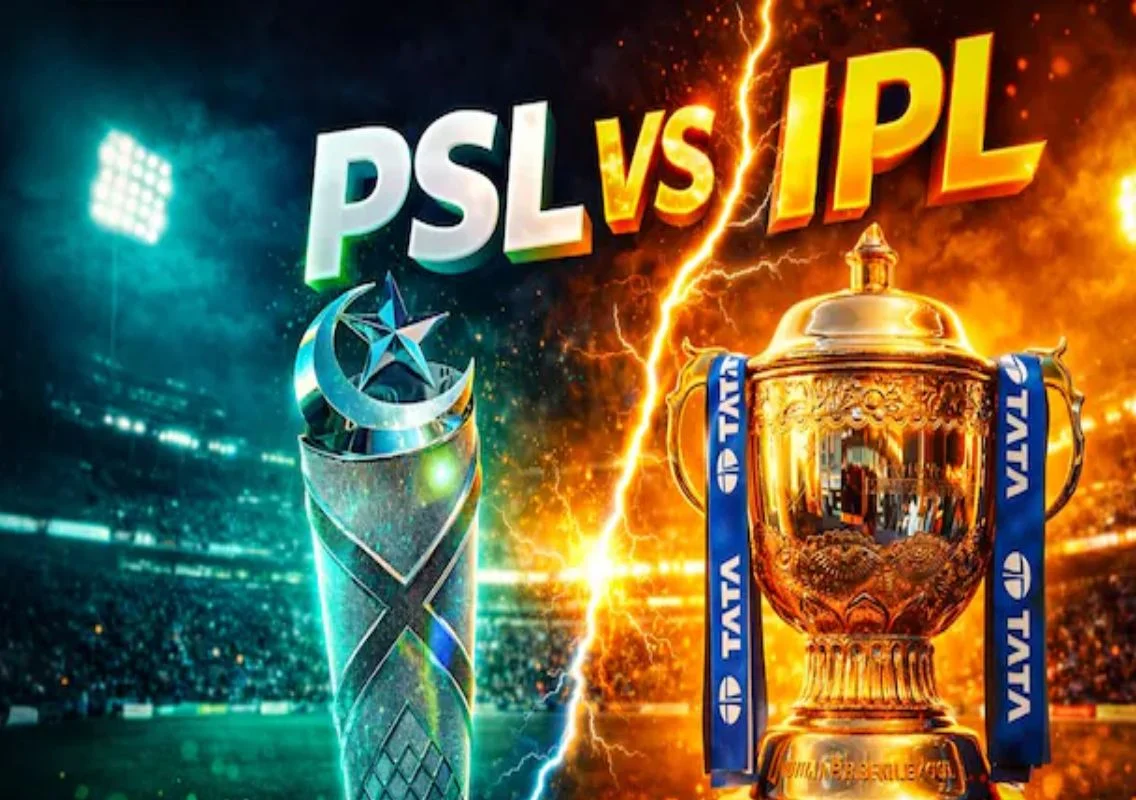

New Delhi: A bold claim by Mohsin Naqvi that the Pakistan Super League will soon overtake the Indian Premier League as the world’s No. 1 T20 competition has triggered debate across the cricketing ecosystem. While optimism around the PSL’s growth is evident, financial data from 2026 highlights a vast gap between the two leagues.
Naqvi made the statement during the 82nd Board of Governors meeting at Gaddafi Stadium, expressing confidence in PSL’s rising commercial appeal and investment potential. However, industry figures suggest that the journey from ambition to reality remains steep.
The massive valuation gap
At present, the IPL stands as a global sporting powerhouse with an estimated valuation of $18.5 billion (₹1.54 lakh crore approx.)making it one of the richest sports leagues in the world.
In comparison, the total valuation of all PSL franchises combined is estimated at around $260 million (₹2,100 crore approx.)—a fraction of the IPL’s worth.
The disparity becomes even clearer when individual franchises are compared. In 2026, Royal Challengers Bengaluru reportedly touched a valuation of $1.78 billionwhich alone is nearly seven times the value of the entire PSL ecosystem.
Meanwhile, PSL’s newer teams such as Hyderabad and Sialkot were sold for just over $6 million eachunderlining the significant difference in investor appetite and market scale.
Broadcast revenue drives dominance
A key factor behind the IPL’s supremacy is its media rights ecosystem.
The IPL’s 2023–2027 broadcast deal is valued at approximately $6.4 billion (₹53,000 crore). This translates to about $13.4 million (₹110 crore) per match—an extraordinary figure that places it second globally on a per-match basis, behind only the NFL.
By contrast, the PSL’s latest domestic broadcast deal, secured for the 2026–2029 cycle, is worth about $93 million (₹770 crore) over four seasons. This results in roughly $7.75 lakh (₹6.4 crore) per match.
In effect, one IPL match generates more media revenue than an entire PSL seasonhighlighting the scale of the financial divide.
Structural and economic challenges
Beyond finances, the PSL faces structural challenges that impact its growth trajectory. The 2026 season is being conducted across only two venues—Lahore and Karachi—due to security concerns and a domestic fuel crisis.
Additionally, concerns have emerged regarding sponsorship sustainability. Some franchises reportedly struggled to secure jersey sponsors this season, with brands opting for direct advertising routes instead of team partnerships.
Critics, including former franchise stakeholders, argue that Pakistan’s domestic economy may not yet be robust enough to support rapid commercial expansion of the league.
Signs of growth and optimism
Despite these hurdles, the PCB remains optimistic. Officials point to a 600% surge in digital viewership in 2025with total streaming minutes nearing 50 billion—a strong indicator of growing audience engagement.
Franchise auctions have also shown improved investor interest, suggesting that the PSL is gradually strengthening its commercial base.
Naqvi maintains that the PSL offers a promising investment market and believes that continued growth in digital consumption and fan engagement will help bridge the gap over time.
Talent, salaries and global pull
Another stark contrast lies in player economics. In the IPL, top players can earn multi-million dollar contracts in a single season, sometimes exceeding the total salary purse of an entire PSL team.
This financial muscle enables the IPL to attract the best global talent consistently, reinforcing its dominance both on and off the field.
While the PSL has produced high-quality cricket and nurtured emerging talent, matching the IPL’s global pull remains a long-term challenge.
Conclusion
Mohsin Naqvi’s vision of the PSL becoming the world’s top T20 league reflects ambition and belief in its potential. However, the financial and structural realities of 2026 underline a significant gap between aspiration and current standing.
For the PSL to realistically challenge the IPL, it will need sustained growth in media rights, sponsorship, infrastructure, and global reach. Until then, the rivalry remains one of regional pride rather than financial parity.
Comments are closed.