
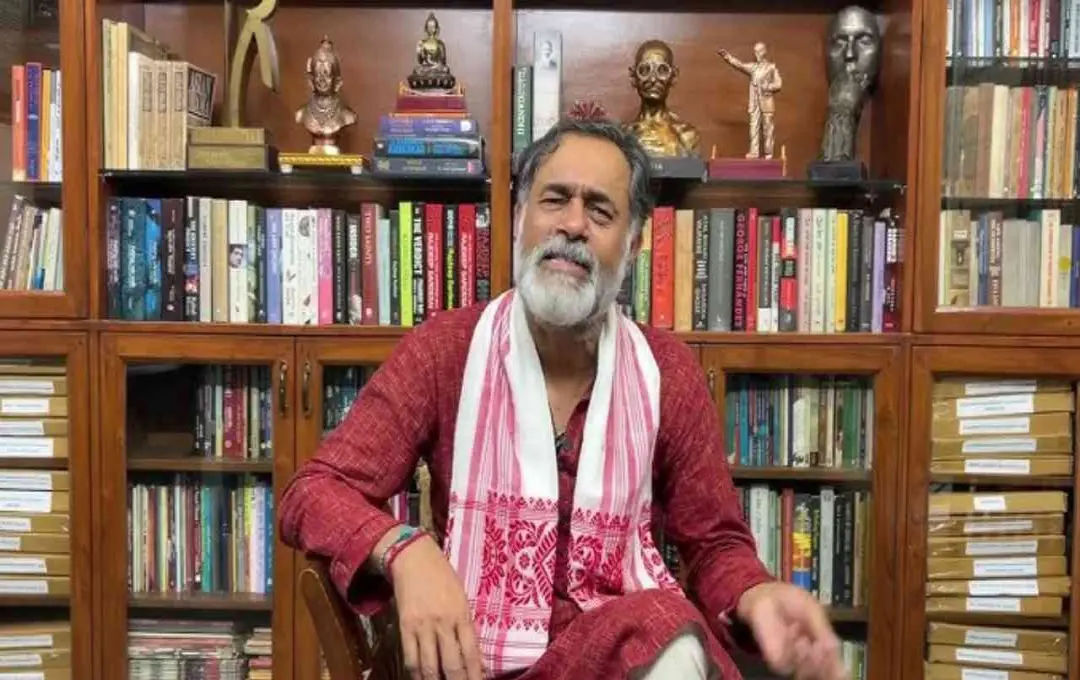

Yogendra Yadav reacted amid the talk of Raghav Chadha allegedly leaving the party and joining BJP. Raising questions on anti-defection law and democracy, he said that complaints cannot be one-sided and stressed on contesting elections.
Raghav Chadha leaving AAP controversy came into limelight when political analyst Yogendra Yadav reacted sharply to the news of Rajya Sabha MP Raghav Chadha allegedly leaving Aam Aadmi Party and joining Bharatiya Janata Party. He said complaints cannot be one-sided and the spirit of the anti-defection law is weakening. Yadav also raised serious questions on democracy and the electoral process.
Political stir due to Raghav Chadha’s alleged leaving the party
The stir in the political circles has intensified after the news of Aam Aadmi Party (AAP) Rajya Sabha MP Raghav Chadha leaving the party came to light. After this development, many discussions have started, especially when there were speculations about other MPs joining the Bharatiya Janata Party (BJP) along with him. This has sparked a new debate about defection and internal dissatisfaction in the country’s politics.
Different reactions are coming from political analysts and leaders regarding this entire matter. Some people are considering it to be the result of personal dissatisfaction, while some are linking it to political opportunism and tendency to defection. Meanwhile, the matter is not limited to just one party but has become a subject of widespread political discussion.
Yogendra Yadav’s sharp reaction
Political analyst Yogendra Yadav took a strong stance on this development and said that this is not just a matter of complaint or dissatisfaction of any individual, but there is a big political and moral debate behind it. He said that any leader can have complaints, but changing the party on this basis cannot be considered in accordance with democratic traditions.
Referring to the anti-defection law, Yogendra Yadav said that such activities weaken its basic spirit. According to him, this law was made so that political stability is maintained and the mandate is respected, but continuous defection affects this objective.
He also said that if a leader feels that he has the support of the public, then he should go directly to the public by contesting elections. The option of switching parties weakens the democratic process and also affects political trust.
Questions arising on democratic system
This entire controversy has once again raised questions on stability, morality and culture of defection in Indian politics. Political analysts believe that such incidents can affect public confidence in democracy and also affect the credibility of political parties.
Yogendra Yadav also said in his comment that power-centric thinking is increasing in today’s politics, where personal gains and political opportunities have become more important than ideology. This trend is being seen as a challenge to democracy, which needs to be seriously considered.
Comments are closed.