
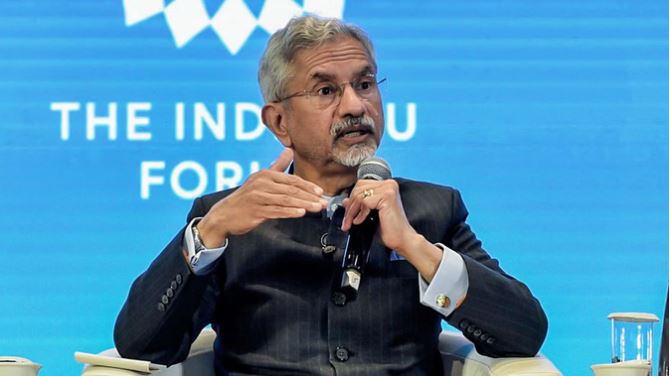
Raisina Dialogue 2026: S Jaishankar said – Technology and demography will decide the direction of the world in the change of global system, today ‘no country can call itself the supreme power’

New Delhi. Amid global tension, External Affairs Minister S Jaishankar said that today no country is completely dominant. S. Jaishankar said the global expectation of maintaining a fixed world order since the mid-20th century was ‘unrealistic’ and power is now largely dispersed across different dimensions.
Read :- The impact of reforms should not be measured by announcements, but by their results on the ground: PM Modi
Speaking at the Raisina Dialogue 2026 held in Delhi, the External Affairs Minister expressed his views on the evolving nature of global governance over the last seven decades. He said, ‘When we look back at these 70 years, I think the hope of fixing 1945 or 1989 forever was a very unrealistic expectation.
Jaishankar said it was unrealistic to expect the world order created after 1945 or 1989 to last forever. He said that if we look at the last 70 years from the perspective of history, it is only a small part of India’s thousands of years of history, hence it is natural for the world to change.
Two big forces behind the change in global system
Jaishankar said that two big forces are working behind the change in the global system: technology and demography. These two factors will decide the direction of the world in the coming decade. He also said that today global politics is often analyzed around America, but the reality is that the world is gradually dividing into many powers. Now there is no country that completely dominates in every field – such as economy, military power, technology or diplomacy.
Read :- PM Modi thanked President Trump, said – Trade deal framework will deepen investment, technology partnership between us.
According to the Foreign Minister, today strength no longer means just GDP or military power. Different parts of the world are becoming stronger in different areas, so global power is now spread across many countries and regions.

Comments are closed.