
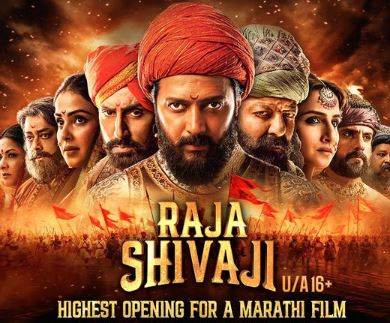

Mumbai: Raja Shivaji, directed by and starring Riteish Deshmukh, attempts a grand retelling of a defining chapter in Maratha history. While the film does not always maintain a sharp narrative edge, it delivers several compelling moments through measured storytelling and strong performances.
A more grounded historical retelling
Unlike recent historical spectacles such as Tanhaji and Chhaava, which leaned heavily into dramatic exaggeration, Raja Shivaji takes a relatively restrained approach.
The film explores the rise of Chhatrapati Shivaji Maharaj and the establishment of “Hindavi Swarajya” in the 17th century. Spanning from 1629 to 1659, the narrative builds towards the iconic confrontation with Afzal Khan.
Despite a disclaimer acknowledging creative liberties, the film largely avoids excessive fictionalisation, choosing instead to humanise its central figure.
Riteish Deshmukh anchors the film
Riteish Deshmukh portrays Shivaji with a blend of restraint and intensity, presenting him not as a larger-than-life superhero but as a grounded leader navigating personal and political challenges.
He is shown as a son, husband, and ruler dealing with adversity while striving to unite people against oppressive forces.
While some viewers may question the casting, Deshmukh’s performance remains convincing and forms the emotional core of the film.
Strong antagonist and supporting cast
Sanjay Dutt plays Afzal Khan, Shivaji’s formidable adversary, bringing menace and gravitas to the role.
Other notable performances include:
- Abhishek Bachchan as Sambhaji Shahaji Raje
- Sachin Khedekar as Shivaji’s father
- Vidya Balan in a sharp supporting role
- Bhagyashree as Jijabai
- Genelia Deshmukh as Saibai
The film also benefits from smaller yet impactful roles played by Jitendra Joshi and Mohit Takalkar, especially during the tense lead-up to the climactic encounter.
Visual scale meets narrative restraint
Cinematographer Santosh Sivan brings visual richness to the film, marking his debut in Marathi cinema.
Battle sequences, duels, and large-scale sets are mounted effectively but without overwhelming the narrative. The film consciously avoids turning Shivaji into a stylised action hero, opting instead for realism and emotional depth.
Where the film falters
Despite its ambition, Raja Shivaji struggles with pacing and narrative flow. At over three hours, the film occasionally feels stretched, with certain portions lacking coherence.
Dialogues, particularly in the Hindi version, do not always land effectively, and some scenes feel slightly stilted.
The film’s restrained tone, while refreshing, may not appeal to audiences accustomed to high-octane historical dramas.
A balanced portrayal of conflict
One of the film’s strengths lies in its nuanced depiction of conflict. It avoids reducing the narrative to religious binaries, focusing instead on oppression, power struggles, and the fight for self-rule.
Even antagonists are framed within political contexts rather than simplistic ideological lines, adding depth to the storytelling.
Women characters get due space
Unlike many historical dramas, Raja Shivaji gives its female characters meaningful roles.
Jijabai and Saibai are portrayed as influential figures in Shivaji’s life, while Vidya Balan’s character adds sharpness to the narrative. Their presence aligns with historical accounts and strengthens the film’s emotional fabric.
Conclusion
Raja Shivaji may not always strike with the sharpness of the legendary wagh nakh it references, but it stands out for its intent.
By choosing restraint over spectacle, the film delivers a thoughtful, if uneven, cinematic experience. It may not fully satisfy audiences seeking constant thrills, but for those open to a slower, character-driven historical, it offers moments worth engaging with.

Comments are closed.