
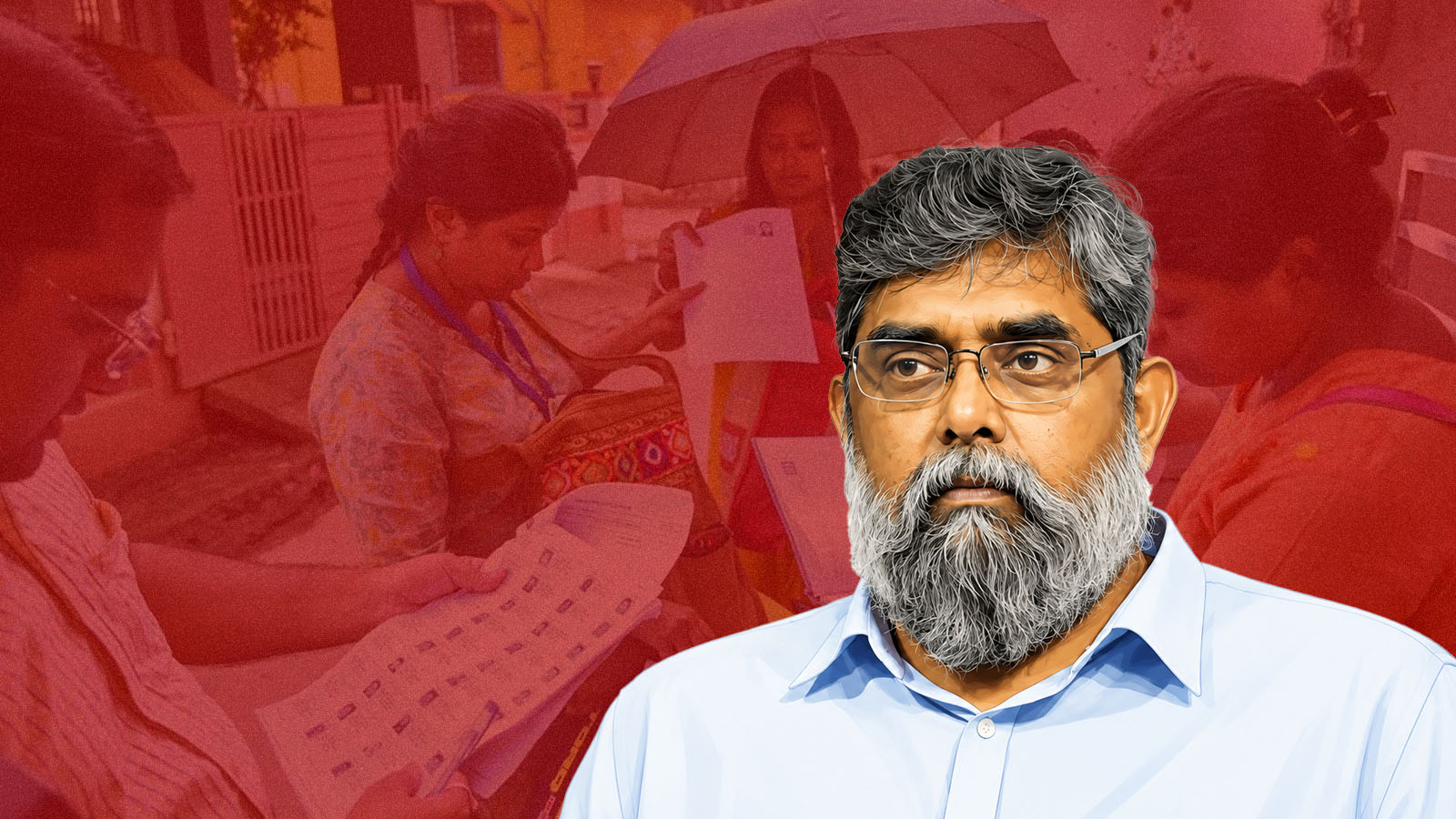
What if SIR deletes your name? Telegraph ex-editor pens note on life in ‘civic uncertainty’

Former The Telegraph editor R Rajagopal has shared the consequences he has suffered after his name was removed from the electoral rolls after the SIR in West Bengal, saying he has been left in a “state of civic uncertainty”.
In a detailed note that was shared by journalist Paranjoy Guha Thakurta on X, Rajagopal has shared that his passport renewal was delayed after his name was deleted from the Ballygunge constituency in Kolkata during the Special Intensive Revision (SIR) exercise.
He added that he could not trace either his name or that of his late father in the 2002 voters’ list.
A personal account
The development, he said, left him in a “state of civic uncertainty”, as he spent considerable time reconstructing decades-old family records after an adverse police report linked to his omission from the electoral rolls stalled his passport renewal.
Also read: One year of SIR: Nearly 6 crore deletions, legal battle and migrants’ agony
“Like nearly 27 lakh other residents of West Bengal, I was excluded on account of what were described as ‘logical discrepancies’. No reason was furnished even after I submitted my matriculation certificate, and my appeal is now pending before one of the tribunals constituted pursuant to the Supreme Court’s directions,” Rajagopal wrote.
He said his passport renewal application was also affected despite completing biometric formalities on March 19, 2026. “Police verification has not been cleared because my name no longer appears on the electoral roll,” he said.
“In fact, today (June 27, 2026) is the 100th day since my biometrics for passport renewal were taken. I was formally informed last week by the passport-issuing authority that Kolkata Police sent an adverse report, citing the deletion of my name from the voters’ list. I have been asked to appear before the Regional Passport Office in Calcutta “immediately” but when I sought an appointment, without which it is difficult to gain entry, the date granted is July 17, 2026,” he wrote.
“My days begin with checking my voting right appeal status and then the passport tracker. Then I write to the college where my mother taught in 1965 and to her school from where she passed out in 1959, asking for any document that proves she existed. The school has been very helpful but not the college. Similarly, I speak to prohibition campaign activists in Kerala…asking for any news clipping or photographs that show my father campaigning against illegal liquor vends and communalism,” he narrated, highlighting the absurdity of the exercise.
Rajagopal clarified that his intention was not to present himself as a victim, but to highlight the difficulties faced by ordinary citizens caught in the process. “If someone who spent his professional life in journalism and edited a relatively well-known newspaper can encounter such difficulties, one can only imagine what the truly marginalised must endure,” he wrote.
Opposition reacts
Following Rajagopal’s account, Opposition leaders from the Congress, Trinamool Congress and CPI(M) criticised the SIR exercise, arguing that the incident reflected wider concerns over citizens’ rights.
Congress Rajya Sabha MP Vivek Tankha said the episode reflected “the level of irrationality” the country had reached.
“Are we determined to remove the tag of a nation governed by the rule of law so assiduously curated by our founding fathers! What a pity!!” he wrote on X.
Also read: Bengal SIR fiasco continues as tribunals clear just 0.26 pc of around 25L appeals
TMC Rajya Sabha MP Sagarika Ghose described Rajagopal’s experience as “shocking” and “heart-rending”.
“If this can happen to R Rajagopal, former editor of The Telegraph, imagine what citizens with far fewer resources are enduring,” she said.
CPI(M) general secretary M A Baby alleged that the SIR exercise was being used to disenfranchise people and questioned its impact on vulnerable sections.
“Right from the outset, the CPI(M) had warned that the SIR exercise would disenfranchise the poor and vulnerable sections of our country. But now, even an editor of repute and an acclaimed journalist like R Rajagopal has been denied his right to vote,” Baby said.
SIR controversy
The SIR exercise in West Bengal has triggered political and legal controversy after lakhs of electors were either removed from electoral rolls or referred for adjudication.
The Supreme Court did not stay the exercise but directed the creation of appellate tribunals headed by retired high court judges to hear challenges against deletion of names.
Also read: Bengal SIR row: SC directs petitioner to move Calcutta HC over ration card deletion plea
Rajagopal’s remarks came amid continuing legal challenges, with several petitioners claiming that despite submitting government-issued identity documents, their names were either removed or kept under adjudication.
Last phase of SIR
The SIR of electoral rolls, which began in Bihar on June 24 last year, has since expanded to several states and Union territories.
The exercise has led to the deletion of nearly six crore voters from electoral rolls, triggering a political confrontation between the Opposition and the Election Commission. In the pilot Bihar exercise, nearly 65 lakh voters were removed from the rolls.
The impact has been reported to be most severe among vulnerable groups, including poor families, women, minorities and migrant workers. In West Bengal alone, around 27 lakh citizens had their names referred to tribunals for verification and adjudication.
Also read: Bengal voter purge leaves 27 lakh in panic over citizenship, welfare schemes
Several affected voters have reported difficulties accessing welfare schemes, ration subsidies and government assistance after their names were removed from electoral records.
The third phase of the SIR covering 16 states and three Union territories – Andhra Pradesh, Arunachal Pradesh, Haryana, Jharkhand, Karnataka, Maharashtra, Manipur, Meghalaya, Mizoram, Nagaland, Odisha, Punjab, Sikkim, Tripura, Telangana, Uttarakhand, Delhi, Chandigarh, and Dadra and Nagar Haveli and Daman and Diu – involving 36.73 crore voters, began on May 14 and is scheduled to conclude later this year.
(With agency inputs)

Comments are closed.