
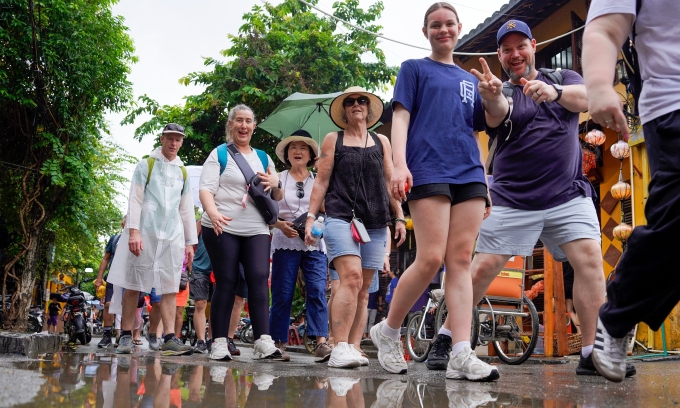

The number surpasses the previous best, in 2019 before Covid, by more than 10%.
Meanwhile, overall global tourism has only recovered to 90% of pre-pandemic levels.
Vietnam received its 20th millionth foreign visitor in a year for the first time at the Phu Quoc International Airport on Dec. 15.
Speaking at a tourism conference on Dec. 27, Prime Minister Pham Minh Chinh stressed the need for restructuring to boost competitiveness and rapidly develop tourism into a truly leading economic sector.
To achieve the target of 25 million international visitors next year, he said the industry must focus, particularly in the context of the global digital economy, on three strategic pillars: institutions, infrastructure and human resources.
Nguyen Trung Khanh, head of the Vietnam National Tourism Administration, said the visa waiver policy was the “key” to this year’s success.
In March the government decided to extend visa exemptions until 2028 for citizens of 12 countries: Denmark, Finland, France, Germany, Italy, Japan, Norway, Russia, South Korea, Spain, Sweden, and the U.K.
In August it added 12 more countries: Belgium, Bulgaria, Croatia, Czechia, Hungary, Luxembourg, the Netherlands, Poland, Romania, Slovakia, Slovenia, and Switzerland.
Along with bilateral waivers, including for ASEAN member countries, it took the total number to 39.
The government also added 41 more entry points for foreigners, bringing the total number to 83.
Pham Hai Quynh, director of the Asian Development Institute, said an achievement this year beyond just the visitor numbers was the diversification of source markets, which reduces reliance on a limited number of them.
Vietnam’s continued recognition by major international platforms, including the World Travel Awards, has strengthened its position on the tourism map.
There were also significant improvements in tourism infrastructure this year, with a number of airports, expressways and tourist ports opening or expanding, facilitating smoother connection between destinations.
Vietnam has achieved a reputation as a safe destination offering diverse natural landscapes, a rich cultural heritage and great value for money.
But it admittedly faces major sustainability challenges.
Vu Van Tuyen, general director of tour operator Travelogy Tourism Company, said the achievements of 2025 should be used as a foundation to reach a higher stage of development through stricter control over service quality, tourism safety, environmental protection, human resource development, and balance between growth and sustainability.
Ha Van Sieu, deputy director of the tourism administration, said a persistent issue for the industry has been the lack of a professional national tourism promotion agency.
China is one of its most important source markets, but Vietnam still lacks effective tourism promotion in major Chinese cities, he said.
In terms of transport infrastructure, while highways and ports have made notable progress, over-reliance on air travel remains a constraint, he added.
Herbert Laubichler-Pichler, CEO of Alma Resort, said Vietnam lags behind regional competitors such as Thailand and Indonesia in visa openness and “still has much to do.”
According to the Henley Passport Index, Vietnam ranks 80th out of 227 countries and territories in terms of travel openness. In comparison, Thailand ranks 35th, Indonesia 48th and Singapore 15th.

Comments are closed.