
Rejected from top US universities, Vietnamese statistician now leads $346,000 University of Sydney grant

Linh, 35, joined Sydney’s School of Mathematics and Statistics in 2022 as a lecturer. His ARC Discovery Project grant, announced Oct. 30, 2025, was awarded AUD482,133 (US$346,040), a major milestone for an academic career that began with a string of rejections from elite American universities.
Linh and his three co-investigators: Shila Ghazanfar and Rachel Wang at Sydney, and Francis Hui at the Australian National University, are developing new statistical tools to extract patterns from massive, multi-layered datasets. The applications range from genetic data and medical records to detecting the spread of misinformation on social media.
Sydney won 51 ARC Discovery Project grants in this round worth a combined AUD38.6 million, against a national success rate of roughly one in eight applications. The University of Sydney ranks 25th globally and third in Australia in the QS World University Rankings 2026.
Linh’s path to that grant started in Hanoi, where he attended the High School for Gifted Students at VNU University of Science, Vietnam’s most selective math and natural sciences high school. He graduated from the University of Miami in Florida in 2015 with strong grades, top-tier GRE scores, and an international research publication already on his record. He applied to PhD programs at top U.S. universities expecting, in his words, “a brilliant ticket to the future.” Instead, the rejections came in waves. Several schools offered him only a master’s place.
“At one point, I told myself it was a top program or nothing,” Linh said.
The disappointment was so deep that when Southern Methodist University (SMU) in Dallas, which he had filed as a backup, offered him admission with a Fellowship for outstanding incoming students, he hesitated.
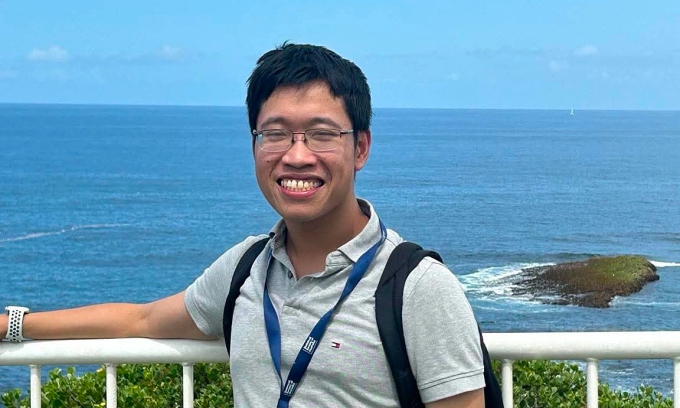
Nghiem Hoang Linh, aVietnamese statistician leading leads an Australian Research Council project at the University of Sydney. Photo courtesy of Linh |
The turning point came when he sought advice from a former undergraduate mentor at Miami. The mentor’s response, Linh says, woke him up: doctoral admissions are brutally competitive everywhere, very few applicants get in anywhere, and the value of a PhD ultimately comes from what the student makes of it.
That advice freed Linh from the pull of brand names. He chose SMU based on criteria that mattered to him: depth of the research group, small cohort size, and a curriculum focused on theoretical foundations. He earned his PhD in statistics in 2019, completing the program in three and a half years, well below the typical five.
In his first year at SMU, Linh focused on six foundational courses in theory, applied statistics, and computation. The leap from master’s-level work was steep, and every result, however minor, had to be proven rigorously.
“You hit a real shock when you move from being a consumer of knowledge to being a producer of it,” he said. “You’re no longer studying to accumulate what already exists; you’re studying to create something that has never existed before.”
The biggest hurdle was a three-day qualifying exam at the end of year one: an eight-hour theory marathon on day one, five hours of model-building on day two, and a six-and-a-half-hour real-data computing session on day three. He passed.
“You can’t wait for ideas to fall out of the sky,” Linh said. “I’d build a list of ideas by reading a wide range of papers, even bad ones, because they’re the kindling for later discoveries.” He also credits a young, hands-on advisor willing to reply to emails at midnight or spend a full day debugging code with him. Linh graduated with three publications in leading statistics journals.
His current ARC project, which will fund up to two new PhD students starting in mid-2026, sits at the heart of a problem facing modern science: technology has produced datasets that are large, high-dimensional, and tangled by complex temporal, spatial, and network dependencies, but the statistical methods to interpret them honestly haven’t kept pace.
Linh likens science to a 100-story pyramid where people tend to remember only the first stone and the last. Stories two through 99 are a long journey shared by many.
“What matters isn’t which story you stand on,” he said, “but whether you’re laying down a useful brick.”
Comments are closed.