

Hazaribagh,
Jharkhand
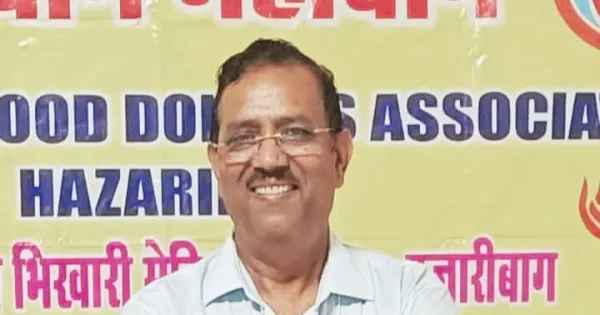
The positive effect of the efforts made by the government to provide safe blood in Jharkhand was seen in the month of November, when there was a significant increase in the number of blood donation camps. However, this number decreased in December, raising concerns about the availability of blood in the future. This information was given by Nirmal Jain, President of Voluntary Blood Donors Association and popularly known as “Blood Man”.
After the incident of transfusion of HIV infected blood to children suffering from thalassemia in Chaibasa, the government’s attention focused on the investigation and maintenance system of blood banks. Earlier, in ELISA and kit based tests, there was a possibility of infection due to the window period. To reduce this risk, the government started NAT (Nucleic Acid Test) testing facilities at some places, due to which patients started getting safer blood.
Government investigation found that many blood banks did not have licenses and proper maintenance arrangements, due to which they were closed. In order to overcome the shortage of blood, “Blood Donation Fortnight” was run across Jharkhand from 12th to 28th November. Government and non-government organizations participated enthusiastically in this campaign. 695 blood donors donated blood through 40 blood donation camps at Sheikh Bhikhari Medical College Hospital in Hazaribagh.
In these, 322 units of blood were collected from 14 camps organized by the Voluntary Blood Donors Association, which is considered to be a record. However, since NAT testing facility is available only in Ranchi, blood banks of nearby districts have to send the samples there. Delay in investigation report and sometimes machine breakdown leads to the situation of not receiving the report for three to four days. As a result, despite having sufficient blood in the blood bank, blood is not available to the patients on time, which is also creating chaos.
Nirmal Jain said that it has been the association’s continuous effort to provide blood to the needy without replacement. Under this thinking, blood was provided to more than 300 thalassemia suffering children and HIV patients in Hazaribagh, keeping their identity confidential, so that they could be protected from social discrimination. In Chaibasa, the victims are facing serious problems due to their identity being exposed.
He warned that if the number of blood donation camps continues to decline and adequate awareness is not spread, children suffering from thalassemia may have to face huge difficulties in the times to come. For this, the government needs to take more powerful initiatives, so that all the needy can get safe blood without replacement and the rights of thalassemia children are not violated.
Nirmal Jain especially thanked Civil Surgeon Dr. Ashok Kumar, Superintendent Anusan Purti and in-charge Dr. Neeraj Kumar for providing NAT tested blood for a long time at Sheikh Bhikhari Medical College Hospital, Hazaribagh.

Comments are closed.