
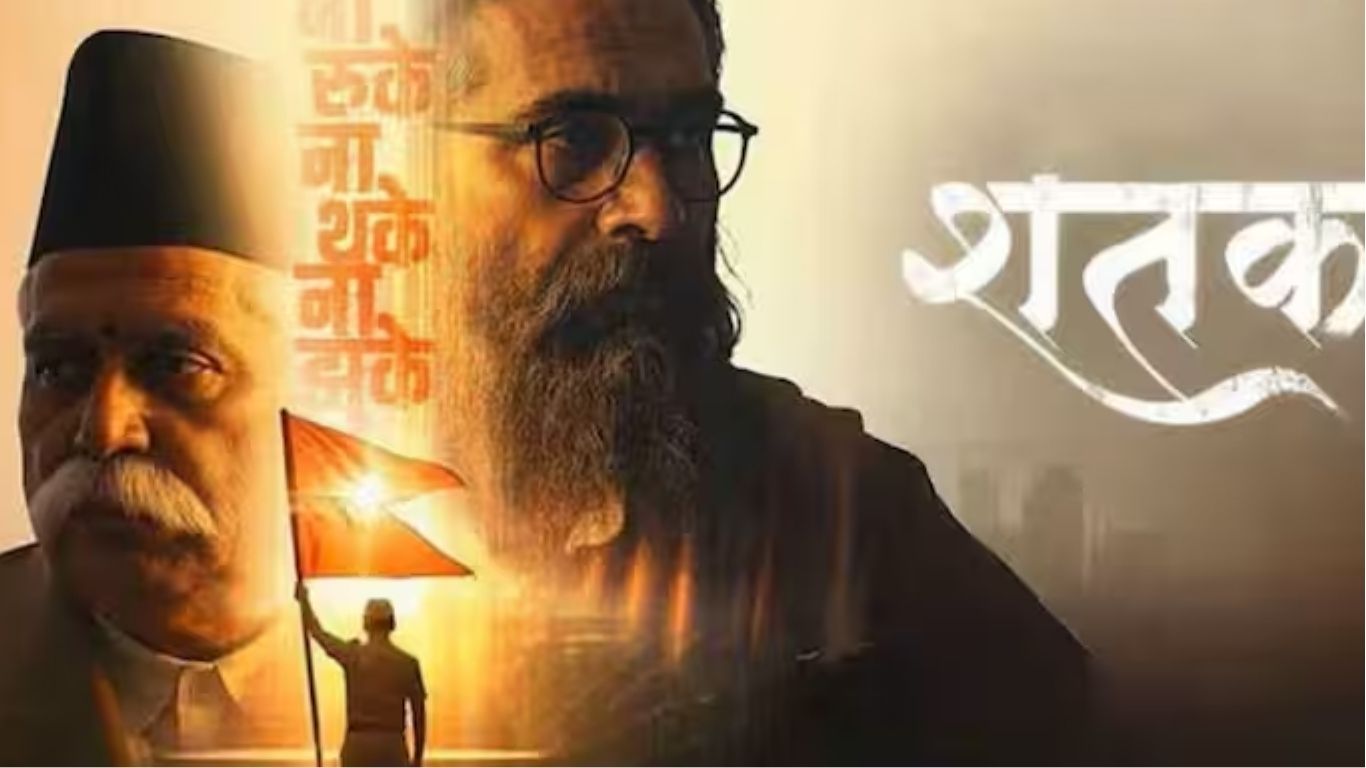
A great film with AI and Real Actors, without propaganda, without any trappings, showing the story of 100 years of RSS.

Shatak Movie Review: The political and social situation of India has changed, but one organization has remained the center of discussion, controversy and curiosity since its inception – Rashtriya Swayamsevak Sangh (RSS).
Shatak Movie Review: In today’s time, from the digital corridors of social media to tea shops and streets, opinions are formed and changed, but have we ever wondered where the roots of this changing environment lie? If we turn the pages of history, we will have to go back almost a century. The wheel of time has turned, the political and social conditions of India have changed, but one organization has remained the center of discussion, controversy and curiosity since its inception – Rashtriya Swayamsevak Sangh (RSS). Many questions often arise in the minds of people regarding this, like did the Sangh have a hand in the assassination of Gandhiji, did the Sangh have any role in the freedom struggle, how was the relationship between Gandhiji and the Sangh chief, what work did the Sangh do during the war, did Nehru ji and Indira ji try to ban the Sangh? These questions come up again and again because we keep hearing them continuously on various forums. Amidst such questions, a film has come out, named ‘Shatak’, which claims to bring the 100 years of RSS’s journey on screen.
The film ‘Shatak’, released in theaters on February 20, is a serious and big attempt to look at the old era from today’s perspective. Instead of presenting any issue in a twisted manner, it presents the story in front of the audience in simple words. The film shows how an idea that started in a small street of Nagpur on the day of Vijayadashami in 1925 became one of the largest organizations in the world today. The film builds a direct bridge between the past and present, helping us understand how today’s India has been shaped by past struggles and resolutions. This 1 hour 52 minute long film contains so much content that it was not easy to show, and the audience gets to know many things about the Sangh that they may have never heard before. The film claims that every aspect shown in it is a part of the 100-year history of the Sangh.
Story
The story of the film starts from 1925, when Dr. Keshav Baliram Hedgewar founded the Sangh. His childhood, his thoughts and the challenges he faced are shown in detail in the first part of the film. It is also shown what the Sangh was doing during the freedom struggle. After this, in the second part Guruji i.e. M.S. Golwalkar’s era is shown and it is explained how he took the organization forward. The film also explains why the Sangh did not enter active politics and how it focused on strengthening the organizational structure. ‘Shatak’ begins in an environment where resources are limited, there are neither big buildings nor huge crowds, but the thinking and resolutions are very big. The script of the film is balanced and controlled. There is no feeling of haste anywhere, rather the story slowly takes the audience to the period where a small seed was being sown. In the entire film, an attempt has been made to cover the journey of RSS in a systematic manner.
how is the movie
This film gives so much information in 1 hour 52 minutes that the viewer is often surprised. The very first scene goes straight to the point and the story wastes no time in laying out the establishment of the Sangh and its role in the country year after year. Effective use of voice over gives momentum to the story. Some such information comes to light which is less commonly heard and which shocks the audience. There has been no unnecessary tension anywhere in the film nor has anyone been directly targeted. Gandhi, Nehru and Indira Gandhi have also been shown for some time, but the focus was not only on negative things about them. The center of the film is the story of the Sangh. If the claims shown in the film are factually correct, then this may indeed be new and shocking information for many viewers. Even in the post-independence era, the role of the Sangh has been shown in detail, which generally gets less discussion.
The film has been made with hybrid technology, that is, both AI and real actors have been used, the makers claim. However, the impact of AI is felt in very few scenes. The use of VFX is more visible in war scenes. At some places it seems that more information has been given than necessary, but it was not easy to cover 100 years of history and the film was also not made long. Overall the film is informative and serves its purpose effectively.
Direction and Production
The film’s director Ashish Mall has shown a strong hold on the subject. He has avoided making the story unnecessarily emotional. Where there is a need to pause, the film pauses and gives the audience a chance to think. Producer Veer Kapoor’s cooperation is clearly visible in the scale and production value of the film. Respect and honesty towards the subject is visible throughout the film. No attempt was made to sensationalize it, rather the story has been taken forward naturally.
music
The music of the film is impressive and moves forward as per the spirit of the story. The music of Sunny Inder and Shantanu Shankar keeps the audience engaged. The songs sung in the voices of Shankar Mahadevan, Shaan and Suresh Wadekar further strengthen the impact of the film. Overall, if you want to know about the Sangh in detail, then this film is worth watching.
Writing and concept
The soul of any film is its script. The way Nitin Sawant, Rohit Gehlot and Utsav Daan have put the journey of a hundred years into words is commendable. The subject matter is serious and there was potential for many political controversies, but the writers have kept the story simple and clear. Anil Dhanpat Aggarwal’s original concept is the backbone of this film. His aim was not just to show the victory of any organization, but to bring out the continuity of an idea. The impact of this vision is clearly visible throughout the film.
shortcomings
Like every film, ‘Shatak’ also has some shortcomings. The biggest challenge is its speed. Due to covering hundred years of history, the film starts looking like a documentary at many places, due to which the entertainment element gets reduced a bit. Some difficult and controversial questions have been left in a simple manner instead of touching them deeply, which may irritate serious viewers. Excessive use of CGI and VFX makes some scenes artificial, which reduces the natural impact of emotions. Also, some important historical figures have got less screen time, due to which the full impact of their contribution is not revealed.
movie summary
‘Shatak’ is not just a historical film or a promotion for any organization. This is a film that shows the power of faith, patience and commitment, which brings forward the spirit of working peacefully instead of making noise. Even though the film seems to avoid some difficult questions, it strongly presents the basic aspects related to nation building. By the time he reaches the final scenes, the viewer not only understands the history of a hundred years, but also feels it. Overall, this film can be watched with the family. This film is 3 out of 5 stars from me.
Read this also- Assi Movie Review: Amazing acting by Taapsee Pannu and Kani Kusruti, Anubhav Sinha’s story shook you

Comments are closed.