
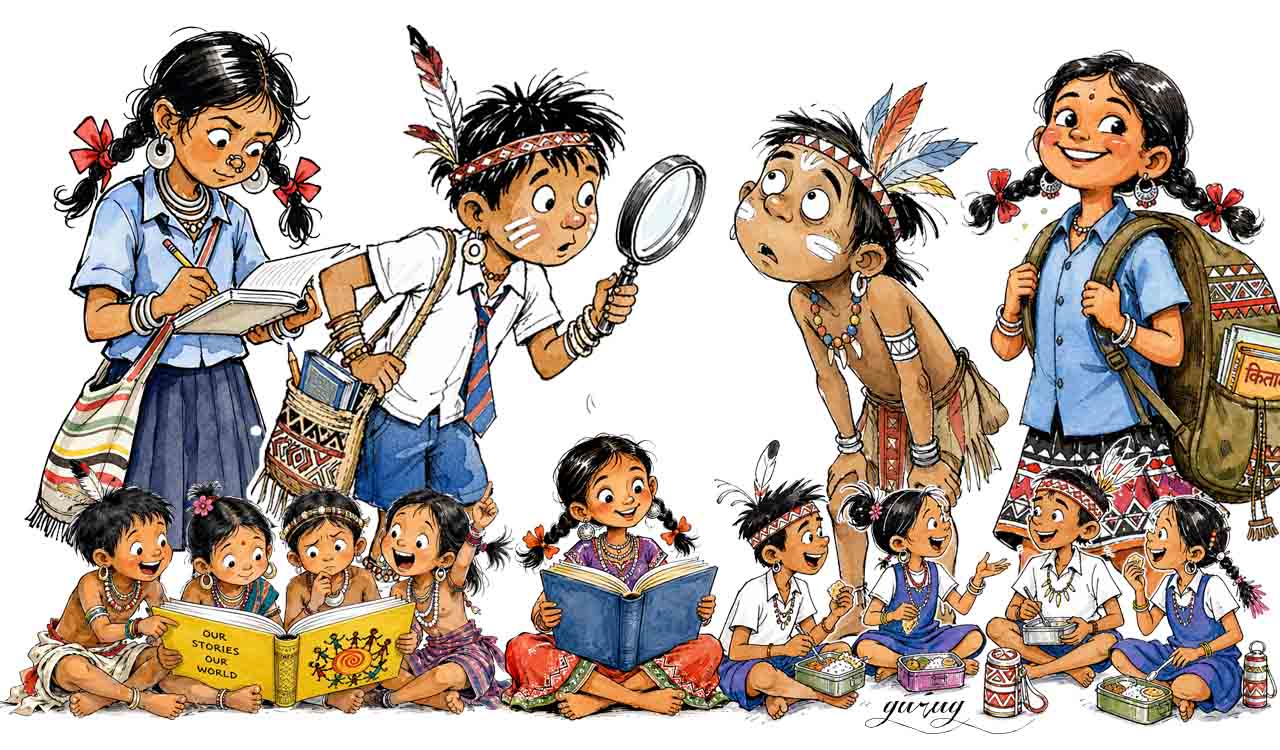

For many tribal children in Telangana, learning Hindi means navigating four languages at once—making a compelling case for mother tongue-based learning
Published Date – 27 June 2026, 11:53 PM
Illustration: GuruG
By Dr T Aruna Kumari
The debate on educational inclusion in Telangana often focuses on infrastructure, enrolment, and retention. However, a less discussed yet significant issue concerns language learning among tribal students, particularly the acquisition of Hindi.
For thousands of tribal children studying in Ashram Schools, Tribal Welfare Residential Schools, Kasturba Gandhi Balika Vidyalayas, and Government Schools across Adilabad, Komaram Bheem Asifabad, Mulugu, Bhadradri Kothagudem, Mahabubabad, Nagarkurnool, and other tribal-dominated districts, Hindi is not merely a subject in the curriculum; it represents a third or sometimes even a fourth language.
While Hindi serves as an important link language for higher education, competitive examinations, employment, and national integration, learning it remains challenging for tribal students whose linguistic and cultural backgrounds differ significantly from those of the mainstream educational environment.
Telangana is home to several Scheduled Tribe communities, including Gonds, Koyas, Kolams, Naikpods, Chenchus, Thotis, Konda Reddies, Lambadas, and Yerukulas. According to Census data, Scheduled Tribes constitute approximately 9.1%of Telangana’s population. In many tribal habitations, children begin life speaking tribal languages such as Gondi, Koya, Kolami, Naiki, Chenchu, or Lambadi.
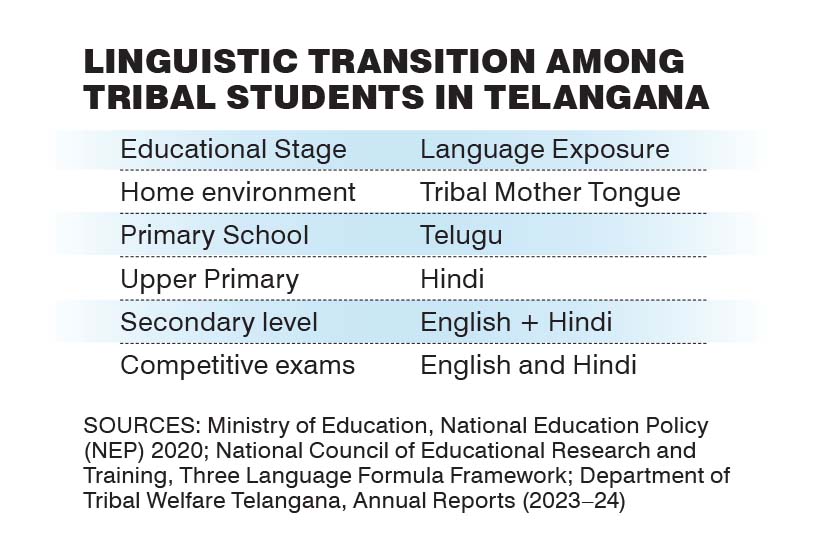
Multilingual Transition
When they enter school, they are introduced to Telugu as the medium of instruction. Subsequently, Hindi is added as a third language, and English is added as another compulsory language. Thus, a tribal child often negotiates four linguistic systems simultaneously, creating an educational burden rarely experienced by students in urban settings.
This multilingual transition creates a complex learning environment. Unlike Telugu-speaking children, who can connect classroom instruction to home communication, tribal students often encounter unfamiliar linguistic structures on their first day of school. Consequently, language-learning difficulties accumulate over time and become more evident in Hindi classrooms.
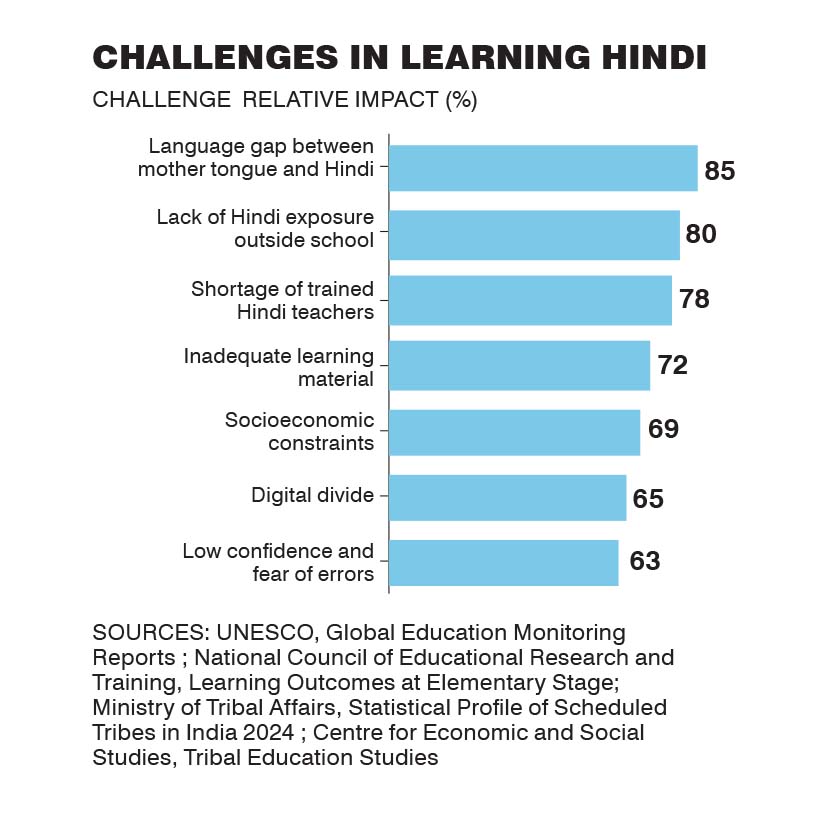
One of the principal barriers is the linguistic distance between tribal languages and Hindi. Gondi, Koya, Kolami, and Chenchu belong to different linguistic traditions and possess distinct phonetic systems, grammatical structures, and vocabulary. Many sounds common in Hindi are absent in tribal languages, making pronunciation difficult. Similarly, Hindi sentence construction differs substantially from tribal speech patterns. As a result, students often memorise lessons without developing genuine comprehension or communication skills.
Another challenge is the absence of a Hindi-speaking environment. In most tribal villages, daily communication occurs in tribal languages and Telugu. Opportunities to hear or use Hindi outside the classroom are extremely limited. Unlike urban children, who encounter Hindi through television, cinema, social media, and peer interactions, tribal students may engage with Hindi only during classroom periods.
Language acquisition research consistently demonstrates that exposure and practice are essential for fluency. Without a supportive linguistic environment, Hindi remains an examination subject rather than a living language.
Teacher availability constitutes another major concern. Several tribal schools face vacancies in Hindi teaching positions, while many teachers posted in remote areas lack training in multilingual pedagogy. A teacher unfamiliar with tribal languages often struggles to explain Hindi concepts effectively. The result is a dependence on rote learning, translation, and memorisation rather than meaningful language acquisition.
Similar experiences in multilingual education programmes across India have demonstrated that teacher preparedness is a decisive factor in improving learning outcomes among indigenous children. Programmes using trained multilingual teachers and culturally relevant materials have reported higher participation, confidence, and academic achievement among tribal learners.
Far From Lived Reality
The curriculum itself presents additional obstacles. Most Hindi textbooks are designed for mainstream learners and frequently portray urban lifestyles, middle-class experiences, and cultural references unfamiliar to tribal students. Stories about metropolitan life, railway stations, airports, and city markets often have little relevance to children living in remote forest villages.
Consequently, learners find it difficult to relate classroom content to their lived realities. Educational research increasingly emphasises that culturally relevant pedagogy improves student engagement and comprehension. When instructional materials incorporate local stories, traditions, livelihoods, and ecological knowledge, learning becomes more meaningful and effective.
Socio-economic conditions further complicate language learning. Many tribal households face persistent challenges related to poverty, seasonal migration, inadequate educational support at home, and limited access to books or digital resources. Students who are first-generation learners often lack family members who can assist with Hindi assignments. In such circumstances, language acquisition becomes dependent entirely on school-based instruction, which may itself be constrained by staffing shortages and resource limitations.
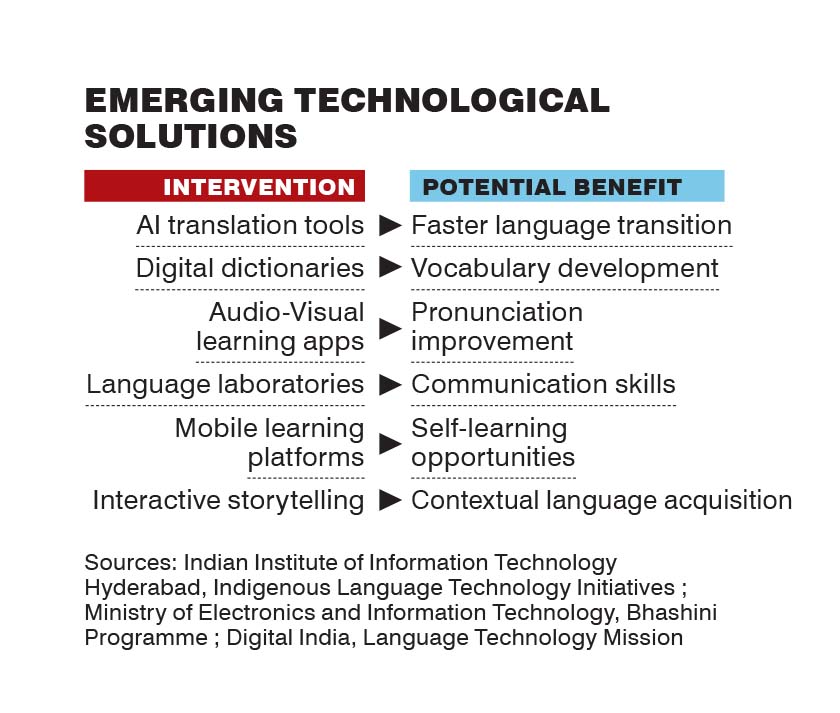
The digital divide adds another layer to the problem. While digital education is transforming language learning in urban India, many tribal regions continue to face connectivity issues and limited access to devices. Nevertheless, emerging technological initiatives offer promising solutions. Recent innovations in artificial intelligence have enabled the development of translation tools connecting tribal languages with Hindi and English.
The Adi Vaani initiative, involving institutions such as IIIT Hyderabad, IIT Delhi, and other research organisations, demonstrates how technology can bridge linguistic gaps by facilitating communication between tribal languages, Hindi, and English. Similar efforts are being extended to tribal languages spoken in Telangana, including Koya, Kolami, and Naikdi.
Lessons for Telangana
Evidence from multilingual education initiatives elsewhere in India offers valuable lessons for Telangana. Odisha’s multilingual education programme, which began in tribal languages and gradually introduced additional languages, expanded to thousands of schools and demonstrated improved learning outcomes among tribal children.
Likewise, the Palash programme in Jharkhand currently serves more than 35,000 tribal students through instruction in indigenous languages, supported by over 1,000 trained teachers and culturally responsive learning materials. These experiences show that children learn additional languages more effectively when their mother tongue is respected and used as a foundation for further learning.
The solution, therefore, does not lie in imposing Hindi at the expense of tribal languages. Instead, Telangana must adopt a comprehensive multilingual strategy. Tribal languages should be used as foundational learning tools in the early years, followed by systematic transitions to Telugu, Hindi, and English.
Textbooks should incorporate tribal folklore, local history, environmental knowledge, and indigenous cultural practices. Teacher training programmes must equip educators with multilingual teaching competencies. Digital technologies should be leveraged to develop bilingual dictionaries, translation applications, audio lessons, and community-based language resources.
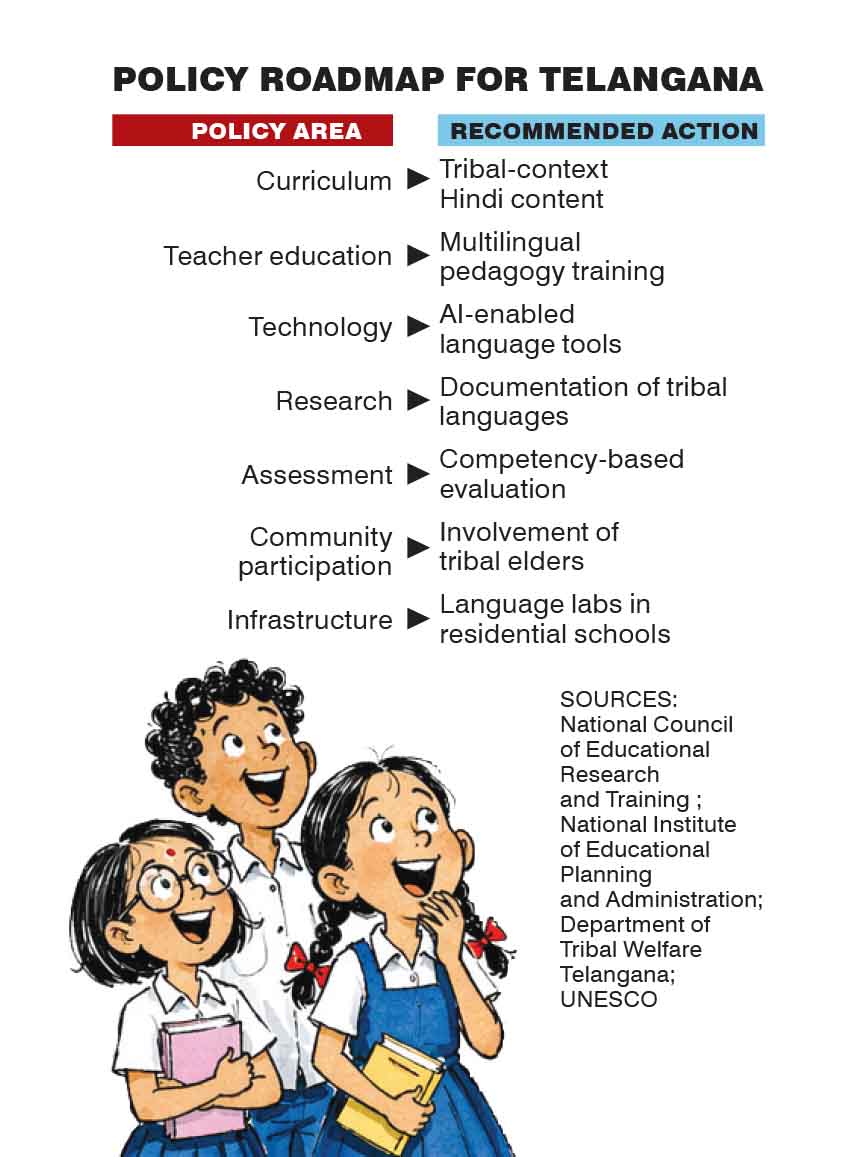
The future of Hindi learning among tribal students in Telangana depends on recognising linguistic diversity as an educational asset rather than a barrier. Tribal children should not be expected to abandon their mother tongues to learn Hindi. Instead, educational policy must build bridges between indigenous languages and national languages. Such an approach would strengthen Hindi proficiency while simultaneously preserving tribal identities and cultural heritage.
Language is not merely a medium of communication; it is a carrier of memory, culture, and knowledge. If Telangana succeeds in creating an inclusive multilingual educational framework, Hindi can become a language of opportunity rather than a source of anxiety. By combining mother-tongue-based education, culturally relevant curricula, teacher empowerment, and digital innovation, the State can transform language learning outcomes for tribal students and advance the broader goals of educational equity, social inclusion, and sustainable tribal development.
(The author is Associate Professor of Hindi, Government Degree College (A) Paloncha, Bhadradri Kottagudem district)

Comments are closed.