
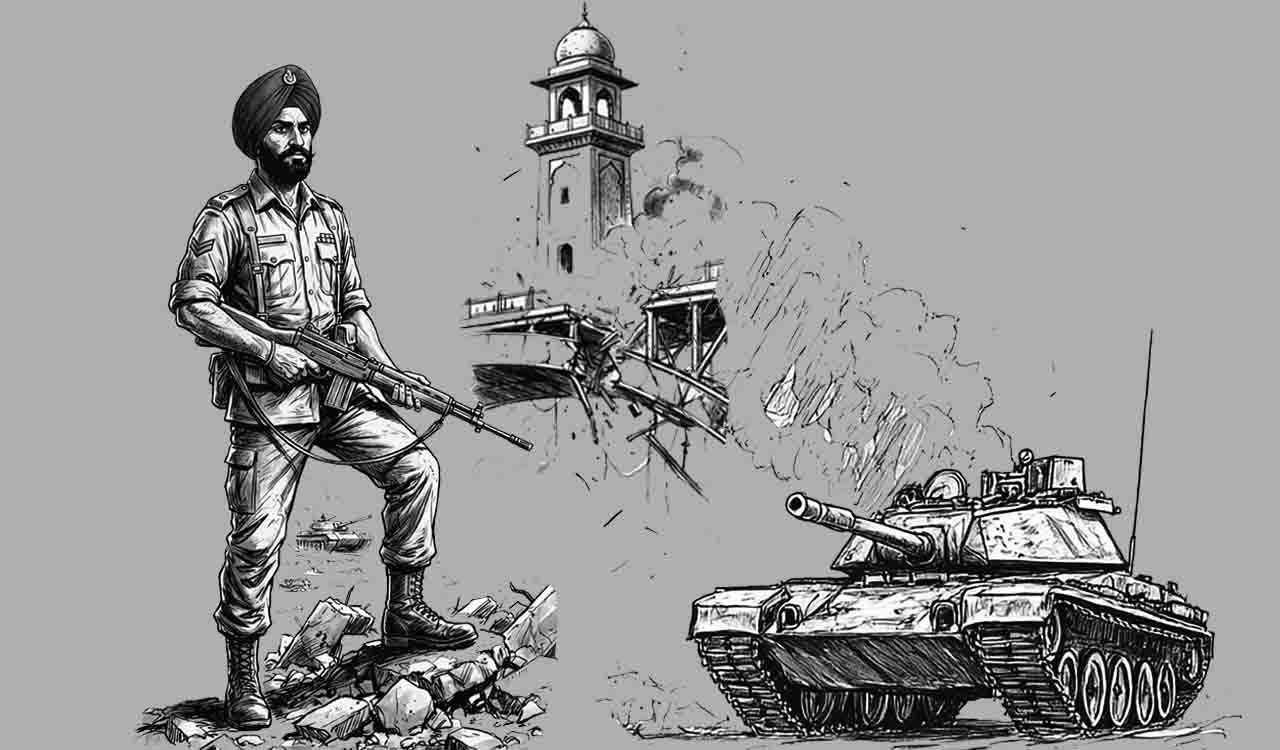
Rewind: When 15 Punjab held the line at Hussainiwala — A forgotten chapter of the 1971 war

Outnumbered and outgunned, the battalion gave a bloody nose to a full Pakistani brigade, turning a quiet Ferozepur enclave into one of the 1971 war’s fiercest defensive victories
Published Date – 27 December 2025, 11:55 PM
By Brig Advitya Madan (retd)
I cannot let the month of December pass without paying tribute to the brave soldiers of 15 Punjab, who in December 1971 gave a bloody nose to a full Pakistani brigade — supported by an armoured squadron and divisional artillery — at Hussainiwala. What unfolded there was not merely a tactical engagement of the 1971 war; it was a story of grit, leadership, and raw courage, written by men who refused to yield ground even when heavily outnumbered and outgunned.
Hussainiwala is an enclave near Ferozepur, situated on the western bank of the Satluj River, which extends over an area of eight hectares. Pakistan had Satluj Rangers deployed on their side, whereas we had the deployment of Border Security Force and a few immigration officials on our own side of the border. A road passing through this enclave once connected Ferozepur directly with Lahore. After the 1965 warthe Wagah border was closed, and the only movement between India and Pakistan took place through the joint check post at Hussainiwala.
After the 1965 war, the Wagah border was closed, and Hussainiwala became the only land gateway between India and Pakistan
Many are familiar with the retreat ceremony at Wagah near Amritsar, but few remember that a similar ceremony was once held at Hussainiwala, drawing spectators from both sides of the border. The Ferozepur-Lahore highway was ceremonially closed at the end of the day with a formal retreat ceremony, after which no traffic either way was permitted to cross. That quiet, symbolic frontier would soon turn into one of the fiercest battlegrounds of the western sector.
Bold Deployment
In December 1971, 15 Punjab was deployed forward of the Satluj with all four rifle companies across the river— a bold and risky deployment by any standard.
• The Delta Company, under Major Kanwaljit Singh, was positioned at Perimeter Bundh, covering the south-western approach to the Hussainiwala headworks, just after crossing the bridge to the left. There is a prominent Pakistani post known as the ‘Kikar post’ located approximately 200 metres away in the Pakistani territory. Incidentally, I was the Perimeter company commander from 1998 to 2000, and even during the Kargil war, and walked every inch of ground to know more about this famous battle.
Hussainiwala hosted a retreat ceremony similar to Wagah near Amritsar, drawing spectators from both sides of the border
Major Kanwaljit Singh, better known as Major KJ Singh, was a tall and burly Sikh officer. He was not only a brave soldier but a sportsman of great repute. Few know that in early 1971, he had miraculously saved the life of a young soldier, who, during training capsule, by mistake had mishandled an armed hand grenade after taking out its pin. Major KJ Singh, who was supervising the training, without caring for his personal safety, dived and threw the hand grenade out of the trench, thereby saving the lives of several soldiers. Due to this act, he had lost four fingers. As a result of his injuries, he was graded as a medical category and was due for his posting to a peace station to aid his recovery near a military hospital. In a rare gesture, he refused to move on a peace posting and volunteered to fight the war along with 15 Punjab. He was awarded the Shaurya Chakra, and the whole battalion used to swear by his courage.
• The Charlie Company, commanded by Major SPS Waraich, occupied the Samadhi area, the very ground where the mortal remains of Shaheed Bhagat Singh, Rajguru, and Sukhdev were cremated on 23 March 1931.
• The Alpha Company covered the northern flank at Kunde Bundh, while the Bravo Company, under Major Narain Singh, was held in depth at Guide Bundh. An ad hoc company, formed by pulling troops from other units, was deployed on the home bank of the Satluj along the twin canals.
3 December 1971, 6 pm
On 3 December 1971, around 6 pm, as civil traffic was still clearing the area, Pakistani artillery opened up and began shelling all company positions. Almost simultaneously, 3 Punjab of the Pakistan Army and 41 Baluch launched coordinated attacks on the Perimeter Company and the Samadhi Company. The intent was clear: overwhelm the forward Indian positions, seize the headworks, and punch through towards Ferozepur.
At the Samadhi complex, Major SPS Waraich led a resolute defence. Wave after wave of Pakistani assaults were repulsed through the night. However, sheer numerical superiority eventually allowed Pakistani troops to gain access to the ground floor of the Samadhi tower. It was here that one of the most extraordinary acts of gallantry of the war took place.
The Ferozepur-Lahore frontier soon turned into one of the fiercest battlegrounds of the western sector during the 1971 war
Naik Surjeet Singh, with just seven men, blocked the staircase leading upward. Armed with a medium machine gun, he engaged the enemy throughout the entire night of 3 December, firing endless bursts to prevent Pakistani soldiers from rushing up the stairs. Isolated, surrounded, and under constant pressure, his small detachment held firm against overwhelming odds. By the morning of 4 December, Pakistani tanks began firing directly at the tower. The large holes visible on the structure even today stand as silent witnesses to that brutal bombardment.
With no option left and his position untenable, Naik Surjeet Singh did not surrender. Like a ferocious tiger, he led his men in a breakout. Charging through the enemy, they bayoneted several Pakistani soldiers to death and fought their way out before successfully linking up with Alpha Company at Kunde Bundh.
Such was the impact of this action that Lieutenant Colonel Habib Ahmed, the commanding officer of 41 Baluch, devoted an entire chapter — Chapter 11 — in his book The Battle of Hussainiwala and Qaiser-i-Hind to the bravery of the Sikh soldiers of 15 Punjab, with specific reference to Naik Surjeet Singh. This account was further corroborated by Pakistani Major General Fazal Muqeem Khan in his book Pakistan’s Crisis in Leadership. Few honours are rarer than having one’s courage acknowledged by the enemy. I happened to read both these books again recently, for the third time.
Fighting at Perimeter
While the Samadhi was being contested, equally fierce fighting was underway at the Perimeter Bundh. Major KJ Singh and Delta Company repeatedly beat back at least five assaults by Pakistan’s 3 Punjab battalion. At this juncture, it’s worth highlighting another daring act of Major KJ Singh, reflecting his presence of mind in the thick of war. While motivating his men running from trench to trench, he spotted a Pakistani patrol led by a young officer attempting to probe the rear of his company’s defences at ‘Perimeter’. He quickly got into action and, with the help of just three soldiers, immediately nabbed the complete Pakistani Section.
He interrogated them and extracted vital information from the Pakistani young officer that a Pakistani armoured squadron was soon to manoeuvre through Kasur Nallah and would attempt to cross the Hussainiwala headworks with its primary objective to capture Ferozepur. Major KJ Singh, under direct enemy fire, personally laid a mine necklace to block these tanks — an act of calm leadership under fire that proved decisive. His company not only halted the armour but also succeeded in killing the Pakistani commanding officer of 3 Punjab along with several of his soldiers.
Later, this act of dare-devilry found a mention in two separate books written by the Pakistani Commanding Officer whose battalion was attacking and the Pakistani General who was the GOC (General Officer Commanding) of the formation involved in the offensive.
The situation on the Hussainiwala bridge itself was chaotic. In the fog and confusion of battle, one of our own tanks slipped off the bridge and plunged into the fast-flowing waters of the Satluj as a result of ‘reserve demolition’ by our troops. Reserve demolitions are those which are fired by the engineer detachment in the face of the enemy during the battle, whereas the preliminary demolitions are those which are fired before the enemy is contacted.
It was due to the heroic action of two officers, Captain MS Sibia (15 Punjab) and Captain VK Bedi (13 Punjab), who exposed themselves to enemy fire, that the tank crew was saved from certain death. 13 Punjab was also deployed behind the Satluj river as part of second tier of defences near the Twin Canals just next to irrigation department office.
Enter the Air Force
By the morning of 4 December, the tide decisively turned. The Indian Air Force entered the battle and played merry hell with Pakistani armour, destroying 20 Pakistani tanks and 22 vehicles. Meanwhile, Alpha Company at Kunde Bundh and Bravo Company at Guide Bundh continued to dominate Pakistani battalion positions with accurate and effective fire, denying them any breakthrough.
The battle of Hussainiwala ended as a resounding defensive victory for India. 15 Punjab was awarded the Theatre Honour “Hussainiwala”, a recognition earned through blood, sacrifice, and unyielding resolve. For me, this victory holds a deeply personal significance. In 2005, I had the honour of constructing a memorial at Hussainiwala to commemorate the triumph and honour the brave men of 15 Punjab who stood firm in December 1971.
As the years pass and memories fade, it becomes all the more important to remember battles like Hussainiwala — not just as military engagements, but as reminders of what disciplined leadership, regimental spirit, and individual courage can achieve against overwhelming odds. December belongs to those soldiers who held the line at Hussainiwala, and it is our duty to ensure that their story is neither forgotten nor diluted.
The Bravehearts
• Major Kanwaljit Singh (Shaurya Chakra): Led Delta Company; stopped repeated assaults, captured an enemy patrol, mined armour routes under fire
• Major SPS Waraich: Commanded Charlie Company; led the epic defence of the Samadhi complex
• Major Narain Singh: Held Bravo Company in depth at Guide Bundh, denying enemy breakthrough
• Naik Surjeet Singh: With seven men, held the Samadhi staircase all night; broke out through bayonet charge under tank fire
• Captain MS Sibia (15 Punjab): Risked life to rescue tank crew after bridge demolition
• Captain VK Bedi (13 Punjab): Jointly saved trapped tank crew under enemy fire
(The author is a retired Army officer and commanded 15 Punjab in Lebanon as part of UN peace-keeping force in 2007)

Comments are closed.