

The position change made tactical sense on paper. The execution across three of four innings this season has made LSG’s middle order pay the price for a captain who is batting like a cameo player in a role that demands an anchor.
Rishabh Pant promoted himself to number three for LSG
There is a version of the Rishabh Pant at number three experiment that works beautifully and we saw it once this season against Sunrisers Hyderabad when Rishabh Pant scored 68 off 50 balls and anchored LSG through a chase with the kind of controlled aggression that makes him such a compelling cricketer to watch.
That version of the experiment justifies everything, the decision to disrupt the Marsh-Markram opening partnership, the extra responsibility, the captain Rishabh Pant putting himself where the pressure is highest. The problem is that version has appeared exactly once in four matches.
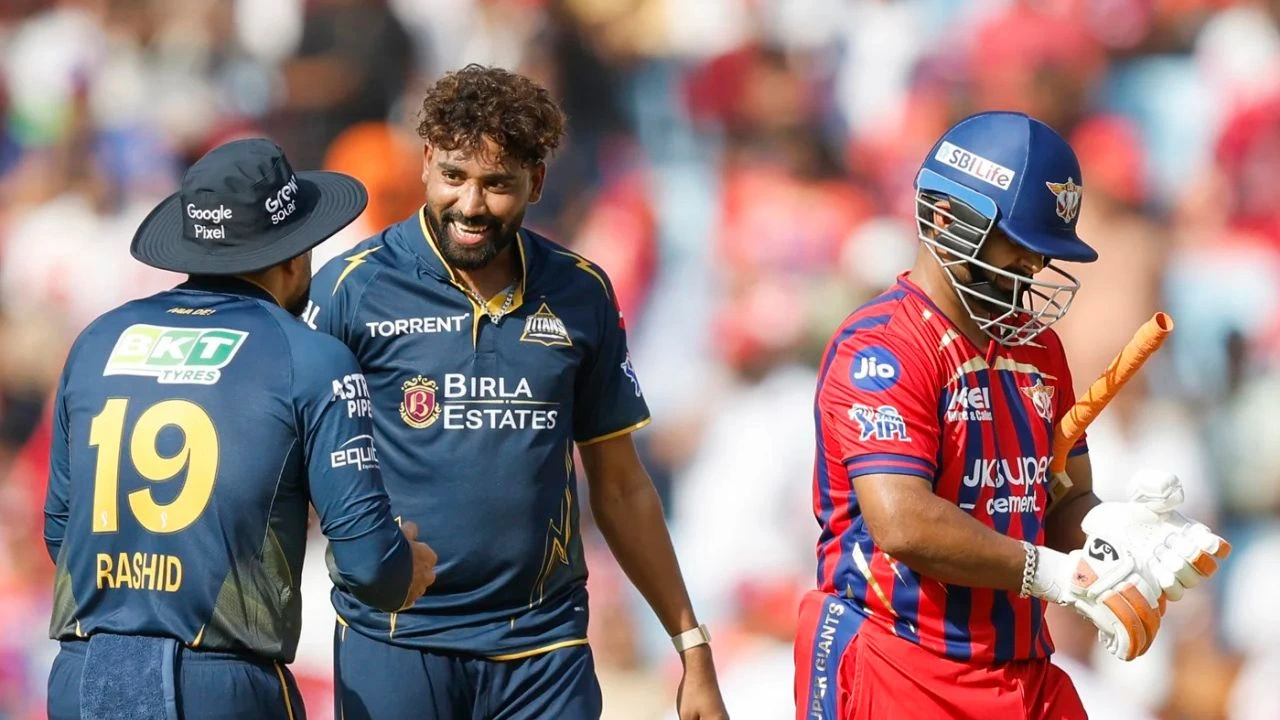
Today against Gujarat Titans Rishabh Pant fell for 18 off 11 balls to Mohammed Siraj attempting a ramp that was not on at that stage of the innings and LSG’s middle order was left scrambling again.
Strip the fifty out of his season returns and Rishabh Pant is averaging 8.5 across the other three games. That is not a number three struggling for form.
That is a number three who has physically promoted himself but whose shot selection in three of four innings this season has been that of a player batting at seven with twelve balls left rather than a captain batting at three with a game to construct.
The stats tell a story that the one good innings keeps obscuring
The overall average of 42.5 looks reasonable until you understand that it is being held up entirely by a single unbeaten innings.
Pull that out and the picture changes completely. In three of his four outings this season Rishabh Rishabh Pant has fallen before the tenth over while attempting high-risk shots with the game still in a phase where the platform was either being built or needed to be. Against KKR he managed 10.
Today against GT he managed 18. The pattern of dismissal is as consistent as the pattern of failure, a loose attacking shot in the transition overs between the powerplay and the middle period, precisely the phase where a number three is supposed to be at their most calculating.
The number three position in T20 cricket is not a license to attack from ball one regardless of conditions. It is a license to dictate, to read what the innings needs and respond to it rather than impose a predetermined plan on a situation that may not call for it.
Rishabh Pant’s career strike rate at this position is 173 and that is the statistical argument that justified the move. But a career strike rate without the accompanying match awareness is just aggression without intelligence and right now in three out of four innings that is what LSG are getting.
Match 1 vs DC – 7 (9), run out – Struggled
Match 2 vs SRH – 68* (50) – Won
Match 3 vs KKR – 10 – Collapse
Match 4 vs GT – 18 (11) – Struggling
Also READ: Rajasthan Royals manager Romi Bhinder under BCCI scanner after phone spotted during RCB game
The domino effect on the rest of the LSG batting order is the part nobody is talking about enough.
The most damaging consequence of Rishabh Pant’s inconsistency at three is not what it does to his own numbers, it is what it does to everyone batting below him.
Mitchell Marsh and Aiden Markram at the top cannot play with the freedom their game requires because they know that the man coming in at three is as likely to be gone in seven balls as he is to bat thirty overs. That uncertainty tightens their own approach.
Nicholas Pooran is a death-overs destroyer who is being forced to come in during the eighth or ninth over to rebuild an innings rather than finish one and that is one of the most wasteful misallocations of batting resource you can produce in T20 cricket.
Pooran playing defensively in the middle overs to compensate for Rishabh Pant’s early dismissal is not a Pooran problem. It is a structural problem created by a captain whose shot selection in pressure moments is not matching the responsibility of his position.
LSG sit fifth with a negative net run rate and two of their losses have been directly shaped by middle-over collapses that trace back to Pant’s departure at a moment when his presence was the thing holding the innings together.
The experiment has not failed yet. But it is failing the team in its current form and at some point the captain has to look at that connection and respond to it differently than he has so far.
Comments are closed.