
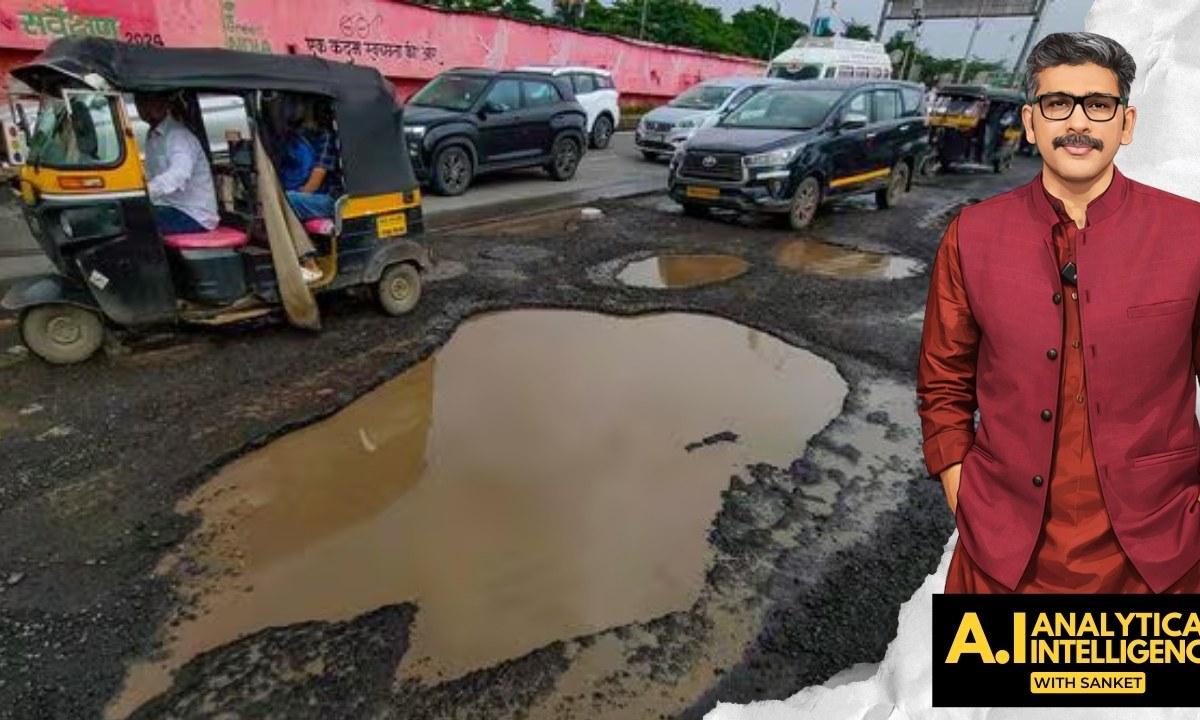

“Every day, 500 people die in road accidents across India — 20 times the number that led to a war between two countries — and yet we don’t do enough,” said Anuj Gupta, highlighting the scale of India’s infrastructure crisis.
With India investing nearly $100 billion under the National Infrastructure Pipeline (NIP), questions around quality, accountability, and safety have become urgent. On AIWithSanket, The Federal spoke to journalists Anuj Gupta and Aarshi Tirkey on why brand-new roads and bridges fail within months — and whether reforms in the Road Transport Ministry could change that.
A pattern of failure
The discussion began with a troubling observation: infrastructure meant to last decades, collapsing within months.
From newly constructed bridges showing structural gaps to highways developing craters and exposed girders, the signs of poor quality are visible across cities. Gupta pointed out that the problem is not confined to roads. “It’s in our airports, our ports, railway accidents — it’s all around us,” he said.
Referencing incidents such as the Morbi bridge collapse in Gujarat and recurring infrastructure chaos at airports, Gupta argued that the issue reflects a systemic problem rather than isolated failures.
Also read: Kiran Mazumdar-Shaw criticises Bengaluru roads, garbage; Priyank Kharge responds
He stressed that around 500 daily road fatalities represent a silent crisis. “For 26 deaths, we fought a nuclear country. But for 20 times that number dying every single day, we probably do not do enough,” he said.
The L1 dilemma
At the heart of the debate lies the “L1” system — a procurement model where the lowest financial bidder wins government contracts.
Aarshi Tirkey explained that government tendering has traditionally combined technical and financial components. Over time, however, aggressive underquoting became common. Firms would drastically reduce financial bids to secure contracts, often compromising on technical depth.
“The intention was to widen participation, especially during Covid-19 when liquidity was low,” Tirkey said. Relaxations were introduced to increase competition. But in practice, underbidding squeezed margins and incentivised cost-cutting.
Also read: Shivakumar: ‘50 potholes on 100-metre New Delhi road stretch’, why target Bengaluru?
Gupta described the L1 principle as a product of bureaucratic risk aversion. “Nobody wants to take a chance and face scrutiny from institutions like the CBI, CAG, CVC or the courts,” he said. Awarding the lowest bid became a safe administrative choice, even if it affected quality.
He argued that once contractors win with ultra-low bids, they recover profits by compromising on materials and workmanship — a phenomenon often dramatised in popular culture but rooted in economic reality.
The DPR issue
A key structural flaw, Tirkey said, lies in the Detailed Project Report (DPR) — the blueprint of any infrastructure project.
Consultants prepare DPRs covering alignment, geometry, pavement design and safety features. Earlier, both financial and technical bids were considered. However, Tirkey noted instances where firms allegedly reused templates from previous projects, even when geographical conditions differed drastically.
“You cannot use the same DPR for Kerala, which sees heavy rainfall, and Rajasthan, which has very different terrain conditions,” she said.
Such template reuse, driven by cost-cutting, weakened project foundations. Under the L1 model, financial underbidding often overshadowed technical merit.
Also read: Gambhira bridge collapse adds to India’s long list of similar disasters
Recognising this, the Road Transport Ministry recently removed the financial bid component for consultant selection. Now, consultants are evaluated purely on technical merit and past performance.
“This is the first time in 75 years of independence that such a system has been devised,” Gupta said, adding that the reform aligns with General Financial Rules (GFR) and has approval from oversight bodies.
Quality-first shift
The reform shifts focus from lowest cost to technical competence. Past performance now plays a significant role in evaluating bids. Companies previously blacklisted for poor execution face disadvantages in new tenders.
Gupta believes this change could have ripple effects beyond roads. “If every infrastructure ministry follows this formula, you will see significant improvement — fewer railway accidents, better hospitals, faster court construction,” he said.
The principle, he added, is simple: reward technical expertise and eliminate abnormal profit margins created by substandard execution.
Also read: 10 collapses in 15 days: Why Bihar’s bridges are crumbling like cookies
Under the modified contracts, consultants oversee projects in ways that compel quality materials and labour. This, Gupta argued, leaves little room for “super-normal profits” — the surplus margins that may enable kickbacks.
Kickback allegations
The conversation also addressed allegations of commissions ranging from 22% to 40% in certain states.
Gupta framed bribery as a symptom of systemic inefficiency rather than mere greed. “If somebody is paying a bribe, that money is coming from super-normal profits,” he said. Those profits, he argued, are often generated through substandard work.
By capping upside profits and limiting downside losses, the new contract structure aims to reduce incentives for corner-cutting.
Tirkey added that digitisation and transparency are critical to curbing backdoor dealings. Building efficiencies into procurement pathways can narrow avenues for corruption.
Risk-sharing model
Another major reform involves redistributing risk between the government and contractors.
Traditionally, traffic projections determined revenue potential for toll-based road projects. Contractors assumed traffic growth risks — leading to inflated projections and distorted bidding.
Gupta explained that infrastructure risk should be borne by the party best equipped to manage it. Since government policies influence surrounding development and traffic generation, it makes sense for the state to shoulder part of that risk.
Also read: India’s cities are drowning in a crisis of governance, not rains
“For the first time, contracts say that if traffic is below projections, the government will compensate the contractor,” he said.
By capping both upside and downside, the system incentivises performance rather than speculative profit-taking.
Larger implications
The panel emphasised that infrastructure reform is not merely a technical issue — it affects everyday lives.
From flyovers narrowing unexpectedly due to design constraints to mismatched bridge alignments in cities like Mumbai and Mira Bhayandar, poorly conceived projects can turn into safety hazards.
Also read: Highway agencies should not charge toll on poor roads: Nitin Gadkari
Gupta described the broader lesson: procurement systems must prioritise quality over mere cost savings. Are we building durable assets or future liabilities?” he asked.
As India expands its infrastructure footprint under the National Infrastructure Pipeline, the question becomes increasingly urgent.
For Gupta and Tirkey, the Road Transport Ministry’s reforms offer a template. Whether states and other ministries replicate this model will determine whether India’s next generation of roads and bridges become symbols of growth — or cautionary tales.
The content above has been transcribed from video using a fine-tuned AI model. To ensure accuracy, quality, and editorial integrity, we employ a Human-In-The-Loop (HITL) process. While AI assists in creating the initial draft, our experienced editorial team carefully reviews, edits, and refines the content before publication. At The Federal, we combine the efficiency of AI with the expertise of human editors to deliver reliable and insightful journalism.

Comments are closed.