
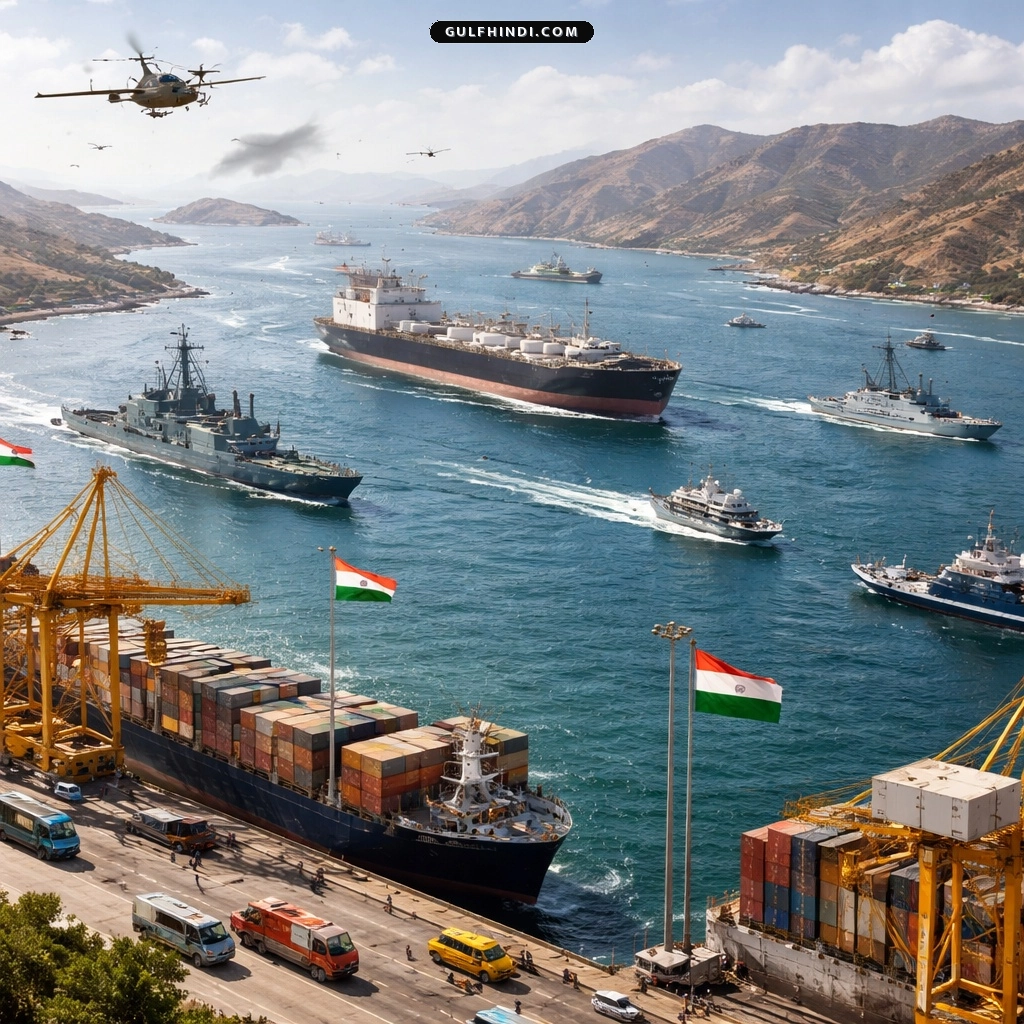
Route of ships changed due to security crisis in Strait of Hormuz, heavy pressure on ports of India and Oman increased

Due to the ongoing security crisis and uncertainty in the Strait of Hormuz, ships have changed their routes. Due to this, the pressure on the ports of India, Oman and other Gulf countries has increased a lot. Following stern warnings from Iran’s military and new security incidents, major shipping companies have shunned the route, increasing both the cost and time of moving freight around the world.
🗞️: Closeness will increase between UAE and Libya, special meeting of President Sheikh Mohammed bin Zayed and PM Dabibe.
Iran’s new warning and strict security rules
Iran’s Army and Revolutionary Guard have clearly stated that all commercial and oil carrying ships will have to follow their designated routes. Iran considers this maritime area as part of its sovereignty, while America and many Gulf countries are opposing it. Iran has warned of strict action after a foreign container ship recently went astray. Due to this tension, the insurance cost (War Risk Premium) of ships going through this route has increased a lot, due to which it is proving to be very harmful for the companies to pass through this route.
Increased pressure and jam situation at alternative ports
Due to the change in route, the congestion of ships at many major ports in the Gulf region and India has increased significantly. The current status of various ports is given in the table below:
Change in shipping route increases time and expense
Major international shipping companies such as Maersk, MSC, CMA CGM, and Hapag-Lloyd have completely diverted their ships. Now these ships are going through the long route to Africa’s ‘Cape of Good Hope’. Due to this alternative route, ships are taking up to 14 days additional time to complete their journey. The change affected more than 81,000 shipments, more than 250 percent compared to normal times. Talks are going on between the US and Iran under the mediation of Qatar and Pakistan, but danger still remains at the ground level.
Comments are closed.