
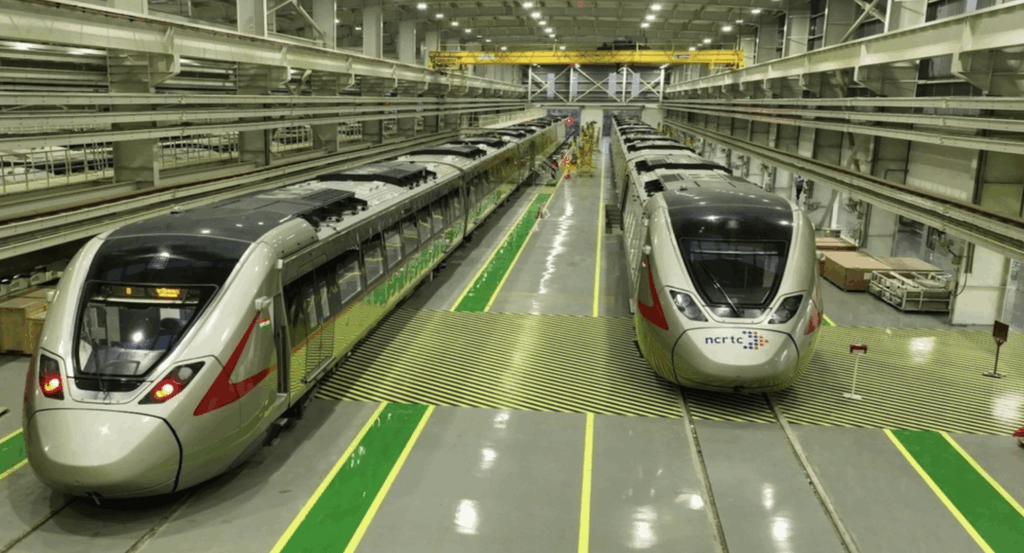

A major boost to regional connectivity in the National Capital Region (NCR) is on the horizon as the National Capital Region Transport Corporation (NCRTC) has submitted the Detailed Project Report (DPR) for a new Namo Bharat Regional Rapid Transit System (RRTS) corridor connecting Gurugram, Faridabad, Noida and Greater Noida. The ambitious project aims to significantly reduce travel time between some of NCR’s busiest urban centres while integrating multiple public transport networks into a seamless mobility ecosystem.
A ₹19,390 Crore High-Speed Transit Project
According to the DPR, the proposed corridor will span approximately 63 kilometres and is estimated to cost ₹19,390 crore. Of the total route length, around 50 kilometres will be located in Haryana, while the remaining 13 kilometres will pass through Uttar Pradesh. To fund the project, NCRTC is planning to secure a soft loan of over ₹10,000 crore, while the remaining investment is expected to come from participating state governments and other sources.
The proposal has been submitted to the Haryana Mass Rapid Transport Corporation (HMRTC) for review before it moves through further approval stages. If approved, the corridor will become one of the most significant transport infrastructure projects in the NCR region.
Route and Key Stations
The proposed RRTS corridor will originate from IFFCO Chowk in Gurugram and pass through key locations in Gurugram, Faridabad, Noida and Greater Noida. Seven major RRTS stations have been proposed, including IFFCO Chowk, Sector 61, Gwal Pahari, Sainik Colony, Bata Chowk, Sector 87-88 intersection, Noida Sector 142 and Surajpur.
In addition to the rapid rail network, the project incorporates metro connectivity. New metro stations have been proposed across Gurugram, Faridabad and Noida to ensure smoother last-mile connectivity and easier interchanges with existing transport systems.
Transforming Travel Across NCR
The corridor is expected to dramatically improve connectivity between major residential, commercial and industrial hubs across NCR. Commuters travelling between Gurugram, Faridabad and Noida currently face long travel times due to road congestion and limited direct public transport options.
By providing a dedicated high-speed transit system, the project aims to reduce dependency on private vehicles, ease traffic congestion and lower carbon emissions. The integrated metro component will further strengthen urban mobility by connecting passengers to local transport networks.
Economic and Infrastructure Impact
Beyond improving transportation, the project is expected to drive economic growth across the region. Improved connectivity often leads to increased real estate development, higher commercial activity and greater employment opportunities around transit hubs.
The corridor will also strengthen links between major economic centres in Haryana and Uttar Pradesh, making daily commuting easier for lakhs of residents. Infrastructure experts believe the project could become a key component of NCR’s long-term urban development strategy.
A New Mobility Backbone for NCR
The proposed Gurugram-Faridabad-Noida Namo Bharat corridor represents a significant step towards creating an interconnected and efficient transportation network for NCR. As authorities review the DPR and move towards approvals, the project has the potential to reshape how people travel across the region.
If implemented as planned, the corridor will not only reduce travel times but also support sustainable urban growth, improve public transport accessibility and strengthen economic integration across one of India’s most important metropolitan regions.
Summary
NCRTC has submitted the DPR for a ₹19,390 crore Namo Bharat RRTS corridor connecting Gurugram, Faridabad, Noida and Greater Noida. The 63-km project will feature rapid rail and integrated metro services, improving regional connectivity and reducing travel times. Once approved, the corridor is expected to ease congestion, support economic growth and transform public transportation across the NCR region.
Image Source
Comments are closed.