
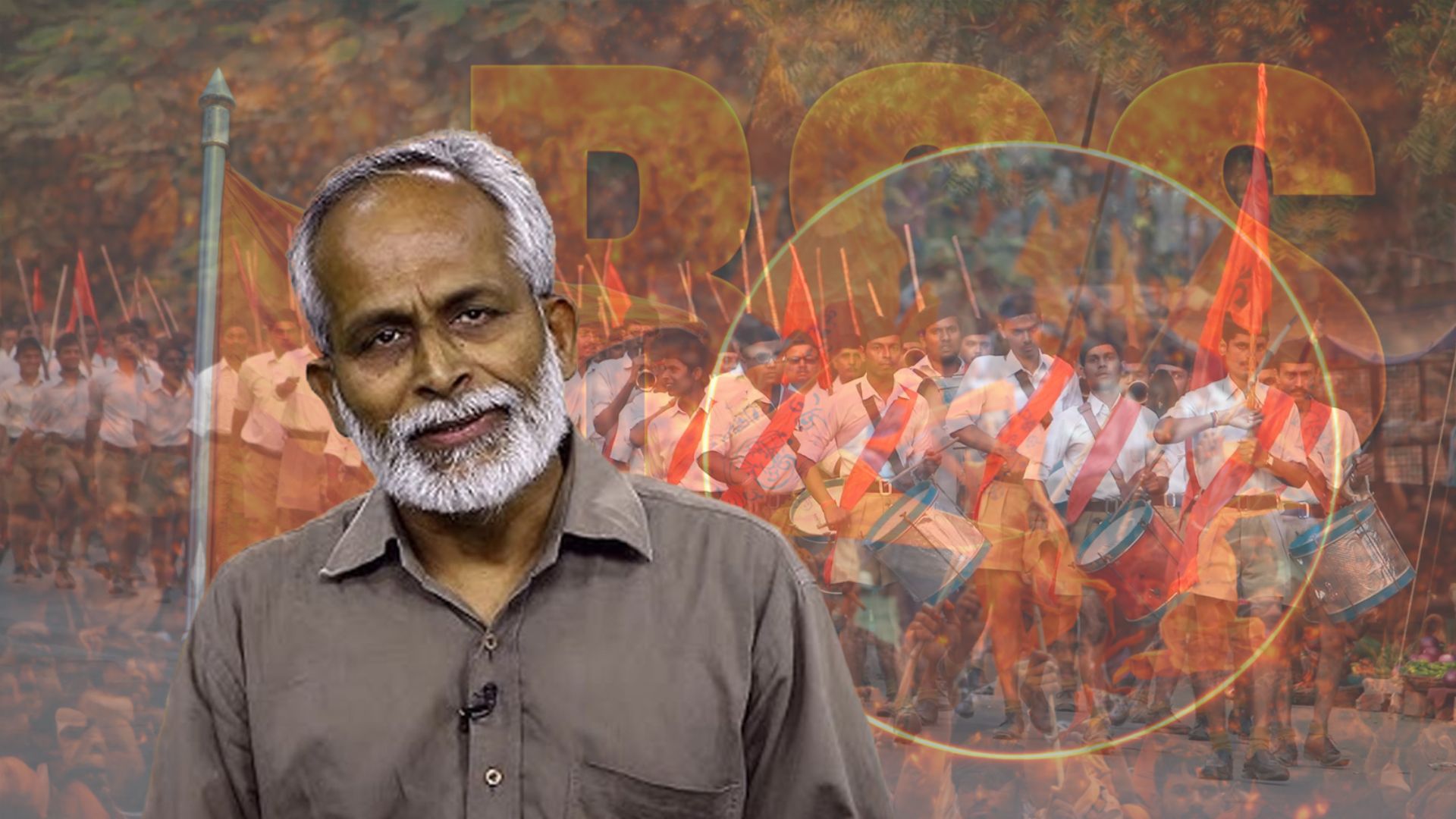

With the Rashtriya Swayamsevak Sangh (RSS) marking its centenary, questions about its origins, ideology and evolution have resurfaced. The Federal spoke to Subhash Gatade, author and long-time scholar of the Sangh Parivar, on the organisation’s roots, its relationship with caste, Savarkar, Hindu Mahasabha, Arya Samaj, and the politics of appropriation.
Why was the RSS established in Maharashtra, and why has its leadership largely remained Maharashtrian Brahmin?
The RSS is usually understood through its self-definition — that it is a Hindu organisation defending civilisation against Muslims. But that is only a partial understanding.
If you look at Maharashtra, Muslims have historically been less than 10 per cent and were never politically dominant there. Even Chhatrapati Shivaji’s army was composite. One of his close associates, Madari Mehta, helped him escape from Agra. So the idea that the RSS was born purely out of a civilisational battle against Muslims does not hold when you examine Maharashtra’s history.
Also read: Gita Press and RSS: Akshaya Mukul on how ideas shaped Hindu politics for a century
To understand its origins, one has to look at the 19th-century social reform movement led by Mahatma Jyotirao Phule. Maharashtra and Bengal were the main centres of social reform in British India. Phule’s Satyashodhak Samaj challenged Brahminical dominance. Under the Peshwa rule till 1818, non-Brahmins had virtually no rights. Dalits could not walk on streets in the morning lest their shadow fall on a savarna. Women had no rights, and education was denied to them.
When the British opened up education, Phule, with Savitribai Phule and Fatima Sheikh, started schools. This was a rebellion. Over decades, this anti-caste assertion grew into the non-Brahmin movement and influenced Dr BR Ambedkar, who called Phule the greatest Shudra.
The RSS must be seen in that background. It emerged as a response to the decline of Brahmin dominance, not simply to Muslim dominance.
Was the public celebration of Ganesh Utsav and Shiv Jayanti part of this counter-mobilisation?
Yes. Traditionally, caste divisions in Maharashtra were so rigid that there was no culture of mass Hindu festivals. Dalits and backward castes often participated in Muharram processions. That created anxiety among upper castes.
Bal Gangadhar Tilak started Ganesh Utsav and Shiv Jayanti partly to organise people against the British, but also as a counter to this trend — to draw non-Brahmins away from Islamic festivals. It was a social and political mobilisation strategy.
Also read: Why Felix Pal thinks RSS is an ‘aloof parent’ of the Sangh Parivar
When the RSS was founded in Nagpur in 1925, it was in the backdrop of communal riots in 1924. In CP Bhishikar’s official biography of KB Hedgewar, he says Hedgewar identified two threats: Muslim ‘snakes’ and the non-Brahmin movement. So the anxiety about caste assertion was very much present.
How much did Vinayak Damodar Savarkar’s Hindutva influence the RSS?
Savarkar’s book Hindutva is often called the ideological bible of the RSS. Hedgewar met Savarkar in 1923 before founding the RSS. But whether the RSS fully continued Savarkar’s ideological line is debatable.
Savarkar had a broader vision. He spoke of scientific temper and challenged practices like cow worship, saying the cow was a useful animal, not a divine being. The RSS did not necessarily adopt all of that.
There were differences later. But certainly, Savarkar laid down the theoretical framework of Hindutva.
Did the RSS remain committed to the Varna system over the decades?
Yes. From the beginning, the RSS believed in the Varna system, and that belief continues in various forms even after 100 years.
Most RSS chiefs have been Maharashtrian Brahmins, except Rajendra Singh ‘Rajju Bhaiya’, who was a Rajput from Uttar Pradesh. During Constitution-making, leaders like MS Golwalkar expressed admiration for Manusmriti and questioned the need for a separate Constitution. They were against universal adult franchise.
Also read: ‘The Sangh Parivar plan is to present a sanitised, RSS-compatible Gandhi’
If you look at policies over the Modi years, you can see continuities in thinking.
But hasn’t the RSS and BJP expanded representation to backward castes and Dalits?
“That expansion is within a framework. Golwalkar’s vision was exclusive Hindutva. Balasaheb Deoras, who became chief later, spoke of inclusion in 1974 in Pune’s Vasant Vyakhyanmala lectures.
I differentiate between Golwalkar’s exclusive vision and Deoras’s inclusive Hindutva. But inclusion did not mean dismantling caste hierarchy. The structure remained.
If Dalits and backward castes accept the RSS’s Hindutva vision, they are included. The RSS even created the Samajik Samrasta Manch and tried to project Hedgewar and Ambedkar as similar social reformers, despite opposing Ambedkar’s Hindu Code Bill and constitutional vision.
This is more than tokenism. Dalits and Adivasis were mobilised during riots, including in Gujarat in 2002. They were empowered in a limited way, and their anger was redirected towards Muslims instead of systemic injustice.”
At what point did Islamophobia become central to the RSS?
“If you read Golwalkar’s Bunch of Thoughtshe identifies Muslims, Christians and Communists as three internal threats. During Partition, there is ample documentation of the RSS’s role in violence. At the same time, it mobilised Hindu refugees from West Punjab, which explains its support base among those communities.
Also read: 75-year retirement to caste census: Decoding Mohan Bhagwat’s speech
So Islamophobia was there in Golwalkar’s time. It was not a later development.”
What happened to the Arya Samaj and Hindu Mahasabha? Have they been co-opted?
Effectively, yes. Though not formally affiliated, they function within the RSS framework today.
All three had anti-Islam agendas. The Arya Samaj had a relatively radical vision — it wanted a casteless Hindu society. But the dominant Hindu mindset was not keen on radical social reform.
The RSS offered a vision where Chaturvarna (four-fold caste system) remained but Hindus were united. That resonated more. Hence the RSS succeeded where others weakened.
What about the recent emphasis on ‘Sanatan Dharma’? Does this create discomfort among Arya Samaj followers?
Yes, there is discomfort. But they are not in a position to protest. They have been co-opted and risk further marginalisation if they resist.
Have critics of the RSS misunderstood its core motivations?
Yes. Critics largely responded to the RSS’s self-definition as a Hindu civilisational force. If anti-caste struggle had been central to opposing the RSS from day one, things might have been different.
Also read: RSS centenary: Historian explains why distorting the past is deeply problematic
An anti-patriarchal struggle should also have been central. The RSS calls itself a Hindu organisation, but it is fundamentally an organisation of Hindu men. Women had to form a separate body, the Rashtra Sevika Samiti. If critics had foregrounded caste and patriarchy, broader social unity against the RSS might have been possible.
(The content above has been transcribed from video using a fine-tuned AI model. To ensure accuracy, quality, and editorial integrity, we employ a Human-In-The-Loop (HITL) process. While AI assists in creating the initial draft, our experienced editorial team carefully reviews, edits, and refines the content before publication. At The Federal, we combine the efficiency of AI with the expertise of human editors to deliver reliable and insightful journalism.)

Comments are closed.