
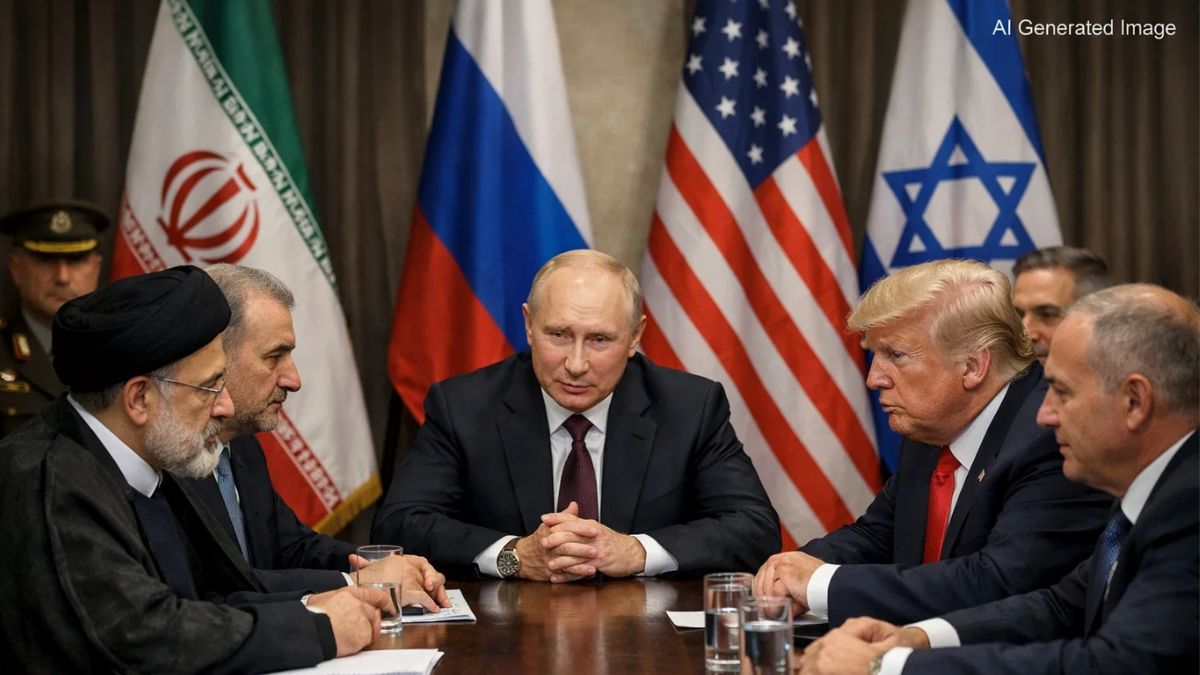
Pakistan’s wind out, now Russia comes forward; Does Putin have a peace plan for the Middle East? Russia Offers Mediation in Iran-US-Israel War, Iran Rejects Pakistan Proposal

Russia on Iran Israel US War Mediation: The war between Iran and Israel-America is going on since February 28. Russia’s entry has changed the equations amidst the ongoing tension in the Middle East. us President donald trump In his recent address, he had talked about peace along with a tough stance on Iran. America wants Iran to keep the Strait of Hormuz open and reduce its military activities. At the same time, Iran has made it clear that it will not step back until it gets concrete security guarantees and compensation for war losses. Meanwhile, Russian President Vladimir Putin has officially offered mediation.
Russia has said that it is ready to do ‘everything’ to restore peace between Iran and Israel. Putin Currently in touch with the Crown Prince of Saudi Arabia and the leaders of Egypt. Russia is presenting itself as an alternative to America, so that it can strengthen its hold in the region. For the last few days, Pakistan was claiming that it is the main mediator between Iran and America. He has conveyed America’s 15-point peace proposal to Iran. However, international analysts believe that Pakistan’s influence is now decreasing, because Iran has rejected the proposals coming through Pakistan as ‘excessive’. Now Iran prefers to talk directly to big countries like Russia and China.
What did Pakistan say while offering mediation?
- Pakistan presented itself as a ‘diplomatic bridge’ by offering mediation in the Iran-Israel-US conflict. Foreign Minister Ishaq Dar had said on 30 March 2026 that Pakistan would be honored to ‘host and facilitate meaningful dialogue’ between the two sides (US and Iran) in the coming days.
- Pakistan claimed that both America and Iran have expressed ‘confidence’ in Pakistan’s mediation ability.
- Pakistan’s Prime Minister Shahbaz Sharif said that this war is badly affecting Pakistan’s economy and the stability of the region. Therefore, Pakistan is actively working to reduce tension.
- Pakistani officials also confirmed that they had conveyed the US’s 15-point peace proposal (which included terms of a ceasefire and closure of nuclear facilities) to Iran.
- Pakistan argued that it has working relations with both Iran and the Gulf countries (Saudi Arabia etc.), making it a unique arbiter in the region.
However, according to the latest reports of 2 April 2026, Pakistan’s Foreign Ministry has admitted that these efforts are facing ‘obstacles’. Iran publicly refused to engage in any direct talks mediated by Pakistan and described Pakistan’s efforts as its ‘own private efforts’.
What did Russia say?
- After Donald Trump’s address, Russia gave a clear indication of playing its active role in restoring peace in the Middle East. Kremlin spokesman Dmitry Peskov said on April 2, 2026 that Russia is fully ready to contribute to resolving the Iran conflict.
- Peskeev said that President Putin is in constant touch with regional leaders. He spoke by phone with Saudi Arabia’s Crown Prince Mohammed bin Salman and hosted Egyptian Foreign Minister Badr Abdelati in Moscow to discuss diplomatic paths to de-escalation.
- Russia’s main objective is to bring this military situation on a peaceful course as soon as possible.
- Russia has requested the US and Israel to ensure a temporary ceasefire to ensure the safe evacuation of Russian employees (about 200 people) from Iran’s Bushehr nuclear plant.
- Iran has also indicated that it is ready to accept Russia as a mediator in its ongoing conflict with the US and Israel.
- Responding to Trump’s possible threat to withdraw from NATO, Peskov said that Russia views NATO as a “hostile alliance”.
In short, Russia is now emerging as a major power broker in this crisis, offering diplomatic solutions in the face of America’s military pressure.
Iran’s 4 big conditions (via Russia)
Iran’s ambassador to Russia has made four major demands for peace;
- attacks should stop completely
- Guarantee that there will be no war in future
- be compensated for the loss
- Iran’s rights on the Strait of Hormuz should be respected
At present the ball of diplomacy is in Russia’s court. While America is pursuing pressure politics, Putin is establishing himself as a ‘peacemaker’. Pakistan seems to be gradually moving out of this entire picture.
When did Trump address the nation?
Trump gave his first prime-time address to the nation from the Cross Hall of the White House on April 1, 2026 (April 2 morning Indian time). This speech was given on the completion of one month of the ongoing military operation against Iran (Operation Epic Fury).
What did Trump say in his address?
- Trump announced that the war against Iran is in its final stages. This may end in the next 2 to 3 weeks. He said that America is close to fulfilling its ‘key strategic goals’.
- Trump claimed that Iran’s navy has been completely destroyed. Their air force and military leadership (IRGC) have been caused huge losses.
- Trump warned that if a deal is not reached, the US will launch a ‘very severe attack’ on Iran in the next few weeks and send it back to the ‘Stone Age’.
- Trump reiterated that he will never allow Iran to acquire nuclear weapons. He claimed that Iran’s nuclear sites had been “obliterated” by B-2 bombers.
- Trump urged other countries to show courage regarding the Strait of Hormuz and take responsibility for the security of this important trade route. He said that this route will open naturally after the war ends.
- Trump asked the American people to see this war as an ‘investment’ for the future, so that future generations can remain safe.
- During the address, Trump also mentioned that he was in talks with Iran, although Iran has denied any formal talks.
What are the terms of Trump’s 15-point peace proposal?
Donald Trump sent a 15-point peace proposal to Iran through Pakistan. This proposal is mainly designed to curb Iran’s nuclear program and its military activities. According to this;
- Iran’s Natanz, Isfahan and Fordow nuclear centers will have to be completely closed.
- There will have to be a permanent ban on uranium enrichment on Iranian soil.
- The current uranium stockpile will have to be handed over to the International Atomic Energy Agency (IAEA) or destroyed.
- Iran will have to limit the number of its ballistic missiles and their firepower.
- Providing financial support and arms to regional allies (such as Hezbollah and the Houthis) must be stopped.
- The Strait of Hormuz must be opened immediately for international trade.
- The proposal calls for a temporary ceasefire of 30 days for discussion.
What will Iran get in return? (Assurances to Iran)
- All economic sanctions imposed on Iran will be completely lifted.
- The US will provide technical assistance for power generation at Iran’s Bushehr civilian nuclear plant.
- The UN’s snapback mechanism will be abolished due to which sanctions can be imposed again.
Iran has rejected this proposal as ‘unfair and maximalist’. Iran says it will end the war on its own terms, including a permanent end to attacks and compensation for war damages.

Comments are closed.