
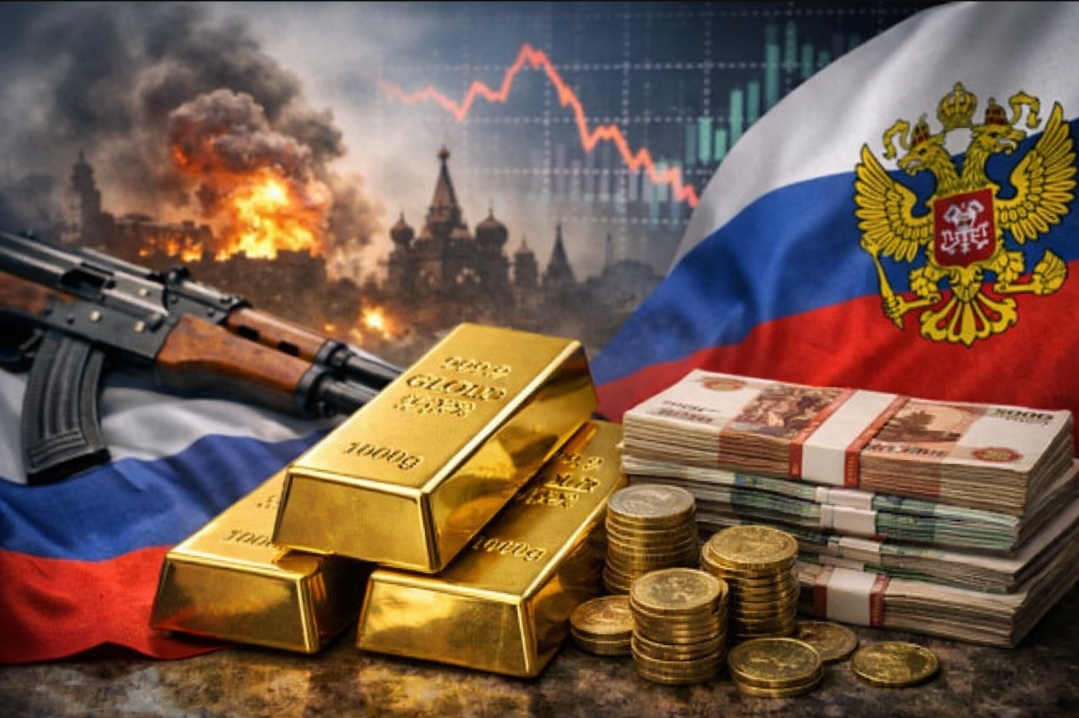

Russia has begun selling physical gold from its central reserves in a notable shift that reflects mounting financial pressure on the government. It is the first time in roughly a quarter century that Moscow has opted to release actual bullion into the market, rather than rely on internal financial adjustments.
The move comes as the country struggles to manage a widening budget gap, largely driven by continued military spending linked to the ongoing conflict in Ukraine. As expenditures rise and revenues face headwinds, authorities are increasingly leaning on reserve assets to stabilize the economy.
A report by bne Intellinews highlights the scale of this trend. Between 2022 and 2025, Russia sold a combined RUB 15 trillion (around $150 billion) worth of gold and foreign currency. This reflects a sustained effort to offset the fiscal impact of sanctions, war-related expenses, and weaker income streams.
Reserve Drawdown Accelerates in 2026
The pace of reserve usage has picked up sharply in early 2026. Within just January and February, Russia liquidated approximately RUB 3.5 trillion ($35 billion) in reserves. A portion of this came from gold sales carried out by the Central Bank of Russia.
Data shows that around 300,000 ounces of gold were sold in January, followed by another 200,000 ounces in February. While these figures may appear modest compared to Russia’s total holdings, they mark a significant departure from past practice.
Until recently, most gold-related operations were largely internal. Transfers between the finance ministry and the central bank were used for accounting purposes, without any physical gold entering circulation. Now, however, real bullion is being released into global markets—an indication that financial pressures are becoming harder to manage through conventional means.
Gold Reserves Decline to Multi-Year Low
As a result of these sales, Russia’s gold reserves have fallen to 74.3 million ounces, the lowest level seen in four years. The disposal of roughly 14 tonnes of gold over the first two months of 2026 represents the most substantial short-term reduction since 2002.
That earlier episode saw a much larger one-time sale, but the current trend suggests a more gradual and sustained drawdown. Analysts view this as a sign that Russia may continue tapping its gold stockpile if fiscal conditions remain strained.
War Spending Continues to Drive Deficit
At the heart of Russia’s financial challenges is the cost of sustaining military operations. Defense spending has remained elevated as the war in Ukraine stretches into its fourth year, placing heavy demands on the national budget.
Russia ended 2025 with a deficit equal to 2.6% of its gross domestic product, significantly above initial projections of just 0.5%. Some economists believe the real figure could be closer to 3.4%, noting that certain government payments were postponed into 2026, effectively understating last year’s shortfall.
This growing gap between revenue and expenditure has forced policymakers to rely on a mix of strategies, including reserve sales, borrowing, and tax adjustments.
Energy Revenues Lose Their Dominance
Another key factor behind the fiscal strain is the weakening contribution of oil and gas revenues. For years, energy exports have been the backbone of Russia’s economy, funding a large portion of government spending.
However, the second half of 2025 saw a drop in global oil prices, while tighter sanctions from the United States and its allies further restricted export flows. As a result, oil and gas tax revenues now account for only about 20% of total government income—roughly half of their pre-conflict share.
This decline has reduced the government’s financial flexibility, making it more dependent on alternative sources such as reserves and domestic taxation.
Rising Gold Prices Offer Partial Relief
Despite the drawdown in reserves, Russia has benefited from a sharp rise in global gold prices. The precious metal has surged past $5,000 per ounce, significantly increasing the value of the country’s remaining holdings.
As of late February, Russia’s total international reserves stood at over $809 billion. However, a substantial portion—around $300 billion—remains frozen under Western sanctions imposed after the escalation of the Ukraine conflict in 2022.
Gold accounts for a large share of the accessible reserves, with holdings valued at approximately $384 billion. The surge in prices has helped cushion the financial impact of ongoing sales, allowing Russia to maintain a relatively strong reserve position despite increased usage.
Long-Term Strategy Behind Gold Accumulation
Russia’s reliance on gold is not new. Over the past decade, the country has steadily built up its reserves as part of a broader effort to reduce dependence on the U.S. dollar and shield its economy from external pressures.
According to data from the World Gold Council, Russia holds more than 2,000 tonnes of gold, making it the fifth-largest sovereign holder globally.
This strategy gained momentum after sanctions were imposed following the annexation of Crimea in 2014 and intensified after 2022. By increasing its gold reserves and reducing exposure to dollar-based assets, Russia aimed to strengthen its financial resilience.
At the same time, the country has kept its external debt relatively low—around 14% of GDP—providing an additional buffer against economic shocks.
Multiple Measures to Manage the Deficit
To cope with ongoing financial pressures, Russia has adopted a multi-layered approach. The government continues to draw from the National Welfare Fund, which holds roughly RUB 4 trillion and is expected to cover much of the current year’s projected deficit.
Domestic borrowing has also increased, with authorities issuing OFZ bonds to raise funds from local investors. Additionally, tax policies have been adjusted, including a two-percentage-point increase in value-added tax (VAT). VAT now contributes about 40% of total government revenue, highlighting its growing role in the fiscal framework.

Comments are closed.