
S-400 Exit on the Cards? Why Turkiye May Make Its Biggest Military U-Turn And Abandon Russia’s Air Defense System world news

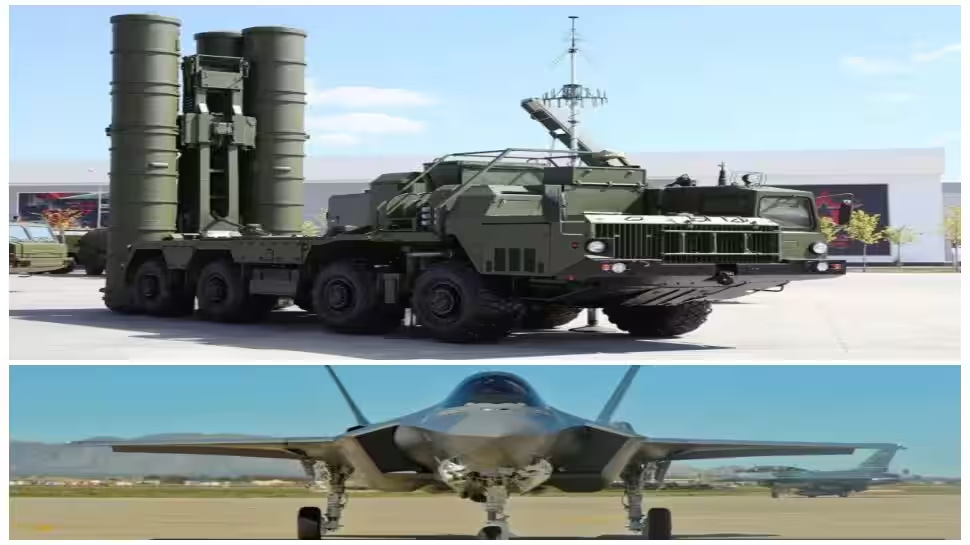
New Delhi: At a high-level conference in Abu Dhabi, US Ambassador to Turkiye Tom Barrack indicated that Ankara is moving toward eliminating its Russian-made S-400 air defense systems, a step that could unlock Turkiye’s return to the Washington-led F-35 fighter jet program.
He confirmed that Turkey has addressed the operational problems linked to the system, while stressing that simply possessing the Russian hardware continues to be a serious point of tension with America.
“I believe these issues will be resolved in the next four to six months,” Barrack declared.
Add Zee News as a Preferred Source
When pressed on whether Turkiye is preparing to get rid of the system, he replied, “Yes.”
How The S-400 Purchase Shut The Door On The F-35
Turkiye’s decision to acquire the S-400 nearly a decade ago ultimately cost Ankara its place in the F-35 Joint Strike Fighter program.
In 2019, the United States removed Turkiye from the project and later imposed sanctions on Turkish defense firms under the Countering America’s Adversaries Through Sanctions Act (CAATSA). Washington maintained that the Russian-made system could expose the stealth design of the F-35 to hostile intelligence, while Ankara insisted the S-400 would not be connected to NATO’s integrated air defense network.
Even after being expelled from the program, Turkiye had already paid around USD 1.4 billion toward the planned purchase of 100 F-35 aircraft, funds that were never returned by the United States.
In September this year, US President Donald Trump said after meeting Turkish President Recep Tayyip Erdoğan that Turkiye might be willing to resume the F-35 acquisition process and added that Erdoğan “would do something for the United States”, without offering any further explanation.
Efforts To Repair Ties Inside NATO
The United States and Turkiye field two of NATO’s largest military forces, and resolving the S-400 and F-35 dispute is widely viewed as a key step toward easing internal alliance frictions.
Turkiye is also navigating a delicate balance with Russia, which remains a major supplier of gas and oil to the country, adding layers of complexity to any final decision.
Within Turkiye, noted political voices have increasingly argued that abandoning the S-400s is necessary to normalize relations with Washington. Former Minister of State Cavit Caglar made it clear when he said, “If I were in charge, I would withdraw the S-400s from Turkiye…. We need to find a way out. We have good relations with Russia. The best way forward is to negotiate and explain that, as a NATO member, we cannot use the S-400s against NATO. We need to address this issue quickly.”
Signs Of Movement Behind Closed Doors
By mid-2024, Turkish Defense Minister Yasar Güler suggested that Washington’s tone had started to change after observing progress in Turkiye’s homegrown fifth-generation fighter project, KAAN.
Speaking in the National Assembly, he stated, “We already have six F-35s there…. Now that they have seen our progress with KAAN, their stance seems to be changing. They are indicating they might be willing to deliver them. We have officially resubmitted our offer to buy the F-35.”
Turkiye initially planned to acquire 100 F-35A aircraft and participated in the program as an industrial partner, with 10 domestic companies involved in the production chain. In 2018, the first F-35 intended for Turkey completed its maiden flight in Texas. Deliveries were halted after the S-400 deal, blocking access to aircraft that had already been paid for.
Other Diplomatic Signals From Washington
In his conversation with Bloomberg, The US ambassador also commented on rising tensions between Turkey and Israel. He described the exchanges between Erdoğan and Israeli Prime Minister Benjamin Netanyahu as “just rhetoric” and said he believed that “Turkiye and Israel will find their relationship at some point”.
Despite those remarks, serious differences remain, particularly over Gaza. Since October 2023, Erdoğan has repeatedly accused Israel of committing “a complete genocide”, while Netanyahu has strongly criticized Turkiye’s position.
Numbers released by the Gaza government’s press office state that more than 70,000 people have been killed and around 171,000 wounded since the conflict began.
A Moment For Turkey’s Defense Direction
Recent signals from both the United States and Turkish officials increasingly point toward a scenario in which Ankara could give up the S-400 system as a condition for re-entering the F-35 program. If confirmed, such a move would represent a major change in Turkiye’s defense procurement strategy and could reopen one of the most strategically important relationships within NATO.

Comments are closed.