
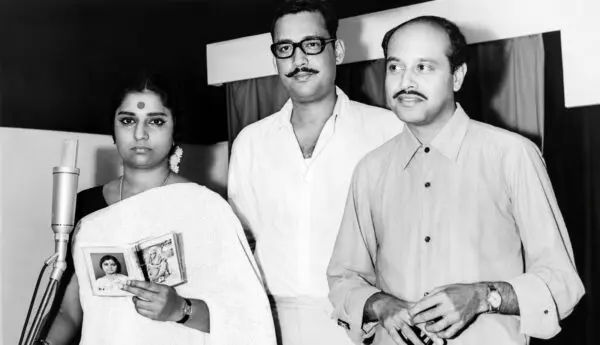

When the story of Odia film music is told, some voices are remembered not simply for the number of songs they recorded but for the lasting impact they left on the art itself. S Janaki is one such singer. Although her contribution to Odia cinema comprises only about 50 songs, each of them bears the unmistakable stamp of an artist who could transform words and melody into living emotion. Her songs continue to occupy a cherished place in Odisha’s musical memory because she never merely sang a composition—she inhabited it.
Janaki’s greatest strength lay in her extraordinary gift for expression. Few playback singers have been able to communicate emotion with such effortless conviction. Her voice could convey joy without exuberance, sorrow without melodrama, romance without affectation, and devotion without excessive ornamentation. It was this rare ability that earned her the title ‘Queen of Expressions.’ Rather than relying on a fixed vocal style, she reshaped her voice according to the mood, character and situation of every song.
Listening to Janaki, one never hears the singer alone; one hears the emotions of the character unfolding through her voice.
By the time she entered Odia cinema, Janaki had already established herself as one of India’s finest playback singers across Tamil, Telugu, Kannada and Malayalam films. Her arrival coincided with an exciting phase in Odia film music, when composers were experimenting with classical melodies, folk traditions and modern orchestration. Janaki adapted effortlessly to this evolving musical landscape, enriching it with her remarkable versatility.
A Memorable Beginning Janaki’s journey in Odia cinema began with Mana Akasha (1974), where music director Upendra Kumar introduced her through the lively number ‘Chora Chora Preeti.’ Unlike the gentle romantic songs audiences often associated with female playback singers, this was an energetic dance composition that demanded agility, rhythmic precision and youthful exuberance. Janaki rose to the occasion with remarkable ease.
The song immediately revealed the qualities that would make her so distinctive in Odia cinema. There was a warm huskiness in her voice that added charm without overpowering the melody. Even more striking was the sense of playfulness she brought to every line. She seemed to smile through the song, not by exaggerating the lyrics but through subtle changes in tone and phrasing. The teasing inflections, rhythmic confidence and effortless vocal control made “Chora Chora Preeti” an instant favourite and introduced Odia listeners to a singer who could perform through her voice as convincingly as any actor on screen.
Romance Beyond Melody.
Janaki sang many romantic songs in Odia films, but none of them sounded repetitive. She treated every composition as a new emotional experience, bringing a distinct mood and expression to each performance.A fine example is the duet ‘Eka Aau Eka Misihue Dui’ from Paribara (1978), composed by Upendra Kumar and sung with Sikandar Alam. The song captures the innocence and excitement of young love, and Janaki’s singing mirrors those emotions beautifully. Her voice moves naturally between playful conversation and quiet tenderness, creating an intimacy that feels completely unforced.
The same film offered a contrasting mood in ‘Purila Aasha Mora,’ her duet with Pranab Patnaik. Here the playful brightness gives way to emotional maturity. Janaki sings with restraint, allowing gentle tonal shifts rather than dramatic flourishes to express longing and fulfilment. It is another reminder of how instinctively she adjusted her singing to suit the emotional demands of a composition.
Years later, in Kie Jite Kie Hare (1991), under the music direction of Akshaya Mohanty, Janaki once again demonstrated that time had done nothing to diminish her expressive power. Songs such as ‘Mana Nuhen Khela Ghara’ and ‘Mana Hajijae Akashara Neela’ reveal a voice that had gained maturity without losing its freshness. Experience had deepened her expression, making these later recordings every bit as captivating as her earlier work.
The Voice of Longing
Few singers could express the pain of separation as naturally as Janaki. She never relied on overt emotion or vocal excess. Instead, she allowed silence, carefully measured pauses and delicate tonal shading to speak for the character.
One of the finest examples is ‘Manara Manisa Jadi Sapana Tikie Dei’ from Rakta Golapa (1977), composed by Dhananjay Satpathy. The song is a masterclass in expressing viraha: the quiet ache of separation. Rather than projecting grief dramatically, Janaki internalises the emotion, making every phrase feel deeply personal. The result is a performance that continues to move listeners decades after its release.
An equally unforgettable example is ‘Nei Jare Megha Mote’ from Balidan (1979), composed by Prafulla Kar. Beautifully composed and sensitively sung, the song remains one of the finest expressions of longing in Odia cinema. Janaki’s measured phrasing, sustained notes and understated emotion transform the melody into an intensely moving musical experience.
Classical Elegance
Janaki’s command over classical music gave her a unique advantage as a playback singer. Even in technically demanding compositions, she never allowed craftsmanship to overshadow emotion.
This is perhaps best illustrated in ‘ Rajani Go Mo Priya Nayane’ from Gouri (1979), composed by Prafulla Kar. Rooted in classical music, the composition required precision, controlled ornamentation and impeccable voice culture. Janaki negotiated every melodic phrase with effortless grace while preserving the lyrical tenderness of the song. Her performance stands as a reminder that technical perfection and emotional depth need not exist separately. In Janaki’s singing, they became one.
Graceful Mujra Singing
Few genres demand as much finesse from a playback singer as the mujra. It calls for a delicate balance of elegance, playfulness, rhythmic precision and dramatic expression. The singer must suggest charm and allure without sacrificing musical discipline—a balance that S. Janaki achieved with remarkable ease.
One of the finest examples is ‘Ja Ja Jare Nagara’ from Bandhu Mohanty (1977), composed by Prafulla Kar. Janaki captures the flavour of the mujra through subtle vocal inflections rather than exaggerated theatrics. There is grace in her delivery, a gentle flirtation in her phrasing and an effortless command over rhythm that perfectly complements the composition.
She explored the same idiom once again in ‘Gora Gora Gale Mora Kala Jai’ from Gouri (1979), another memorable composition by Prafulla Kar. Here, Janaki demonstrates how sensuality in music need not be overstated. Her voice remains refined throughout, allowing expression to emerge naturally from the melody rather than through dramatic embellishment. It is this restraint that gives the song its enduring appeal.
A similar quality can be heard in ‘Kali Ratire Kahigala Nagara’ from Nijhum Ratira Sathi (1979), composed by Akshaya Mohanty. Although the musical treatment differs, Janaki adapts herself effortlessly to the composition, once again proving her remarkable ability to move across diverse musical forms while retaining her own artistic identity.
Folk Simplicity
One of the greatest challenges in playback singing is knowing when not to display technical brilliance. Folk-based compositions demand simplicity, spontaneity and an unforced naturalness. Janaki understood this instinctively.Her rendition of ‘Kau Dhana Khaila Boli’ with Tansen Singh from Sautuni (1979), composed by Basudev Rath, is a fine example. Instead of approaching the song with the polish of a classically trained singer, she softened her voice, adopted the cadence of folk singing and allowed the melody to breathe naturally. Nothing sounds rehearsed or artificial. The song carries the warmth and innocence of rural Odisha, making it feel as though it has emerged directly from the soil and culture of the land.
Devotion Through Melody
Devotional music occupied a special place in S. Janaki’s Odia repertoire. Her approach to such songs was marked not by vocal grandeur but by sincerity. She understood that devotion is communicated as much through humility as through musical excellence.
In Kabi Samrat Upendra Bhanja (1978), Upendra Kumar entrusted her with the powerful Devi Vandana, ‘Janani Bhabani.’ Janaki’s rendition is dignified and deeply reverential. She avoids unnecessary vocal display, allowing the spiritual essence of the composition to remain at the forefront.
Her devotional singing reached another memorable milestone in Shree Jagannath (1979), under the music direction of Akshaya Mohanty. Songs like ‘Se Ta Bhakata Bhabare Bandha’ and ‘Kaliaa Aasila’ continue to resonate with listeners because of the quiet faith that permeates every note. Janaki sings with complete emotional surrender, never allowing technique to overshadow devotion. The result is music that touches both the heart and the spirit.
Motherhood and Childhood
Another facet of Janaki’s artistry was her ability to portray maternal affection with extraordinary tenderness. There is a warmth in her voice that makes such songs feel deeply personal. In ‘Mo Ganthi Dhana Ranka Ratana’ from E Nuhen Kahani (1977), composed by Upendra Kumar, she beautifully conveys a mother’s unconditional love for her child. Her gentle phrasing and affectionate tone lend the song an emotional intimacy that continues to move listeners.
A completely different mood emerges in ‘Saragara Phoola Aame Sarasa Sundara’ from Jhili Mili (1978), composed by Akshaya Mohanty. Filled with innocence, the song showcases Janaki’s remarkable ability to sound playful without ever becoming artificial. It remains one of the most delightful children’s songs in Odia cinema.
Preserving Tradition
Janaki’s contribution to Odia film music extended beyond popular songs. She also helped preserve traditional musical forms by bringing them into mainstream cinema. A notable example is ‘Tulabharana’, the Geeti Natya composition from Janmadata (1978), composed by Upendra Kumar. Geeti Natya occupies a distinctive place in Odisha’s performing arts, demanding a careful blend of classical discipline, lyrical expression and dramatic narration. Janaki’s strong grounding in classical music enabled her to render the composition with authenticity while making it accessible to film audiences. Her performance stands as a fine example of how cinema can become a bridge between tradition and popular culture.
Beyond Language
One of the most remarkable aspects of Janaki’s Odia career is that Odia was not her mother tongue. Yet very few listeners ever felt that they were hearing a non-native singer. She devoted considerable attention to pronunciation, diction and the musical rhythm of the language, ensuring that every word retained its natural beauty. This respect for the language endeared her to Odia audiences, who embraced her as one of their own.
Equally significant was her relationship with composers. Whether singing for Upendra Kumar, Prafulla Kar, Akshaya Mohanty, Dhananjay Satpathy or Basudev Rath, Janaki never imposed a fixed vocal style on their compositions. Instead, she immersed herself in each composer’s musical vision, adapting her voice to the emotional and dramatic needs of every song. It is this rare quality that made her one of the most trusted interpreters of their music.
An Enduring Legacy
Janaki’s contribution to Odia cinema cannot be measured merely by the number of songs she recorded. Her repertoire may have been relatively small, but its artistic impact has been immense. With every performance, she expanded the expressive possibilities of playback singing, demonstrating that a singer could become an actor through voice alone.
Her contribution was formally recognised when she received the Odisha State Film Award for Best Female Playback Singer in 1986. Yet her greatest honour lies elsewhere: in the enduring affection of generations of listeners who continue to cherish her songs.
Decades after they were first recorded, her voice still carries the same freshness and emotional power. Whether singing of love, separation, devotion, motherhood, folk life or classical beauty, Janaki brought an honesty that transcended language and time. She did far more than lend her voice to the screen; she gave lasting emotional life to the characters and stories she sang for. That is why Janaki remains not only one of the finest playback singers in the history of Odia cinema, but also one of its most sensitive and expressive musical storytellers.
A Final Tribute
Janaki passed away on July 11, 2026, at the age of 88, bringing to a close an extraordinary musical journey that spanned more than six decades and over 48,000 songs in nearly twenty Indian languages.
For Odisha, her departure is more than the loss of a legendary playback singer. It is the loss of a voice that enriched Odia cinema with uncommon sensitivity and emotional depth. Though she sang only around fifty songs in Odia, each recording became a benchmark of expressive playback singing, reminding us that greatness is measured not by numbers but by artistic excellence.
Generations will continue to discover her through songs such as ‘Chora Chora Preeti’, ‘Rajani Go Mo Priya Nayane’, ‘Nei Jare Megha Mote’, ‘Se Ta Bhakata Bhabare Bandha’, ‘Nijhum Ratira Sathi’ and many others that have become an inseparable part of Odisha’s musical heritage. Her voice may have fallen silent, but the emotions she poured into every song remain timeless.
Janaki belongs to that rare fraternity of artists whose physical absence can never diminish their presence. As long as Odia film music is remembered and celebrated, her voice will continue to echo in the hearts of listeners: gentle, expressive and eternally alive.

Comments are closed.