
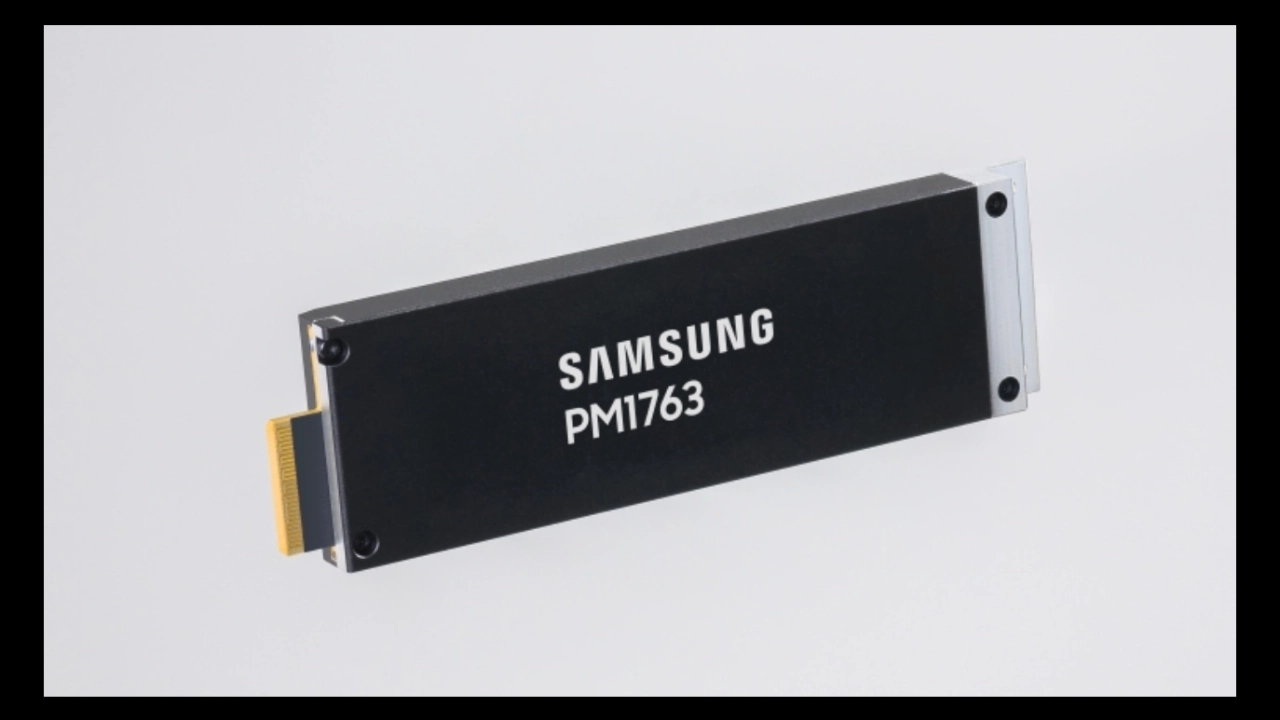

Samsung has now announced mass production of the Samsung PM1763 enterprise SSD, which they say is a noticeable step forward for AI infrastructure. Built around the PCIe 6.0 interface, the PM1763 is meant for the fast-growing storage needs of next-generation artificial intelligence, and yes, high-performance computing servers too.
As AI models keep growing in both size and complexity, enterprise storage becomes sort of the accelerator for data access and system efficiency overall. Samsung’s newest SSD tries to tackle this by pairing top-tier performance, better energy efficiency, and thermal management that’s more advanced than before.
Samsung PM1763: Built for AI and Hyperscale Data Centers
Unlike consumer SSDs, the PM1763 is aimed at enterprise deployments used for AI training, inference, and cloud workloads. Large language models and generative AI apps, they all need huge amounts of data moved between storage and compute resources.
Samsung says the new drive was engineered for exactly those conditions, so it can help cut down storage choke points and, in return, boost server responsiveness. The PM1763 kinda lines up with where the industry is heading, more toward next-generation AI accelerators and server platforms, you know where storage bandwidth suddenly matters a lot, for keeping the whole system running smooth and fast.
PCIe 6.0 Ups The Storage Bandwidth
One of the biggest upgrades is that Samsung is leaning into the PCIe 6.0 interface, which gives way more bandwidth than the PCIe 5.0 generation , so the difference should feel pretty noticeable in real use. Samsung says the PM1763 can hit up to 28.4GB/s for sequential reads and 21.9GB/s for sequential writes, so it should help AI models load faster and make it quicker to reach huge datasets. Also, the drive is expected to lower latency during AI training and inference, and when you’re shuffling large amounts of information around, efficiency really matters to keep the GPU busy.
Powered By 9th-generation V-NAND And A 4nm Controller
Samsung has packed the PM1763 with its latest ninth-generation V-NAND flash memory, along with a newly designed 4nm controller. The company says this refreshed design brings improved performance while also tightening up power efficiency. The controller is tuned to cope with heavy enterprise workloads, meaning data centers can work through larger AI models without a big jump in energy use. Samsung also mentions that the SSD includes upgraded security capabilities aimed at enterprise rollouts, where data protection is still a hard requirement.
Optimized For Liquid-cooled AI Servers
Since AI servers keep getting more powerful, thermal management is becoming a big headache for hyperscale data centers.
Samsung claims it optimized the PM1763 for liquid-cooled server layouts, so the SSD can keep steady performance during long-running workloads. The internal design supposedly helps energy efficiency too , with Samsung saying you can reach up to 1.8x better power efficiency compared with the prior generation. Lowering heat output, while still holding peak throughput, is expected to help operators cut operating expenses and pack more compute into modern AI data centers.

Final Thoughts
As AI workloads keep expanding across industries, the appetite for very fast enterprise storage will likely rise right with next-generation processors and accelerators. Samsung PM1763 feels like a solid step in the direction of those changing needs, bringing more throughput, better operational efficiency, and reliable enterprise-level dependability.
Now that PCIe 6.0 has shifted from prototype work into mass production, the PM1763 should turn into a core piece for the next wave of AI infrastructure. That wave will be used across hyperscale cloud platforms, advanced research environments, and high-performance computing use cases.

Comments are closed.