
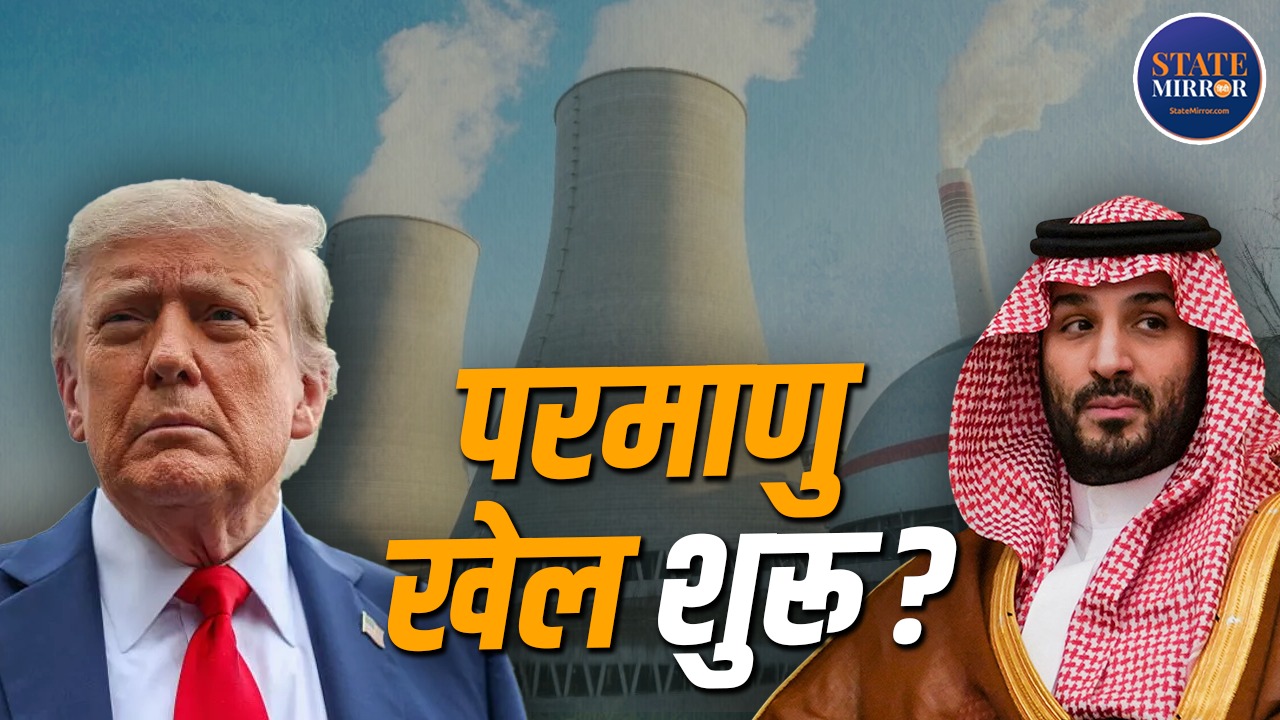
Can Saudi Arabia also make nuclear bomb? How much has Trump’s new nuclear deal changed the game? What will be its impact on the Middle East?

US President Donald Trump’s new nuclear policy and possible nuclear cooperation with Saudi Arabia have again brought the strategic politics of the Middle East into discussion. The question is arising whether Saudi Arabia can acquire the capability to make nuclear bombs in the future. Experts believe there is a huge technical and political gap between a civilian nuclear program and developing nuclear weapons, but if technology like uranium enrichment comes to Saudi Arabia, the regional balance of power could change. It can also have a direct impact on the security strategy of Iran, Israel and the Gulf countries, due to which there is a possibility of starting a new arms competition in the entire Middle East.
New agreement between America and Saudi Arabia civil nuclear deal Has started a new debate in global politics. Under this agreement, Saudi Arabia will get American cooperation in developing a peaceful nuclear energy program and the possibility of uranium enrichment under American supervision in the future has also been kept open. In such a situation, questions are being raised whether this can lead Saudi Arabia to move forward in the direction of making a nuclear bomb? Will this agreement further intensify the strategic competition between Iran and Saudi Arabia? Let us understand what are the important terms of this deal, how much is it related to nuclear weapons and what impact it can have on the security system of the Middle East.
Can Saudi Arabia make a nuclear bomb?
This agreement does not allow Saudi Arabia to make nuclear weapons. It creates a framework to develop nuclear energy only for peaceful purposes. However, concerns have increased regarding technology like uranium enrichment because the same technology can be used for power generation as well as nuclear weapons. The only difference is to what level the uranium is enriched and for what purpose it is used.
What is a civil nuclear deal?
Civilian nuclear agreement is an agreement between two countries through which nuclear energy is used only for peaceful purposes. Under this, nuclear power plants are established, fuel is supplied, reactor technology is shared, scientists are trained and international safety standards are ensured.
America makes such agreements under Section 123 of its Atomic Energy Act. For this reason they are also called “123 agreements”. America has already made such agreements with India, Japan, South Korea, UAE and many other countries.
Why is Saudi Arabia’s deal special?
The biggest feature of this agreement is that for the first time America has kept open the possibility of uranium enrichment for Saudi Arabia under American supervision. Till now, America has been trying to impose strict restrictions on sensitive activities like enrichment and reprocessing in such agreements with most countries.
The UAE had even given up the right to domestic uranium enrichment in exchange for American cooperation. But Saudi Arabia has been continuously saying that under the Nuclear Non-Proliferation Treaty (NPT), it should also get the right to develop a complete civilian nuclear fuel cycle like other countries.
What is uranium enrichment?
The amount of uranium-235 in natural uranium is only 0.7 percent. For nuclear reactors that generate electricity, it is increased to about 3 to 5 percent. In research reactors this level can reach about 20 percent. But to make nuclear weapons, uranium has to be enriched to about 90 percent. This is the reason why enrichment technology is counted among the most sensitive nuclear technologies in the world.
Can a nuclear bomb be made by having the capability of enrichment?
It’s not like that. Merely having an enrichment facility does not mean becoming a nuclear weapon. To make a nuclear bomb, a country has to produce weapon-grade uranium, develop weapon design, prepare explosive systems and develop missiles or other delivery systems. Apart from this, it is also not easy to get out of the monitoring of the International Atomic Energy Agency (IAEA). Any such step is immediately noticed at the global level.
Why does Saudi Arabia want nuclear energy?
Despite being among the world’s largest oil producers, Saudi Arabia is facing rapidly increasing electricity demand. Under ‘Vision 2030’, it wants to take its economy out of dependence on oil. Growing cities, industrial projects, projects like seawater desalination plants, data centers and artificial intelligence require large amounts of electricity.
Nuclear energy will increase domestic electricity production, which will enable more crude oil to be exported and increase government income. Besides, it is also considered an energy source with low carbon emissions.
Why are questions being raised on the timing of the agreement?
This agreement has been reached at a time when tension between America and Iran regarding the nuclear program is at its peak. America has long been calling Iran’s nuclear program a security threat. In such an environment, increasing nuclear cooperation with Saudi Arabia seems contradictory to many experts.
However, supporters argue that if Saudi Arabia’s nuclear program remains under US supervision, it will be less likely to move towards countries like China or Russia and better control can be maintained over nuclear activities.
How different is this from India’s nuclear deal?
The historic civil nuclear agreement between India and America in 2008 was signed under completely different circumstances. India was already a nuclear weapon state and has not signed the NPT. Under that agreement, India’s military and civilian nuclear facilities were separated.
In contrast, Saudi Arabia is a member of the NPT and does not have nuclear weapons. Therefore, its entire civil nuclear program is expected to remain within the scope of international safety standards and IAEA inspection.
What does the agreement have to do with Iran?
This nuclear deal between America and Saudi Arabia has happened at a time when the concern of Western countries and America about Iran’s nuclear program is at its peak. America believes that Iran has come close to the ability to make nuclear weapons, so it has maintained strict sanctions and military pressure on its nuclear program. On the other hand, Saudi Arabia is Iran’s biggest regional rival. In such a situation, America wants to develop Saudi’s civilian nuclear program under its control and monitoring, so that Riyadh does not take help from China or Russia. However, critics believe that this could intensify nuclear competition between Iran and Saudi Arabia in the Middle East.
Will nuclear proliferation get a boost in the Middle East?
The new nuclear deal between Saudi Arabia and America has sparked a new debate regarding nuclear proliferation in the Middle East. Experts believe that if Saudi Arabia gets permission for uranium enrichment even under US supervision, then other countries in the region including Iran may also try to expand their nuclear capabilities. This threatens to increase strategic competition in the region. However, the US argues that the risk of nuclear proliferation can be reduced by keeping Saudi’s nuclear program under its control and within the IAEA’s security standards. Therefore, on the one hand, this deal is a medium for energy cooperation, and on the other hand, it can also have a far-reaching impact on the strategic politics of the Middle East.
Will there be a litmus test in the US Congress?
Now this agreement will have to go through the review of the US Congress. There is a possibility of serious debate there regarding nuclear proliferation. However, to stop this, Congress will have to garner enough support to override the President’s veto, which is not considered easy.
At present, this agreement does not make Saudi Arabia a nuclear weapons state. But this is definitely a big change in American nuclear policy. It will be important to see in the coming years whether this model succeeds in preventing nuclear proliferation or gives new impetus to nuclear competition in the Middle East.

Comments are closed.