
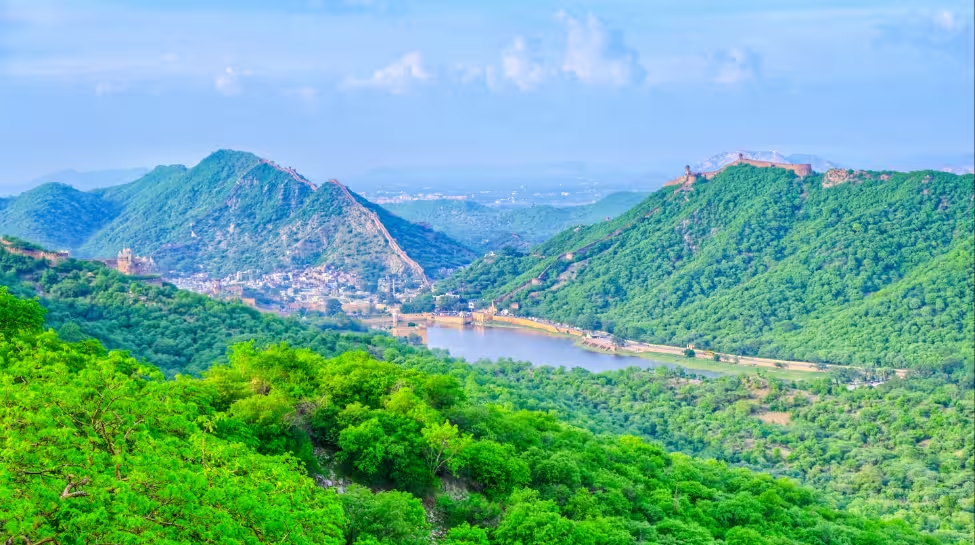
SC Puts On Hold Its Earlier Order On Aravalli Definition, Next Hearing On January 21, 2026 | India News

The Supreme Court on Monday put in obedience its earlier order of November 20 accepting the Central Environment Ministry’s definition of the Aravalli Hills and the Aravalli Range, a move that had raised concerns over large parts of the region being opened up to regulated mining activities.
A bench led by Chief Justice of India (CJI) Surya Kant ordered the constitution of a fresh expert committee to re-examine the issues relating to the definition of the Aravallis and their environmental implications.
The top court also issued notice to the Center and the four Aravalli states, Rajasthan, Gujarat, Delhi, and Haryana, seeking their responses in the suo motu proceedings initiated on the matter.
Add Zee News as a Preferred Source
The court’s decision to revisit the definition comes amid apprehensions that the earlier acceptance could weaken environmental safeguards in the ecologically sensitive Aravalli region.
The hearing comes against the backdrop of a recent directive issued by the Union Ministry of Environment, Forest and Climate Change (MoEF&CC), which has ordered state governments to impose a “complete ban” on granting any new mining leases across the Aravalli landscape. The ban applies uniformly from Delhi to Gujarat and is aimed at curbing illegal mining and preserving the mountain range as a “continuous geological ridge”.
Emphasizing the ecological importance of the region, the Ministry said the move was intended to halt unregulated mining activities that threaten the integrity of the Aravallis. It has also asked the Indian Council of Forestry Research and Education (ICFRE) to identify additional areas across the entire range where mining should be prohibited, beyond those already restricted by the Centre.
Meanwhile, the issue has sparked political debate. Congress leader and former Environment Minister Jairam Ramesh has written to Union Minister for Environment, Forests and Climate Change Bhupender Yadav, expressing serious reservations about a recent redefinition of the Aravalli Hills.
Ramesh has alleged that the new definition limits the Aravallis to landforms with an elevation of 100 meters or more, a move he claims could exclude large portions of the range from protection. Sharing his letter on the social media platform
In the letter dated December 28, Ramesh said there were “understandably widespread concerns with the re-definition of the Aravalli Hills that restrict them to landforms having an elevation of 100 meters or more.” He added: “In this connection, please permit me to raise four specific questions for your consideration.”
The Supreme Court’s intervention is expected to bring clarity on the definition of the Aravalli Hills and could have far-reaching implications for environmental governance, mining regulation, and conservation policy across several states.
(With IANS inputs)

Comments are closed.