
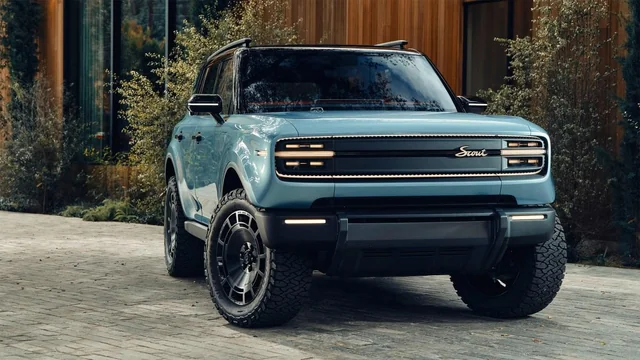

Volkswagen Group’s ambitious revival of Scout is hitting another speed bump. The launch of Scout Motors in the United States has reportedly been delayed by at least a year, with production now unlikely to begin before 2028. The update comes via Germany’s The mirrorwhich cites a mix of technical hurdles and financial commitments as the key reasons behind the pause.
Scout Motors has not officially confirmed a new timeline. In a statement to The Drivea company spokesperson said there are currently no announcements regarding product or timing updates.
From Electric Revival to Range-Extended Reality
Scout was initially positioned as a bold, all-electric reboot of the classic International Harvester Scout SUVs that were produced from the early 1960s through 1980. That promise has steadily softened.
As political and economic conditions shifted in the U.S., Scout reportedly walked back its pure-EV strategy. Current expectations suggest most Scout trucks and SUVs will instead launch as range-extended electric vehicles, using onboard gasoline generators to supplement electric drivetrains.
This pivot reflects a broader recalibration happening across the auto industry, as automakers reassess EV demand, infrastructure readiness, and profitability.
Policy Changes Undercut the Original Business Case
A major factor behind Scout’s U.S. manufacturing strategy was the Inflation Reduction Act of 2022, which offered incentives for domestic EV production. That advantage disappeared when Congress repealed the legislation in 2025.
Without the IRA’s protections and subsidies, the financial logic for accelerating Scout’s production weakened considerably. For a startup-style brand still in its investment-heavy phase, the loss of policy support appears to have forced Volkswagen to slow its rollout and rethink its product mix.
A Startup Within a Giant Automaker
Scout Motors operates with unusual autonomy for a Volkswagen subsidiary. Volkswagen Group has treated Scout as an independent brand, giving it latitude more commonly associated with startups than legacy automakers.
This is also Volkswagen’s third major attempt to establish a manufacturing foothold in the U.S. The company’s earlier Westmoreland, Pennsylvania plant lasted just a decade, while its Chattanooga, Tennessee, facility has become a long-term success producing mainstream VW models.
South Carolina Plant Waits for Production
Scout broke ground on its Blythewood, South Carolina, factory in early 2024, with most construction completed by 2025. The plant was originally expected to start building vehicles by 2027.
Now, with production likely pushed to 2028, the facility stands ready but idle, underscoring the uncertainty surrounding Scout’s future lineup and timing.
For Volkswagen, the delay buys time to adapt to market realities. For Scout, it raises a tougher question: whether a brand born from nostalgia can find its footing in an industry still struggling to define its electric future.

Comments are closed.