
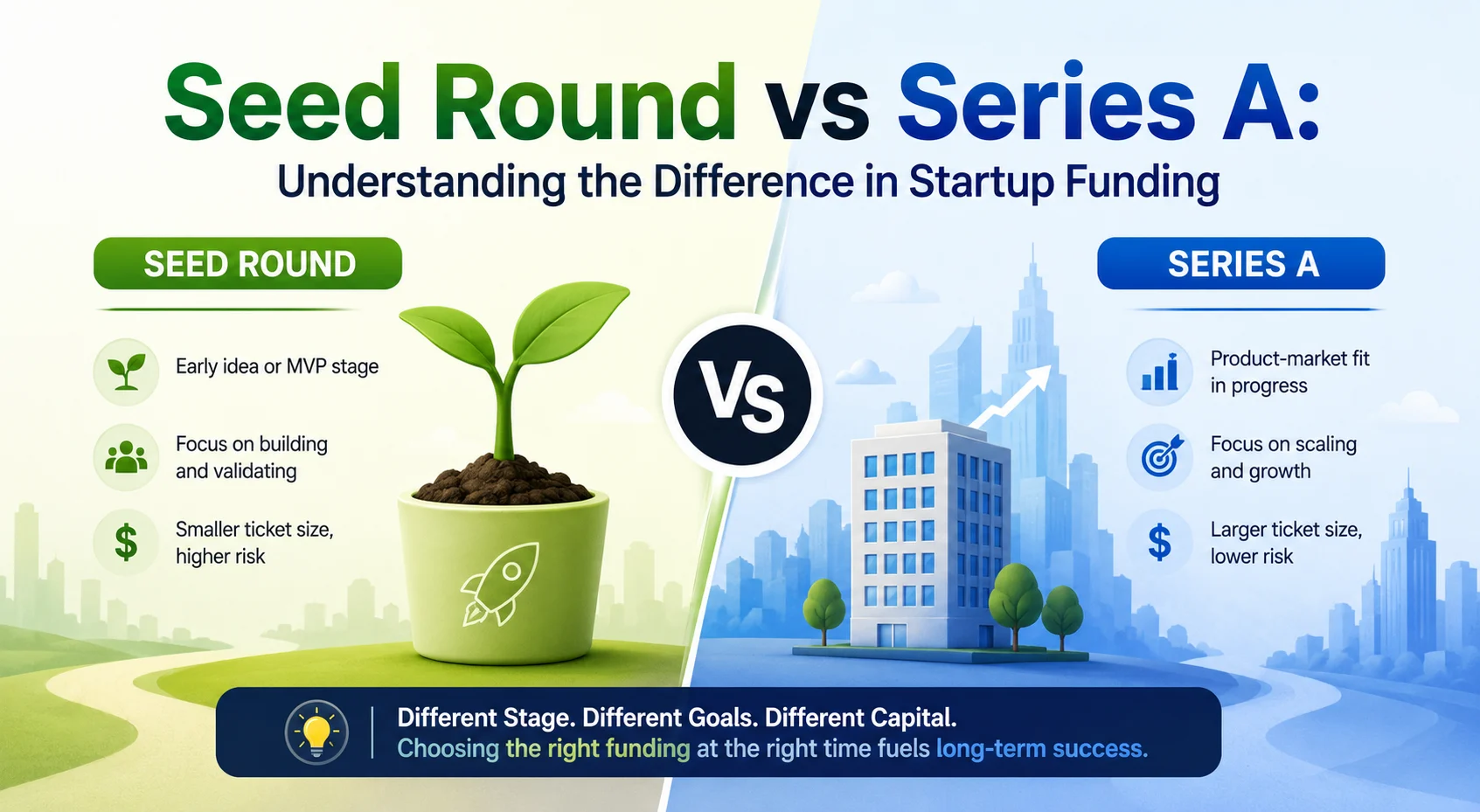

In the sphere of startups, fundraising processes are divided into particular stages, and two of those are the seed round vs Series A, which are the key stages for any startup.
The terms may seem technical for those who are not familiar with the topic, but in general, each round corresponds to a certain stage of the company’s development. Seed round allows a startup to start its business, and a Series A round allows it to grow into a more scalable company.
The difference between these two stages is really important to understand because this is the way to determine the level of readiness of the company for fundraising.
The company that goes into the seed stage tries to prove its value in the market, whereas the one that raises funds at the Series A stage is operating and is going to develop further. This means that the seed round is used for validation and Series A for acceleration.
What Is a Seed Round?
A seed round is normally the first round of external financing that a startup receives. It is referred to as ‘seed’ financing due to the fact that it serves as the basis for further growth. The firm at this stage may only have an idea, a prototype, or even an initial product version. The aim of receiving the seed capital at this stage is to test the hypothesis, build the product, and ensure that there is enough proof to show that the customers really need it.
The common applications for seed capital include developing the product, making early hires, customer research, market testing, and creating the minimum viable product. Investors at this stage take huge risks as the business is new. They are normally betting on the founders, the problem to solve, and the scope of the opportunity rather than revenues.
Commonly seen investors are angel investors, seed venture capitalists, accelerators, incubators, and sometimes even friends and family members. The investors at this stage know that the startup is still experimenting with the business model, price points, product, or even the target audience.
What Is Series A?
Series A is the next significant step after seed funding. By the time a company reaches this stage, it should have more than just an idea. It should have a functioning product, early traction, and some evidence that customers are willing to use or pay for it. The main goal of Series A is to help a startup scale what is already working.
At this stage, investors want to see product-market fit, revenue growth, customer retention, and an expandable business model. The company is no longer asking, “Can this idea work?” Instead, it is asking, “How do we grow this into a much larger business?”
Series A capital is usually used for sales expansion, marketing, hiring, product improvement, and operational scaling. Compared with the seed stage, expectations are much higher. Investors want a clearer path to growth, stronger numbers, and a more organised company structure.
| Feature | Seed Round | Series A |
| Primary Goal | Prove the concept and build a working product (MVP) | Scale a proven business model, grow sales, and expand the team |
| Company Stage | Ideation phase, pre-revenue, or minimal early traction | Established product-market fit, generating consistent revenue |
| Typical Investment | $500k – $3M | $5M – $20M |
| Company Valuation | $3M – $10M | $10M – $50M+ |
| Investor Types | Angel investors, seed-stage VCs, accelerators | Traditional institutional Venture Capital (VC) firms |
| Equity Given Away | 10% – 25% | 20% – 35% |
A comparison of both financing methods is shown in the table below. Seed financing rounds have the objective of enabling the company to survive so that it can validate the concept. Series A financing rounds are meant to transform the validated concept into a business that will grow fast.
Seed Round vs Series A: Main Differences
The first and perhaps the most important distinction between a seed round and a Series A is related to the level of maturity of the companies seeking funding. A seed-stage firm is still validating its product-market fit. A Series A business should already have proof of concept that the venture works and needs expansion.
The second significant distinction is the mindset of the investors. Seed investors tend to care about the team, vision, and market opportunity. On the contrary, Series A investors are interested in traction, revenue, and scalability. Thus, it is necessary for the entrepreneurs to have more data and a better strategy for the Series A funding round.
Thirdly, the risk level differs from one financing stage to another. The seed funding stage involves high risks since the firm is at the initial stage of development. Series A is not free from risks, but by this time, the business has already overcome the main uncertainty, which is customer validation.
What Startups Need to Show when comparing Seed Round vs Series?
To raise a seed round, a startup usually needs a strong idea, a capable founding team, and some early proof that the concept has promise. A prototype or MVP is often enough if the opportunity is compelling. The main objective is to convince investors that the company deserves a chance to build and test.
To raise Series A, the startup needs stronger evidence. This can include real users, recurring revenue, customer growth, retention data, and a clear scaling strategy. A polished pitch matters, but the business must already show that it can grow beyond the earliest stage.
This is why founders often use the seed stage to learn as much as possible about their users, pricing, product, and market. By the time they are ready for Series A, they need data, not just ambition.
Why Do These Rounds Matter?
Seed and Series A financings are crucial because they involve two different types of financing. The seed financing funds new startups, whereas Series A funding enables established companies to evolve into successful ones.
The two financing stages are equally important for investors in that they enable them to minimize risks by not investing in a business all at once but progressively as the business evolves. This is how venture capital works.
It is vital for entrepreneurs to know the difference between seed and Series A financings, in that they determine the type of funding their business will need depending on where they are in their development stage.
Final Thoughts
Seed and Series A stages are equally important in a startup’s path to maturity, but they have distinct roles to play. The former refers to validating the concept and launching the initial product, whereas the latter entails scaling the startup with traction.
In short, Seed is for getting the startup up and running, while Series A is for growing it further. Entrepreneurs with an understanding of the difference between these two would be able to raise funds and communicate with investors much more effectively.

Comments are closed.