
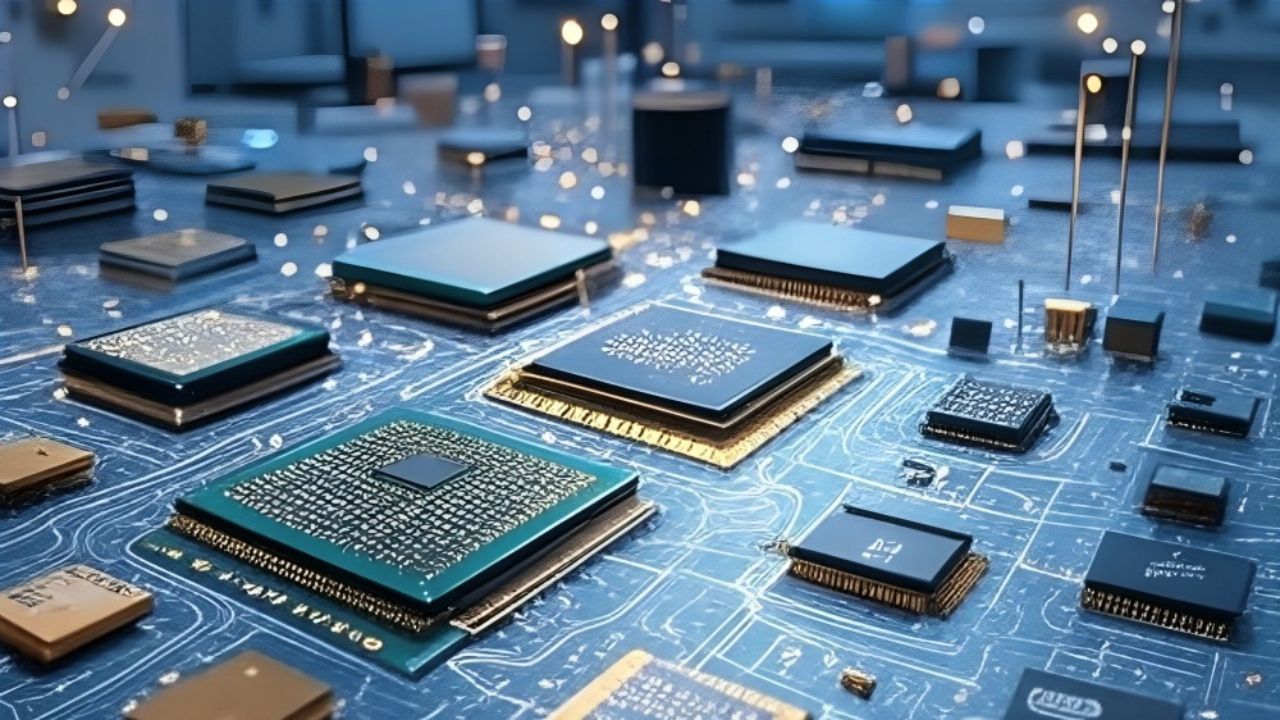

Semiconductors play an important role in the device using which you are reading this news, or the computer through which this news is written. It can be called the ‘soul’ or ‘heart’ of every electronic device. If this is not the case in the digital world, you will neither be able to listen to songs in your car, nor will you be able to start the car. Neither your phone will work, nor your home’s charging system will work. The world has become a slave to semiconductor microchips. Prime Minister Narendra Modi has announced from the ramparts of the Red Fort that by the end of the year, Made in India microchips or semiconductors will start being manufactured in India.
It was some 3 to 4 years ago. The world was struggling with the impact of Covid, the production of semiconductors had come to a standstill, more than half of the world’s industries were in disarray. From car manufacturing companies to mobile phone manufacturing companies, there was a loss of billions of dollars. There was an outcry in countries like China, America, North Korea and Taiwan, where most of such chips are made. Even the production of cars was affected. The wait for cars for people in India had become a little longer.
If you don’t believe it, then consider the news of the past, when the production of silicon chips had stopped. The production of vehicles stops, there is a shortage of medical instruments, manufacturing of everything from toys to mobile phones decreases. Let us know why the government of the country is trying its best to make it, what did PM Modi say, where does India stand in the manufacturing of semi conductors, how important is this device for the country?
Also read: 78 years of partition and independence, how rich did India and Pakistan become?
What did Prime Minister Narendra Modi say on semiconductor?
On the basis of self-reliance, the army continued to do its work without any pause. We aimed for self-reliance in defence, its results are beginning to be seen. The 21st century is technology driven. The countries that mastered technology rose to the top. When we talk about the dimensions of technology. I am not criticizing any government here. The idea of semi-conductor started in the country 50-60 years ago. Today, when semiconductors have become a power in the world, those files got stuck 50-60 years ago. The idea of semiconductor was aborted. Many countries are ruling by mastering semiconductors. Today we are free from that burden and have taken forward the work of semiconductor. Made in India chips will arrive in India by the end of this year.
Why are semiconductors important?
Semiconductor needs are increasing in India. Semiconductors are used in our phones, computers, TVs, satellites and even defense systems. These chips, which can fit between fingers, are the foundation of the digital world. These chips are made up of millions of micro chips, these are transistors, which control electrical signals. They store, process and transfer data. The work that neurons do for the brain is the same work that semiconductors do for any device.
Also read:the biggesteconomyHow did she become so indebted?US but increasing debtStory
How big is the semiconductor market in India?
The world is going digital. India imports semiconductors. Palladium is a very important metal for making semiconductors, whose reserves are with Russia. Prime Minister Narendra Modi himself has reiterated that by the year 2026, semiconductors worth $80 billion will be consumed in India. By 2030 this figure will reach 110 billion dollars.
It is obvious that a large part of the country’s income will be spent on imports. That is why India wants to invite big companies of the world to make semiconductors. When Indian engineers are making chips for companies like Intel, TMMC and Micron, then why not make these chips in India itself. These chips are made in countries like America, Korea and Taiwan.
What is India’s preparation for self-reliance in semi-conductors?
The Union Cabinet chaired by Prime Minister Narendra Modi on August 12 approved four new semiconductor projects under the Engineer Semiconductor Mission (ISM). These projects are of Sixem, Continental Device India (CDIL), 3D Glass Solutions and Advanced System in Package (ASIP) Technologies. These will entail an investment of about Rs 4,600 crore and create 2,034 jobs. So far, 10 projects have been approved, in which an investment of Rs 1.60 lakh crore will be made in 6 states.
Sixem and 3D Glass will set up units in Odisha, CDIL in Punjab and ASIP in Andhra Pradesh. Sixem will build the country’s first silicon carbide based compound semiconductor plant, which will have a capacity of 60,000 wafers and 96 million units. It will make products for missiles, electric vehicles and solar inverters.
3D Glass will bring the world’s most advanced packaging technology. ASIP will manufacture mobile and automobile products with a capacity of 9.6 crore units. CDIL will expand its unit in Punjab. These projects will help in making India self-reliant.
Read also: How much is he earning by imposing tariffs on the world?TrumpOf America?
Why is it important to be self-reliant in the semiconductor industry?
- The backbone of devices in the health sector, communication, defense and space sectors.
- Essential for the growing needs of smart devices, AI, and cloud computing
- More than 60% of the world’s semiconductor production takes place in Taiwan.
- There is always a risk of risk in the supply chain
- China interferes in Taiwan’s trade, chip supply continues to be disrupted
How big is the semiconductor market in India?
- Year 2023: 23 billion dollars
- Year 2024-25: 45 to 50 billion dollars
- Year 2030: Expected to be 100 to 110 billion dollars

What can India do for self-reliance in semiconductors
- India can make some parts of semiconductor equipment
- Use of chemical, mineral and gas construction resources
- There are countless job opportunities in AI, Big Data, Cloud Computing and Internet
What is India’s Semiconductor Mission (ISM)?
India Semiconductor Mission was launched in the country in December 2021 with a budget of ₹76,000 crore. Its objective was to establish a chip manufacturing plant in the country. The need for packaging and testing units in the country was increasing rapidly, hence the aim was set to work towards startups and chip designing in the country itself. Young engineers were given training. The world was encouraged to invest in India.
4 different schemes have also been launched for ISM
- Semiconductor Fabs Scheme: 50% financial assistance scheme for chip manufacturing
- Display Fabs Scheme: Financial scheme for AMOLED and LCD displays
- Compound Semiconductors and ATMP/OSAT Scheme: Financial assistance in the field of packaging and testing
- Design Linked Incentive (DLI) Scheme: With ₹1000 crore to help startups with research-development and design tools
Where are the semi conductor projects in India?
- Micron Technology
Start: June 2023, Sanand, Gujarat
Investment: ₹22,516 crore
Facility: Assembling, Testing, Marking, Packaging
- Tata Electronics
Start: February 2024, Dholera, Gujarat
Investment: ₹91,000 crore
Facility: Powerchip Semiconductor Manufacturing Corporation - CG Power + Renesas
Start: February 2024, Sanand, Gujarat
Investment: ₹7,600 crore
Facility: 15 million chips/day (proposed) - Tata Semiconductor Assembly and Test
Start: February 2024, Morigaon, Assam
Investment: ₹27,000 crore
Facility: 48 million chips/day. (Proposed) - Keynes Semicon
Start: September 2024, Sanand, Gujarat
Investment: ₹3,307 crore
Facility: 6.33 million chips/day (proposed) - HCL-Foxconn JV
Start: May 2025, Jewar, Uttar Pradesh
Investment: ₹3,700 crore
Facility: 15 million chips/day (proposed)
(Source: PIB)
What is Semicon India?
The objective of Semicon India Project is to develop India as the semiconductor hub of the world. It will be organized in Bengaluru in 2022, Gandhi Nagar in 2023, Greater Noida in 2024 and New Delhi between 2 to 4 September. More than 300 companies from 18 countries will be invited. The event will be organized with the partnership of Japan, South Korea, Singapore and Malaysia. Discussions will be held with more than 8 countries. Training will be provided to meet the need of 10 lakh skilled employees by 2030.
Achievements that India achieved
- India’s first indigenous semiconductor chip will be ready for production in 2025
- Startup gets investment of ₹107 crore under government chip design scheme
- IT campus of Madhya Pradesh is getting ready, 1 lakh square feet plant will be ready with an investment of Rs 150 crore.
- Equipment like drones, robots and computers will be made
- India is reducing dependence on imports
- India is emphasizing on research with the help of iCET and SEMI
- Lakhs of job opportunities are being created due to new semi-conductor plants and training centers.
Where does India stand in comparison to the world?
- High earning countries in the year 2025
- Taiwan: $349 billion
- China: $206.70 billion
- America: 123.82 billion dollars
- South Korea: $86.13 billion
- Japan: $22.27 billion
(Data: Taken from Statica and Economic Times)
India is currently an emerging player in the field of semiconductor. Will take the first step towards becoming self-reliant by 2025.

Comments are closed.