
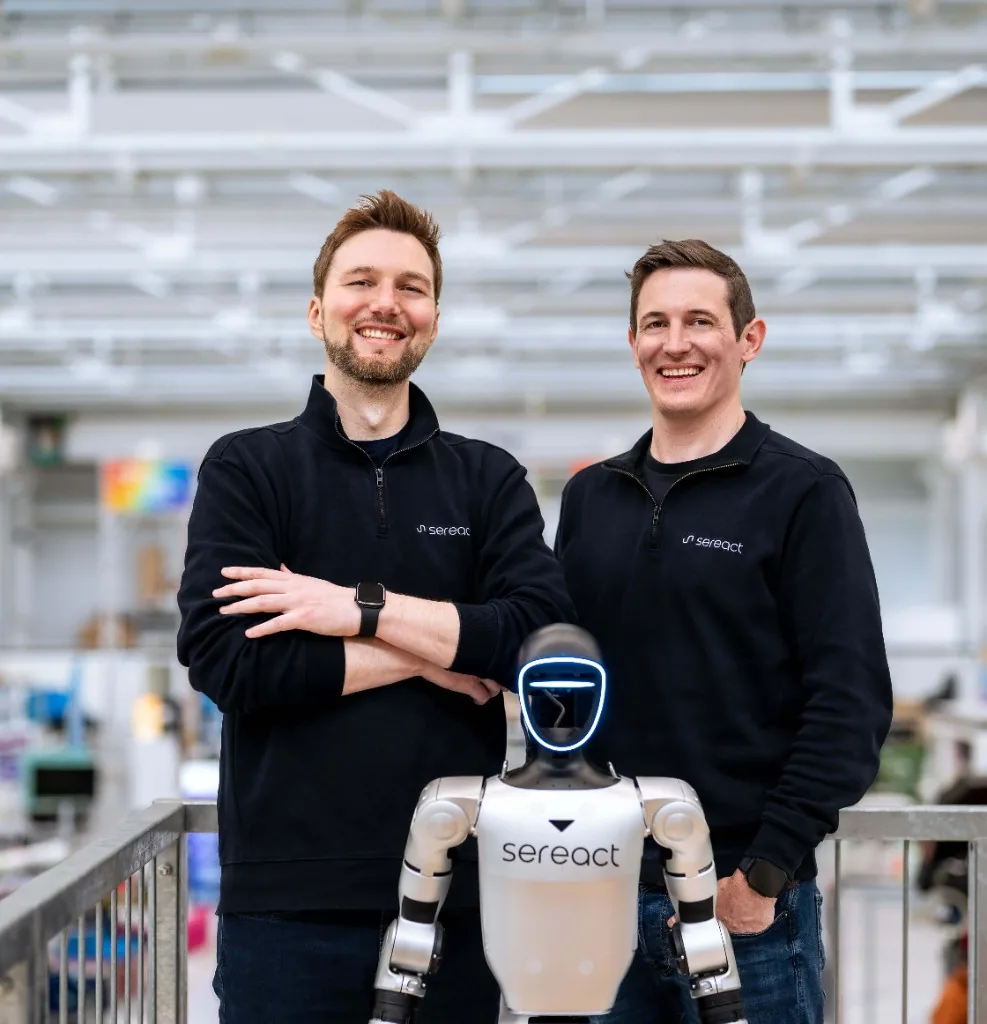

Sereact has raised $110 million in a Series B round led by Headline, with support from Bullhound Capital, Daphni, and Felix Capital. Existing investors Air Street Capital, Creandum, and Point Nine also joined again. The funding will help the company scale its core AI system, Cortex 2.0, and expand into the United States, starting with a new office in Boston.
Sereact builds AI software for robots that work in real environments. Its focus is simple: improve how machines handle physical tasks. The company already has more than 200 systems running across Europe. These systems have completed over one billion real-world picks in warehouses and production sites. Only one in about 53,000 picks needs human help.
That number matters. It shows how close the system is to working on its own in complex settings.
Cortex 2.0: From Reactive Motion to Predictive Planning
At the center of this progress is Cortex. The current version sees objects and reacts. Cortex 2.0 takes a different approach. It plans before it moves.
Instead of trying one action and adjusting after failure, Cortex 2.0 simulates several possible outcomes first. It uses a model of physics and object behavior to test each option. Then it selects the best path based on stability, risk, and efficiency. As the scene changes, it updates its plan in real time.
This shift from reaction to planning opens up new use cases. Tasks that require precision, like placing fragile items or assembling parts under tension, need foresight. A small mistake can cause damage or delay. Cortex 2.0 reduces that risk by ruling out bad moves before they happen.
The system works in what Sereact calls “visual latent space.” In simple terms, it learns from images and patterns rather than fixed commands tied to one robot. This makes the model flexible. The same system can run on single-arm robots, dual-arm setups, or even humanoid machines.
Sereact also adjusts how much planning the system does. For tasks where mistakes cost more, the robot spends more time evaluating options. For simpler tasks, it moves faster. This balance helps keep performance high without slowing down operations.
A key advantage for Sereact is its data loop. Every robot in use feeds data back into the system. Each pick success or failure gets recorded with details like sensor input, robot movement, and outcome. The company filters and uses this data to retrain the model.
Sereact Builds Real-World Robotics Edge with Data Flywheel, Expands to U.S. and Beyond
Once updated, the model goes through automated checks and then rolls out across all systems. This creates a continuous cycle: deploy, learn, improve, and redeploy.
Over time, this loop builds a strong edge. Many competitors rely on simulated data or controlled lab settings. Sereact trains on real operations busy shifts, varied items, and unpredictable conditions. This helps the system handle the “long tail” of rare or messy cases that often cause failures.
Warehouses were the starting point for a reason. They offer scale, variety, and clear performance goals. Every day brings new objects, shapes, and constraints. This makes them ideal for training AI systems that need to generalize.
Sereact now plans to take this learning into new markets, including manufacturing and more complex assembly work. The move into the U.S. is part of that plan, with local hiring already underway in Boston.
The company’s leadership believes its approach sets it apart.
“We bet early that you can’t build real robotics AI in a lab,” said CEO and co-founder Dr. Ralf Gulde. “You build it with a data flywheel fed by real deployments. The numbers show it worked.”
CTO and co-founder Marc Tuscher added, “We give the robot a way to anticipate how the world will respond before it moves. We ship one thing: the model that runs on any robot.”
Sereact was founded in 2021 and is based in Stuttgart. Its customers include major logistics and manufacturing firms across Europe. With this new funding, the company will focus on scaling its model, expanding its footprint, and pushing deeper into tasks where precision and reliability matter most.
The broader goal is clear: build AI that works not just in theory, but in the real world—where every action has consequences, and every improvement counts.

Comments are closed.