
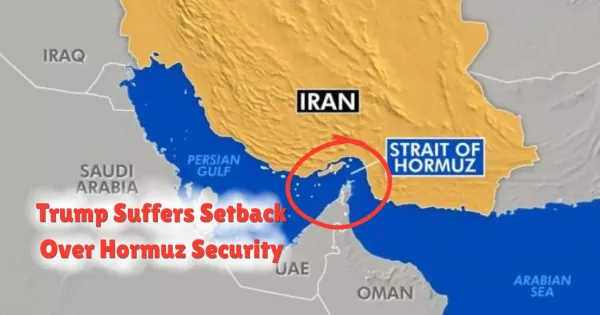
Shock to Trump regarding Hormuz security: Japan-Australia’s denial, Britain’s statement ‘considering options’

Washington. Amid fears of closure of the Strait of Hormuz, US President Donald Trump has said that China, France, Japan, South Korea, Britain and other countries should send warships to protect this important sea route. He warned that the future could be “very bad” for NATO if allies do not help. According to media reports, till now Australia and Japan have clarified that they are not planning to send their ships at present. Britain has said it is considering options, while China has called for an immediate end to the conflict.
Meanwhile, Iran’s Foreign Minister has said that Tehran is ready for discussions with countries that want to discuss the safe use of the strait. There have been no new incidents in the past three days, but the threat across the strait still remains “severe”, according to Britain’s maritime agency. At least 20 ships have been attacked in the Persian Gulf, the Strait of Hormuz and the Gulf of Oman since the war began.
China’s role is important
According to reports, the closure of this major sea route by Iran has affected almost one-fifth of the world’s oil supply, leading to a sharp rise in oil prices in the global market and increasing fears of an energy crisis. Meanwhile, Trump has said that China’s role on this issue is also important. He indicated he wanted to know whether China would cooperate in reopening the strait ahead of a planned meeting with Chinese President Xi Jinping at the end of the month. On the other hand, Japanese Prime Minister Sanae Takaichi said that Japan has not yet taken any decision to send naval ships and the country is considering possible options within its legal framework. Australia has also clarified that it has not taken any decision to send ships in this mission.
Confusion reigns between Japan-Australia government
Japan and Australia, two key US allies, indicated on Monday that they may not be ready to deploy their naval ships to patrol the disputed Strait of Hormuz. This indication has come when US President Donald Trump said that America is in talks with seven oil-dependent countries of the Gulf region and these talks are being held to help in the security of ships in this narrow but strategic sea route.
Speaking to reporters aboard ‘Air Force One’, Trump said on Sunday that several governments have been contacted for help in protecting commercial ships passing through this narrow waterway. However, he did not reveal the names of those countries. Earlier on Saturday, he had said in a social media post that he hoped that China, Japan, South Korea, Britain and other countries which are affected by this artificial barrier will send their ships to patrol this important strait.
Trump said, “I am appealing to these countries to come forward and protect their territory, because it is their territory.” He said that they should cooperate among themselves, because they get energy from this area. The US President said he expected many of the countries contacted to deploy naval vessels to facilitate the safe passage of ships through the strait. This strait is an important sea route, through which about 20 percent of the world’s oil supply passes.
While talking about ‘Operation Epic Fury’, Trump indicated that talks with Iran still remain uncertain. “They’re very much eager to talk, as they should be, but I don’t think they’re prepared to do what they need to do,” he said. “We will get this job done,” he said. It is noteworthy that the war between America and Israel and Iran, which started in late February, has escalated considerably. The conflict has disrupted tanker movements and created instability in global energy markets.
japan stand
Iran has resorted to using drones, landmines etc. to intercept oil shipments via this route. Japanese Prime Minister Sanae Takaichi said on Monday that Japan has not taken any decision to send naval ships to protect ships in West Asia amid rising tensions in the region. In parliament he said the government was still examining what actions could be taken within Japan’s legal framework and what actions it could take independently.
“We have not yet made any decision about sending a security ship. We are constantly examining what Japan can do independently and what can be done within legal limits,” he said.
The Japanese Prime Minister said that the US has not made any formal request to Japan for help in protecting ships in this area. Japan is heavily dependent on energy imports from Western Asia. About 70 percent of its imported energy resources come from this region. For this reason, maintaining stability in the sea lanes there is extremely important for the country’s energy security.
australia’s stand
Meanwhile, Australia, another important ally of America in the Indo-Pacific region, has indicated that its role in this region will remain limited. In a radio interview, Infrastructure and Transport Minister Catherine King said the country is planning to deploy a military aircraft to the UAE to help with defence-related activities.
However, he made it clear that Australia will not send naval ships to the Strait of Hormuz. According to him, Australia has not received any request to send ships and is not involved in the operation to restore maritime traffic through the strait. He further said that the government currently has no plans to send naval forces to the area.
Earlier, Australia’s Department of Foreign Affairs and Trade had already issued travel advisories for several countries in the region through its ‘SmartTraveller’ platform. The department expanded its advice on Saturday, urging Australians to avoid transiting through those countries, including simply stopping inside an airport terminal without entering the country.

Comments are closed.