
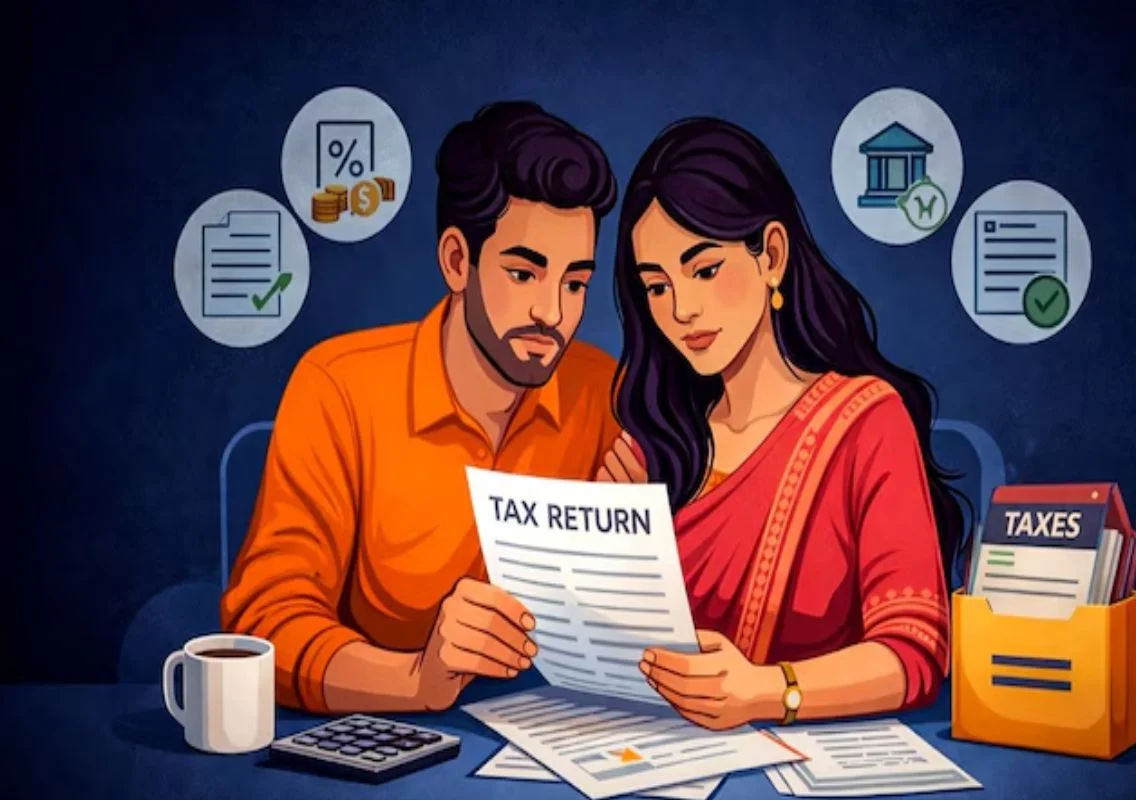

New Delhi: A proposal to introduce joint tax filing for married couples in India has sparked debate, raising an important question — should spouses be allowed to file taxes together instead of individually?
The idea, recently suggested by Raghav Chadha, aims to address disparities in tax burden between households with similar total incomes but different earning structures. While it appears promising, experts say the concept comes with both benefits and challenges.
The gap in the current system
India currently follows an individual-based taxation system, where each person files their income tax return separately, regardless of marital status.
On paper, this ensures fairness. However, in practice, it can lead to unequal outcomes.
For instance, consider two households earning ₹24 lakh annually:
- In one family, both spouses earn ₹12 lakh each
- In another, one spouse earns the entire ₹24 lakh while the other has no income
Despite having identical total income, the single-income household may end up paying around ₹3 lakh more in taxes due to underutilisation of lower tax slabs and exemptions.
According to tax experts like Gaurav Makhijani, optional joint filing could allow such families to pool income and better utilise progressive tax slabs, reducing overall tax liability.
Can joint filing reduce tax burden?
Taxation principles suggest that pooling income could improve efficiency in progressive systems.
Experts believe joint filing could:
- Lower effective tax rates for single-income families
- Improve utilisation of deductions and rebates
- Reduce financial pressure on the higher-earning spouse
Suresh Surana notes that such a system may especially benefit households where one partner has taken a career break or earns significantly less.
However, actual savings would depend on how tax slabs, exemptions, and deductions are structured under a joint system.
Challenges and complexities
While the concept appears attractive, it is not without complications.
Key concerns include:
- Increased complexity: Combining incomes, deductions, and credits into a single return may make filing more complicated
- Higher compliance effort: Couples with multiple income sources may need detailed reconciliation
- Shared accountability: Errors or discrepancies could impact both spouses
Experts warn that what seems like a simplification at first glance could actually increase compliance burden for many households.
Risk of misuse
Any tax benefit system carries the risk of misuse, and joint filing is no exception.
There are concerns that:
- Individuals may enter non-genuine arrangements to reduce tax
- Separated couples may continue joint filing to gain benefits
- Income shifting could be used to exploit lower tax slabs
To prevent this, strong safeguards and clear eligibility criteria would be essential.
Impact on tax administration
From the government’s perspective, joint filing could streamline assessments by reducing the number of returns.
However, it could also introduce complexities:
- Determining responsibility in case of discrepancies
- Handling disputes between spouses
- Increased scrutiny in high-value cases
Experts believe tax authorities may need more robust systems to manage such a transition effectively.
Is India ready for joint filing?
Countries like the United States and Germany already allow married couples to file jointly. However, India’s tax system has always been individual-centric.
Introducing joint filing would require:
- Changes in tax laws
- Updates to return filing systems
- Alignment of TDS credits and reporting structures
Such a shift would be significant and would need careful planning before implementation.
Conclusion
The idea of joint tax filing for married couples in India has merit, particularly for households with uneven incomes. It could make taxation more equitable and reduce financial strain for many families.
However, it is not a simple reform. The potential benefits must be weighed against increased complexity, risk of misuse, and administrative challenges.
For now, it remains a proposal — one that has sparked meaningful discussion but will require detailed evaluation before becoming a reality.

Comments are closed.