

The Ministry of Social and Family Development confirmed on March 26 that shared parental leave will expand from six to 10 weeks for parents of children born on or after April 1, 2026.
Combined with 16 weeks of maternity leave and four weeks of paternity leave, eligible couples can now take more than seven months of paid time off in their child’s first year, The Straits Times reported.
All 10 shared weeks are funded by the government, capped at SGD2,500 (US$1,879) per week, according to the Ministry of Manpower. The expansion was first announced by Prime Minister Lawrence Wong at the 2024 National Day Rally and rolled out in two phases to give employers time to adjust.
To qualify, the child must be a Singapore citizen or become one within 12 months of birth, and each parent must have worked continuously for their employer for at least three months.
The leave will be split equally by default, with each parent receiving five weeks. Parents can reallocate their share through the LifeSG app within four weeks of the child’s birth if one needs more time, MSF said. The shared leave must be taken within 12 months and only after maternity or paternity leave has been used.
If parents cannot agree on arrangements, they may take the leave in a continuous block within the first 26 weeks of the child’s birth, provided they give employers at least four weeks’ notice.
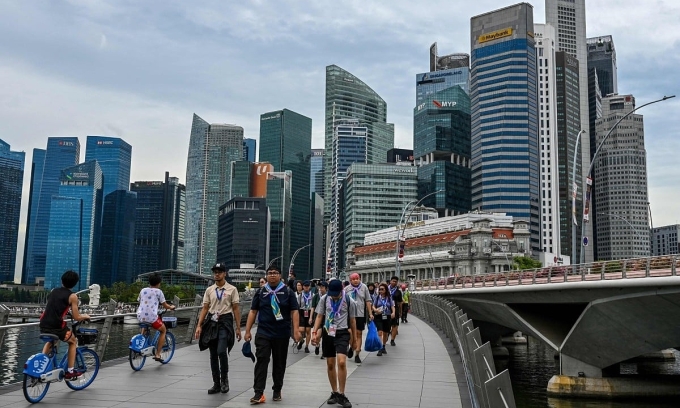
People walk across the Jubilee Bridge at the Marina Bay waterfront in Singapore in November 2025. Photo by AFP |
The expansion arrives at a fraught moment. Singapore’s total fertility rate plunged to 0.87 in 2025, with roughly 27,500 resident births recorded, the lowest in the country’s history, Deputy Prime Minister Gan Kim Yong told parliament in February. A decade ago, the rate stood at 1.24.
At current rates, every 100 Singaporeans today would produce just 44 children and 19 grandchildren, Gan warned, adding that without intervention, the citizen population could begin shrinking by the early 2040s.
Singapore is not alone. Across East and Southeast Asia, governments are racing to respond to collapsing birth rates with a mix of cash incentives, subsidized childcare and expanded leave. South Korea, whose fertility rate fell to 0.72 in 2023 before edging up to 0.80 in 2025, has poured billions into similar efforts with limited results. Japan reported births falling for a tenth consecutive year in 2025.
Whether more generous leave will move the needle remains an open question. Experts say the barriers to parenthood in Singapore run deeper than time off work: the cost of living, a culture of intensive parenting, and satisfaction with child-free lifestyles consistently rank among the top reasons young Singaporeans give for not having children, according to the Institute of Policy Studies.

Comments are closed.