

Meanwhile, the top 1% of households hold about 14% of the total, Jeffrey Siow, Singapore’s Senior Minister of State for Finance, said in parliament on Wednesday when responding to questions about data from a Ministry of Finance paper on wealth and inequality released earlier this month.
These levels of wealth concentration are broadly comparable to those in advanced economies with similar wealth Gini coefficients, he noted.
Nonetheless, he cautioned that the data “should be interpreted with caution, due to sample size limitations and potential under-reporting in survey responses at both ends of the distribution,” as quoted by AsiaOne.
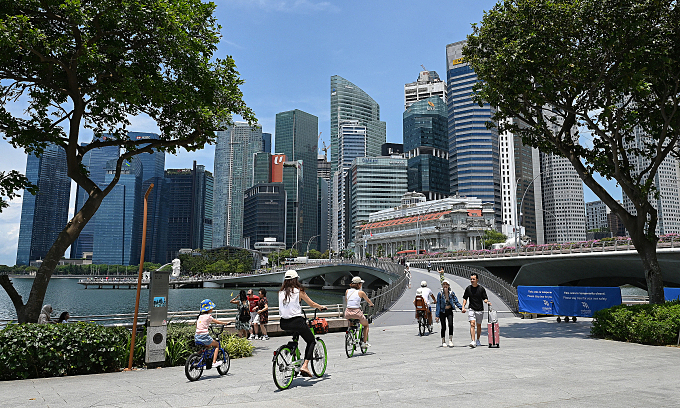
People walk across Jubilee Bridge at Marina Bay in Singapore, April 24, 2023. Photo by AFP |
The ministry’s paper, released on Feb. 9, also found that the richest 20% of households in Singapore had an average net wealth of S$5.26 million (US$4.16 million) in 2023. By comparison, the combined average net wealth of the bottom four quintiles stood at S$3.51 million, about two-thirds of that held by the top group.
The city-state’s wealth Gini coefficient is estimated at 0.55, higher than the income Gini coefficient of 0.379 after taxes and transfers based on household market income, according to The Business Times.
The Gini coefficient gauges inequality on a scale from 0 to 1, with higher values reflecting wider gaps.
Wealth inequality refers to how assets and liabilities, including property, mortgages, stocks and savings, are distributed, while income inequality measures how earnings are spread across the population.
Wealth inequality tends to exceed income gaps in advanced economies because assets accumulate over a lifetime, Siow said.
He later said in a social media post that Singapore’s wealth distribution is comparable to Japan, Australia and Finland, and markedly less concentrated than in the U.K. and the U.S.
When asked on Wednesday whether the government was considering shifting the tax burden from work and income toward wealth, Siow said it “remains open to a broad approach” to taxation and that further wealth taxation could be considered in time.
“But we have to do this carefully so that we know that the outcomes that we want to achieve can be done without too much social perturbation,” he said, as quoted by The Straits Times.

Comments are closed.