
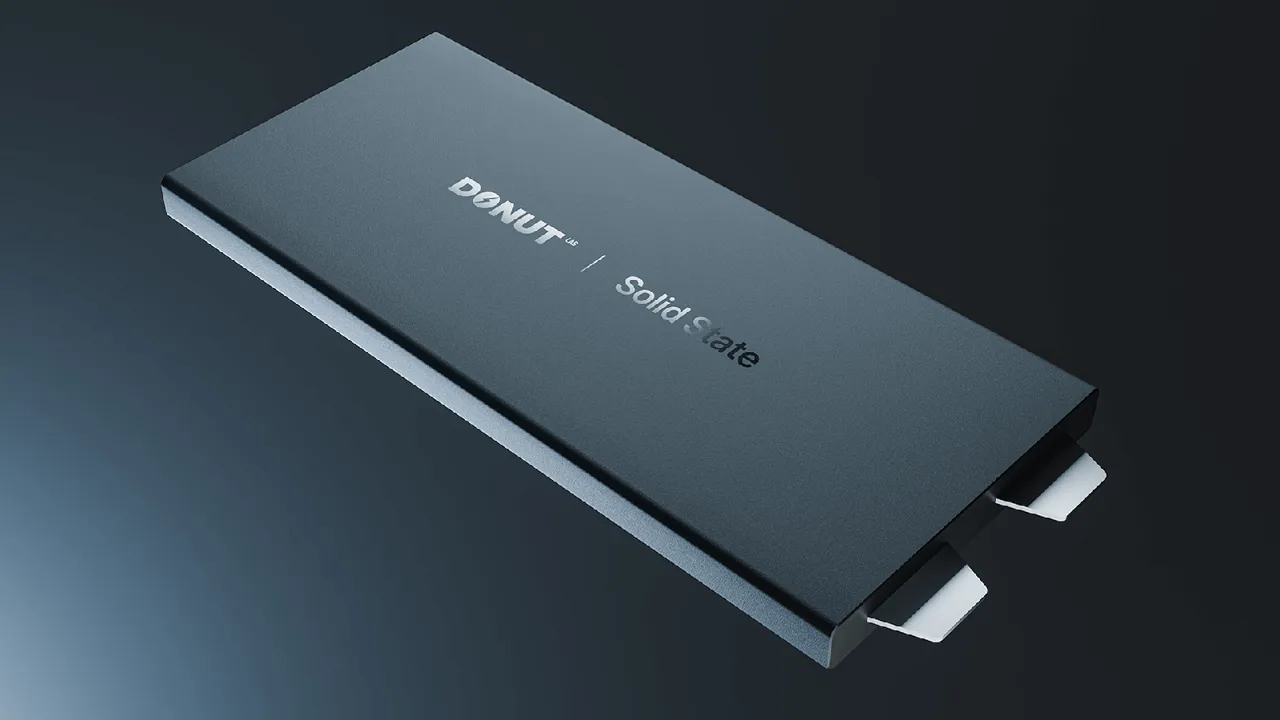

The race to crack ultra-fast charging just took a serious turn. Finnish startup Donut Labs claims its solid-state battery can charge from empty to near full in minutes, and now, independent validation is backing that up.
Tested by the VTT Technical Research Centre of Finland, the battery cell reportedly reached 80 per cent charge in just 4.5 minutes and completed a full charge in slightly over seven minutes. That places it at an 11C charging rate, a level that significantly outpaces conventional lithium-ion batteries.
What 11C Actually Means
Let’s simplify it. A battery’s C-rate measures how quickly it can charge or discharge.
1C means a full charge in one hour.
5C brings that down to about 12 minutes.
11C? You’re looking at a full charge in roughly five to six minutes under ideal conditions.
For comparison, most lithium-ion batteries today operate between 1C and 3C, and that’s with active cooling systems working hard to manage heat.
No Heavy Cooling, No Compression
Here’s where things get interesting. Donut Labs claims its solid-state battery performs at these high charging rates without requiring complex thermal management.
During testing, the cell was evaluated under two passive cooling setups:
Even under these relatively simple configurations, the battery maintained high performance.
At a lower 5C rate, it still hit 80 per cent in 9.5 minutes and reached full charge in just over 12 minutes. That’s already faster than what most EV users experience today.
Why This Matters for EVs
If these results scale, the implications are huge.
Faster charging reduces one of the biggest barriers to EV adoption: waiting time. A five-minute charge starts to feel comparable to refuelling a petrol car. But beyond speed, the real advantage could be in design.
Traditional solid-state batteries often require high الضغط (compressive force) and undergo volume expansion of up to 20 per cent during charging cycles. That demands complex, heavy battery pack structures.
Donut Labs claims its battery avoids both issues. No significant expansion. No need for high الضغط. And minimal cooling requirements.
What this really means is simpler battery packs, lighter, smaller, and potentially cheaper to manufacture.
The Catch: It’s Still Early
Before we get carried away, there’s an important caveat. The test results are based on a single battery cell, not a full battery pack.
Real-world EV systems involve thousands of cells working together, along with thermal management, safety systems, and packaging constraints. Performance at the pack level can differ significantly.
Donut Labs acknowledges this, noting that the current results do not directly simulate full battery behaviour.
What Comes Next
More detailed findings are expected in the coming weeks, including insights into durability, lifecycle performance, and scalability.
That’s where the real test lies. Fast charging is impressive but only if the battery can sustain it over thousands of cycles without degradation.
Still, this validation marks a meaningful step forward. If solid-state battery charging at this speed proves viable at scale, it could reshape not just EVs, but the broader energy storage landscape.
For now, one thing is clear: the gap between charging and refuelling just got a lot smaller.

Comments are closed.