

Nguyen Quoc Trung, deputy general director of Dai Quang Minh Real Estate Investment Joint Stock Company, a Thaco unit, laid out the plan on June 18 as the group detailed its role in building the city’s rail system.
The partner is a name global commuters already know. Hyundai Rotem, the rail arm of South Korea’s Hyundai Motor Group, is one of the world’s largest builders of trains and rolling stock.
Under an agreement signed in Hanoi on June 11, it will hand Thaco the designs, technical documentation, manufacturing processes and quality systems needed to produce locomotives and railcars, along with engineer training in South Korea and on-site support in Vietnam.
The agreement built on an April 23 contract under which Hyundai Rotem will supply 162 railcars for Ho Chi Minh City’s metro lines, six fully assembled in South Korea and 156 shipped as knockdown kits for Thaco to build and assemble itself, a deliberate step up the manufacturing ladder.
After HCMC’s boundaries were widened last year to include the former Binh Duong and Ba Ria-Vung Tau provinces, its planned urban rail network now runs to 1,024 kilometers across 27 lines.
Thaco plans to break ground in early July on a 320-hectare railway and engineering complex in Binh Co Ward, part of the former Binh Duong.
Set inside a larger 786-hectare industrial park, the complex will house factories turning out not only locomotives and railcars but tunnel boring machines, girder launchers, tunnel lining segments and railway sleepers. The company aims to begin production in April 2027, with the trains built to advanced European technical standards.
The ambition is to stop buying what Vietnam can make. Most countries that run metros import their trains, and localizing that production marks a step in Southeast Asia’s industrial climb.
The complex will first feed the metro lines Thaco is building in Ho Chi Minh City, then anchor a domestic railway supply chain.
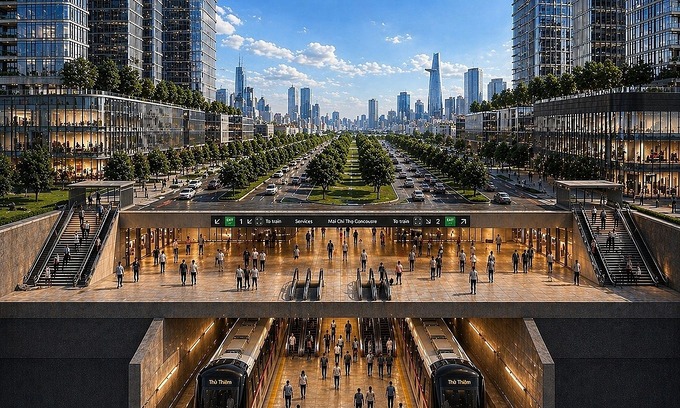
A rendering of the Ben Thanh-Thu Thiem metro line, which Thaco is investing in. Photo courtesy of Thaco |
The arrangement is also a sign of how Vietnam is now leaning on private companies for strategic infrastructure: Thaco, better known as a carmaker, is taking on national rail work under special mechanisms the National Assembly approved in 2025 to speed up urban rail.
Phan Cong Bang, head of the Ho Chi Minh City Management Authority for Urban Railways, said raising the share of locally made components and mastering the technology are central goals as the city expands its metro, and that the scale of investment opens the door for Vietnamese firms to take on work once left to foreign contractors.
The authority has pushed to standardize technology across the whole network so lines stay compatible and operation, maintenance and training are simpler.
Thaco’s footprint already spans the spine of the system. It is the lead engineering, procurement and construction contractor on the Ben Thanh-Tham Luong metro, the investor on the Ben Thanh-Thu Thiem line, and has proposed joining the Thu Thiem-Long Thanh line.
Together those segments form a rail axis of roughly 65 kilometers linking the city’s northwestern edge to the new Long Thanh International Airport, the country’s largest, which is preparing to begin operations.
Today HCMC operates just under 20 kilometers, the Ben Thanh-Suoi Tien line, which has carried more than 30 million passengers since opening in late 2024. The target is to reach about 200 kilometers by 2030.
The build-out is already underway. Since late 2025 the city has broken ground on three projects, the Ben Thanh-Tham Luong and Ben Thanh-Thu Thiem metro lines and the Ben Thanh-Can Gio railway.
Over the next five years it plans to prioritize the Thu Thiem-Long Thanh line, the Binh Duong New City-Suoi Tien line, the first phase of metro line 6 from Tan Son Nhat to Phu Huu, and the Thu Dau Mot-Tao Dan line.
Comments are closed.