

Over the five days to Thursday, the Singapore dollar slipped 1.1% against the U.S. dollar, The Business Times reported.
Meanwhile, the Malaysian ringgit was down 1.3% while the Thai baht and Philippine peso both lost around 1.6%. The Indonesian rupiah slid 0.8% and the Vietnamese dong fell 0.3%.
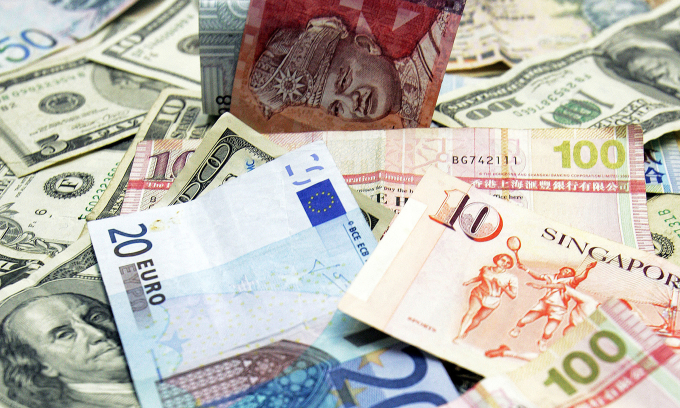
This photo taken in Hong Kong on Jan. 12, 2008, shows various currency bank notes including the Hong Kong dollar, the US dollar, the Euro, Singaporean dollars and the Malaysian ringgit. Photo by AFP |
The downward trend was also seen in the broader Asia region this week, with the South Korean won breaching the 1,500-per-dollar level for the first time since the 2009 global financial crisis.
The won has weakened by 2% from a week earlier as of Friday while the Japanese yen declined by roughly 1% during the same period.
“The recent Asia FX moves underscore fragile global sentiment and rising global growth uncertainty as energy prices climb and geopolitical risks remain elevated,” Lloyd Chan, senior currency analyst at MUFG Global Markets Research in Singapore, said in a note quoted by Nikkei Asia.
A strengthening greenback, supported by safe-haven demand and shifting expectations over interest rate cuts by the U.S. Federal Reserve, and rising oil prices that are deteriorating the region’s terms of trade are the two main factors weighing on Asian currencies.
Globally, the greenback was heading for its strongest weekly gain in more than a year. The U.S. dollar index tracking the currency against a basket of currencies was set to rise 1.4% for the week, which would be its biggest gain since November 2024.
In energy markets, Brent crude has climbed 16.4% over the week while West Texas Intermediate surged 19.2%, on course for their steepest weekly rise since the Russia-Ukraine conflict in February 2022.
Economists at Moody’s Analytics said that higher-income Asian economies, such as Japan, South Korea, Singapore and Hong Kong, are particularly exposed to the impacts from the Iran conflict because they heavily depend on imported commodities.
“Higher commodity prices would raise consumer and producer inflation, potentially forcing central banks to pause their easing cycles or even raise policy rates,” they said.
“Higher prices would also inflate import bills, weakening trade balances. As imports become more costly, greater financial outflows would weaken currencies.”
Nonetheless, whether foreign exchange shifts persist depends less on the initial spike in oil prices and more on the length of supply disruptions.
“If the Middle Eastern conflict continues at its current intensity, it’s likely to bring sustained higher inflation, a stronger U.S. dollar, and a vastly reduced chance of Fed rate cuts,” Tony Sycamore, market analyst at IG, said in a note cited by Reuters.
Meanwhile, Christopher Wong, foreign exchange strategist at OCBC, said the oil risk premium could quickly unwind if tensions in the region and concerns about supply disruptions ease.
“In that scenario, some of the recent weakness in higher-beta Asian currencies could reverse as risk sentiment stabilizes,” he said, referring to currencies that are more volatile and sensitive to market shifts, as quoted by The Business Times.

Comments are closed.