
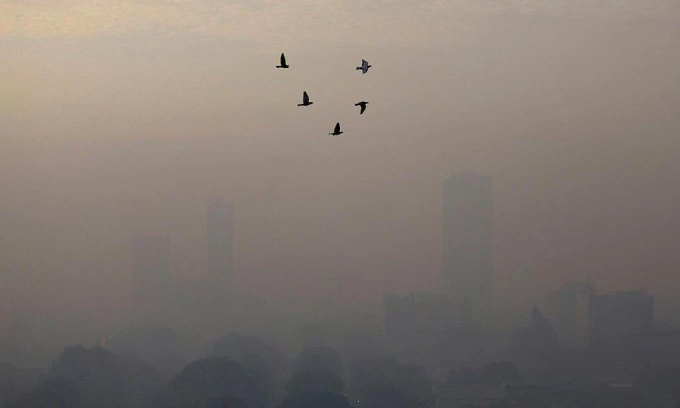

The Swiss air quality monitoring company reported that Indonesia’s annual average PM2.5 concentration fell to 30 micrograms per cubic meter, down from 35.5 in 2024 but still far above the WHO guideline of 5.
Coal-fired power plants, especially pre-2019 facilities near Jakarta, remained a key source of pollution in parts of the country, IQAir said in its report late last month.
PM2.5 refers to airborne particles 2.5 micrometers or smaller, fine enough to penetrate deep into the lungs and enter the bloodstream, where they have been linked to heart disease, stroke, lung cancer and premature death.
A 2024 report by the Jakarta-based Center for Research on Energy and Clean Air found that PM2.5 levels across the greater Jakarta metropolitan area, known as Jabodetabek, ranged from 30 to 55 µg/cu.m, or six to eleven times the WHO guideline. Dry-season smoke from land-clearing fires on Sumatra and Kalimantan, combined with heavy urban traffic and emissions from coal-fired power plants ringing the capital, have long driven the country’s pollution profile.
Indonesia’s improvement in 2025 was part of what IQAir called a regional milestone: for the first time, every country in Southeast Asia met the WHO’s least strict interim target of 35 µg/cu.m.
“Progress was headlined by Laos, Myanmar, Indonesia, Thailand, Malaysia, and Cambodia, all of which continued their year-on-year improvements,” IQAir said in a statement to Eco-Business. The company attributed much of the decline to La Niña conditions, which brought heavy rains, intense typhoons and strong winds that suppressed the agricultural fires typically responsible for dry-season haze.
Weather was not the whole story, however.
Although Malaysia recorded a modest decline in PM2.5 concentration in 2025, it still faced its worst transboundary haze crisis in years in July and August, driven by forest and peatland fires in Indonesia’s Sumatra and Kalimantan regions, Eco-Business reported.
The episode was a reminder that Indonesia’s pollution is a regional problem, not a domestic one, and that progress built on favorable weather can reverse quickly when dry conditions return.
Thailand and Cambodia also recorded improvements in air quality. But not every Southeast Asian country moved in the same direction.
Singapore and Vietnam recorded slight increases in PM2.5 concentrations 2025, with Vietnam’s figure measured at 29.7 µg/cu.m, making it the second most polluted country in the region.
The Philippines saw a sharp 28% jump from 14 µg/cu.m in 2024 to 19 in 2025.
IQAir told Eco-Business the Philippine rise was driven in part by an expanded monitoring network: ground-level monitors grew 25% and the number of cities covered rose by 50%, capturing hotspots that earlier datasets had missed. Traffic congestion and construction dust from major public works projects also contributed.
Globally, only 13 countries and territories, none of them in Asia, met the guideline, down from 17 a year earlier.
Pakistan topped the pollution rankings at 67.3 µg/cu.m, followed by Bangladesh at 66.1, Tajikistan at 57.3, Chad at 53.6 and the Democratic Republic of the Congo at 50.2.
Loni in northern India was the most polluted city in the world at 112.5 µg/cu.m, more than 22 times the WHO limit, according to IQAir.
IQAir’s 8th annual report drew on data from monitoring stations in 9,446 cities across 143 countries and territories.
Comments are closed.