
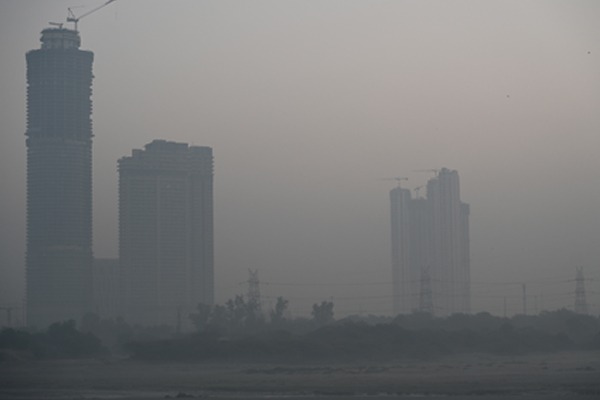

Noida, 8 December. Air quality in Delhi-NCR continues to remain above the danger mark. From the first of December till now the air quality is being recorded in the very severe category. Most of the monitoring stations in the capital Delhi have recorded AQI between 320 to 370, while the situation remains very bad in many areas of Noida and Ghaziabad. Due to poisonous air, the number of patients in hospitals with complaints of respiratory diseases, asthma, allergies and eye irritation is increasing rapidly. Situation in Delhi – ‘Red’ is visible almost everywhere.
The data received from major AQI stations of Delhi is very worrying. In which Anand Vihar – 354, Ashok Vihar – 337, Bawana – 367, Burari Crossing – 327, Chandni Chowk – 321, CRRI, Mathura Road – 301, Dr. Karni Singh Shooting Range – 330, DTU – 343, Dwarka Sector-8 – 326, Nehru Nagar – 350, Patparganj – 340, Punjabi Bagh – 334, Pusa – 353 and RK Puram – 334 have been recorded.
Almost all the stations are maintained in serious and very serious category, which clearly shows that the amount of pollutant particles in the air has reached dangerous levels. The situation is bad in Ghaziabad also. Indirapuram has recorded AQI of 283, Loni – 382, Sanjay Nagar – 329 and Vasundhara – 307. The quality was recorded at its worst in Loni, where the AQI crossed 380.
In Noida too, PM 2.5 levels remained in the ‘red’ category continuously from December 1 to December 7. In which AQI – 321 was recorded on 1 December – 321, 2 December – 393, 3 December – 365, 4 December – 308, 5 December – 339, 6 December – 344 and AQI – 317 was recorded on 7 December. The AQI recorded today in Noida is Sector-125 – 348, Sector-62 – 300, Sector-1 – 345, Sector-116 – 345.
According to the warning of the Meteorological Department, there is no possibility of relief as of now. According to the Central Pollution Control Board (CPCB), the current level of air is extremely dangerous for asthma patients. It is risky for the elderly, pregnant women and children and can cause lung infections and severe respiratory problems with prolonged exposure.

Comments are closed.