
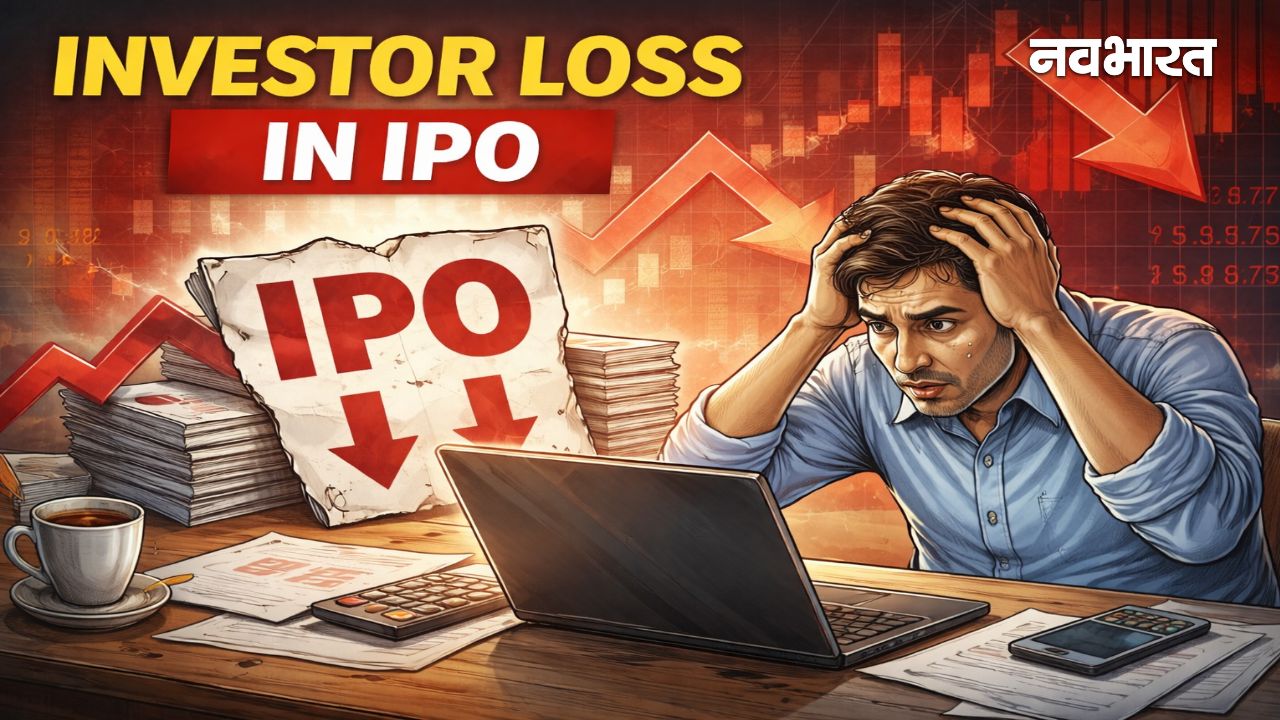
Sinking stock market, looting investors; The biggest ‘IPO-OFS loot’ Side effects of this, the government is also a mute spectator

Vishnu Bhardwaj’s report for Obnews-
Share Market: As expected, the biggest ever ‘IPO-OFS loot’ Due to (IPO-OFS Loot), the risk of recession in the Indian Stock Market has started increasing. Despite the high economic growth of the economy, the stock market is sinking into recession. There was a severe recession in the market last week also. By the way, this recessionary environment in the market is there since October 2024. That means the Indian stock market is suffering from recession for the last 16 months.
Shares of more than 75% of the companies listed in the market are in recession and their share prices have fallen by 20 to 50%. Share prices of many companies are falling to their new lowest levels. Last Friday, shares of about 190 companies in BSE fell to 52-week lows.
Smallcaps fall 18% on budget day
While key benchmarks Sensex and Nifty have lost only 4% from their highest levels, BSE Smallcap, which reflects the broader market trend and comprises shares of 1223 companies, has lost 15% from its highest levels. On the day of budget, smallcaps fell by 18% and Sensex-Nifty by 7%. Looking at the actual market conditions, the Sensex has come not at 83,300 points but around 75,000 points. On the contrary, stock indices of other big countries of the world including America, Japan are reaching new heights.
This is a surprising situation when all the factors of the Indian economy are positive and record investment of retail investors is coming into the market through mutual fund companies. The argument behind the recession here is that India’s valuation is expensive, hence the recession is coming. But this is not the truth. The PE ratio of Sensex-Nifty is at a reasonable level of 20-21. And those fund houses who are calling this valuation expensive, why are they fearlessly investing crores of rupees in public issues (IPOs) of companies with extremely expensive valuations ranging from 100-200 to 1000 PE ratios? This is a big question.
The ‘game’ of index management, the government is a mute spectator.
In fact, in the Indian market, the game of index management is being played by keeping Sensex-Nifty at upper levels. is being played and this ‘game’ The ‘cartel’ of speculators and big fund houses. The company is being played to loot retail investors in expensive IPOs. This is deflating the India Growth Story. SEBI’s ‘open exemption’ The amount of capital that has been raised through expensive IPOs at arbitrary prices in the last 5 years by taking illegitimate advantage of IPOs has not been raised even in the last 20 years.
In the last 5 years, a record capital of more than Rs 5.50 trillion has been raised from the market through about 360 IPOs, which is more than the capital of Rs 4.55 trillion raised through 658 IPOs in the 20 years between 2000 and 2020. It is a matter of great concern that out of this, Rs 3.50 trillion i.e. 65% is the Offer for Sale (OFS) amount, which has gone out of the hands of crores of retail investors and has gone straight into the pockets of capitalists and foreigners. The second worrying thing is that crores of investors have suffered losses in about 45% of IPOs. The surprising thing is that in this biggest ever ‘IPO-OFS loot’ But regulator SEBI and the government remain mute spectators.
When will SEBI conduct the study of losses in IPO-OFS?
Last week, SEBI chief Tuhin Kant Pandey proudly said at an event that India’s market capitalization has grown more than 4 times in the last 10 years to above Rs 470 lakh crore. Rs 14.3 lakh crore was raised through equity and debt issues in the financial year 2024-25, while the figure stood at Rs 11.6 lakh crore in the April-January period of the financial year 2025-26. In 2025, the country led the global IPO activity and stood third in terms of amount raised. But the SEBI chief did not tell how many crores of retail investors of the country suffered huge losses in these record number of expensive IPOs and how much of their deposits were wiped out.
SEBI did a good study last year that found that more than 90% of retail investors suffered huge losses in future-options trading (F&O). Therefore F&O trading is being curbed. This step of SEBI and the government is commendable, but when will SEBI conduct a study that since the time it has given freedom to merchant bankers and company promoters to decide the price in IPOs, how many billions of rupees have been lost to retail investors and investors investing through mutual funds in thousands of expensive IPOs? And why are fund houses betting retail investors’ capital at such high valuations?
Andher Nagri and Chaupat Raja
A recent vivid example of how much darkness there is in the IPO market are the IPOs of Bharat Coking Coal and Shadowfax Technologies that came in January last month. The IPO of Rs 1068 crore of Bharat Coking Coal, a 50 year old profitable strong company of the Government of India, was launched at a PE ratio of only 9 i.e. a very reasonable price. The IPO price of this company, which earns annual profit of Rs 1240 crore, was kept at only Rs 23. As a result, investors got a good profit of 77% on the very first day.
In contrast, the Rs 1907 crore IPO of 9-year-old private company Shadowfax was launched at a record expensive PE ratio of 1020. The IPO price of this logistics company, which earns an annual profit of only Rs 6 crore, was kept at Rs 124. As a result, after getting listed with 9% loss on the very first day, its stock fell to Rs 98. It is known to all that the entire stock market runs on valuation, then on what basis was Shadowfex, which was making modest profits, allowed IPO at a very expensive PE ratio of 1020? This is a very serious and worrying issue. There are many cases of this kind of darkness.
Investors are in bad shape due to Paytm’s IPO
Four years ago today, the Rs 18,000 crore IPO of Paytm, which was suffering from huge losses, was approved at the most expensive price of Rs 2150 and then about 10 lakh retail investors were looted in it. Today even after 4 years, Paytm’s share is still at Rs 1126 with a huge loss of 47% and at the bottom it had fallen to Rs 341. The big question is that why has SEBI not taken action till date against those responsible for this huge loss suffered by 10 lakh investors? The fund houses which invested crores in Paytm, Ola or any other very expensive IPO, do they not have that much understanding or do they have any ‘selfish’ Did retail investors suffer losses?
Also read: Share Market: Fall in the stock market, Sensex fell by 200 points, Nifty in the red, IT shares saw a rise.
Big question on approval of IPO
When the central government Profit Making Companies All the IPOs of IPOs come only at PE ratio of 9 to 20 i.e. at very reasonable prices, then how do private companies earning modest profits or incurring losses get permission to launch IPOs at such expensive prices? Is this ‘blind robbery’? But will SEBI or the Finance Minister impose restrictions?
Vishnu Bhardwaj’s report for Obnews-

Comments are closed.