
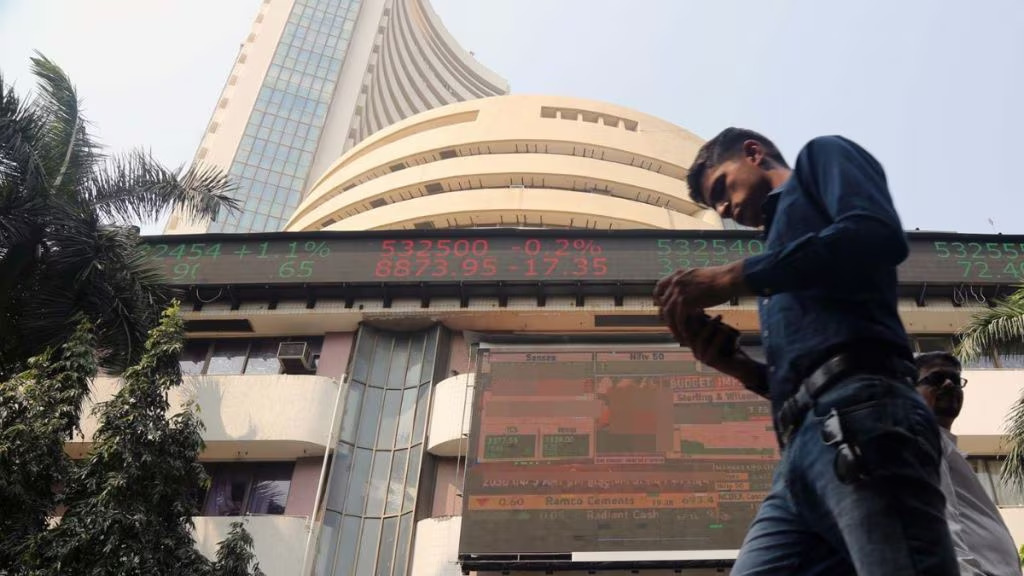

Mumbai, 18 December. The Indian stock market opened in the red on Thursday, the fourth trading day of the week. The effect of weakness in Asian markets was visible on the Indian stock market, due to which the market appeared sluggish. With this, the market witnessed a decline for the fourth consecutive day. In Thursday’s session, the main benchmark of the domestic market, NSE Nifty, opened at 25,764.70 and BSE Sensex opened at 84,518.33.
In early trading i.e. at 9:25 am, Sensex was seen trading at 84,480.44 level with a gain of 79.21 points or 0.09 percent. While Nifty was seen trading at 25,795.65 with a decline of 22.90 (0.09 percent) points. In the early session, all Nifty indices except Nifty IT and Nifty Div Ops 50 were seen trading in the red.
Sector wise, the biggest decline was in auto, pharma and realty sectors, where a weakness of up to 1 percent was recorded. Whereas shares of IT sector and PSU banks saw a rise of about 0.9 percent and 0.25 percent respectively. Talking about the broader market, there was a slight decline in midcap stocks, while some weakness was seen in smallcap stocks too.
Infosys, HCL Tech, TCS, Tech Mahindra, ITC, Axis Bank were among the top gainers in the Sensex pack, while Tata Motors Passenger Vehicles (TMPV), Sun Pharma, Mahindra & Mahindra, NTPC and Asian Paints were the biggest losers. On Wednesday, the domestic market closed in the red. At the end of trading, Sensex closed at 84,559.65, down 120.21 points or 0.14 percent, and Nifty closed at 25,818.55, down 41.55 points or 0.16 percent.
Dr. VK Vijayakumar, Chief Investment Strategist, Geojit Investments Limited, said that weakening of AI trades in the US market is becoming a growing trend. This trend is likely to continue into early 2026 and may benefit non-AI markets such as India.
He said that now one concern in the market is whether the Central Bank of Japan will raise interest rates today and give a tough message. If this happens, it could lead to a reversal of the ‘yen carry trade’, due to which FIIs can sell more. He said that in such a situation, investors should take advantage of the weakness in the market and buy shares of good and reasonably priced companies.

Comments are closed.