
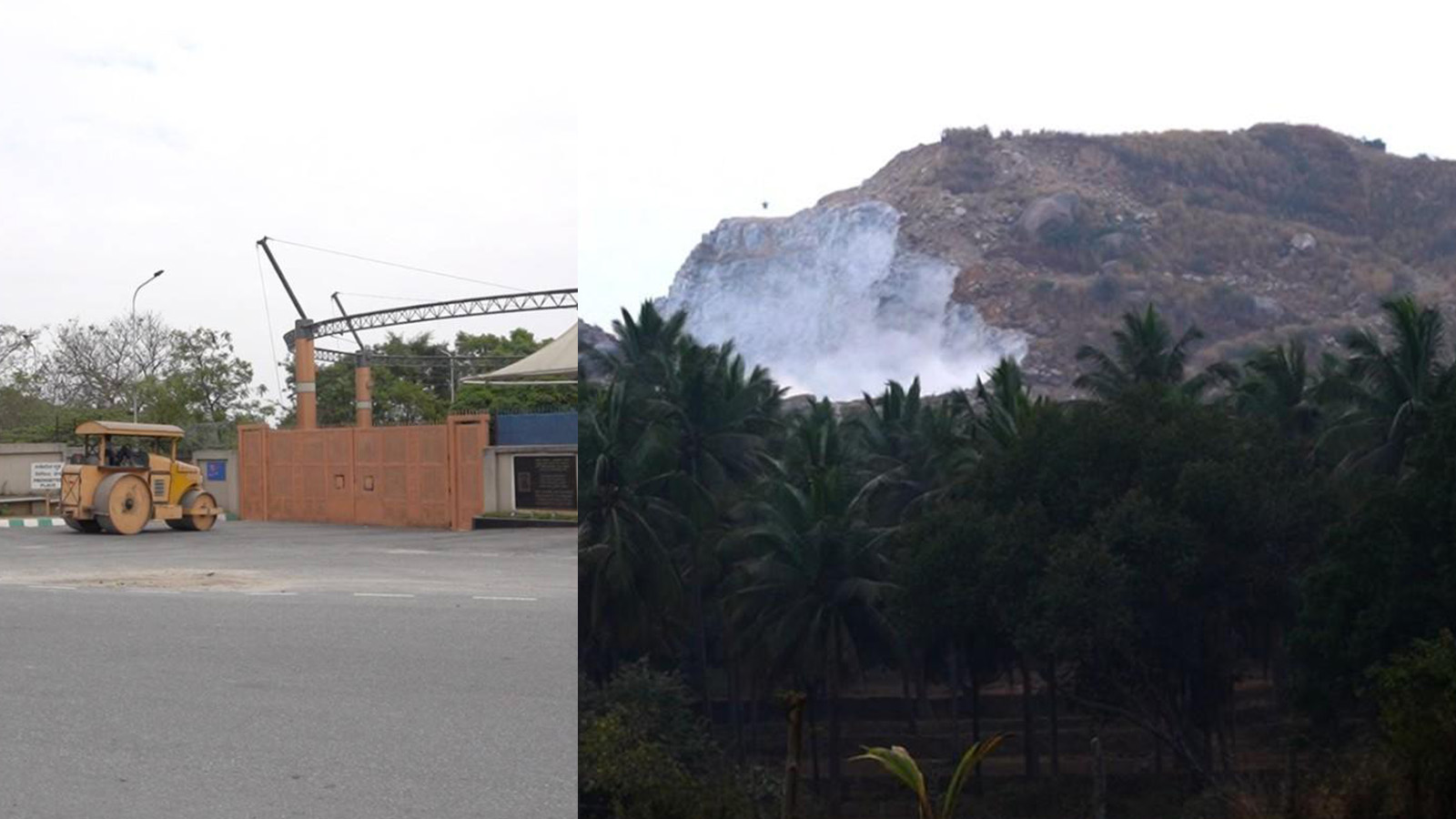

It had played a key role in elevating the country’s pride during space missions such as Mangalyaan and Chandrayaan or helping the national forces during Operation Sindoor, but the Indian Deep Space Network (IDSN), a sophisticated telecommunications infrastructure operated by the Indian Space Research Organisation (ISRO), is currently under threat, not from any external enemy but something apparently innocuous at home — stone mining.
Also read: ISRO to triple spacecraft output, target Chandrayaan-4 launch in 2028: Narayanan
The IDSN campus was set up in Byalalu, near Bengaluru, which is the headquarters of ISRO, to exploit unique natural advantages, such as minimal radio-frequency disturbances owing to its saucer-like shape. But now, the key centre is facing potential harm from relentless activities related to nature, such as stone mining.
Mining threatens sensitive functioning
The mining activities are happening uninterruptedly within just a kilometre of the IDSN centre in Tavarakere Hobli in Bangalore South taluk off the Bengaluru-Mysuru highway, jeopardising the sensitive zone’s functioning. A total of 24 crushers are being used for quarrying in an area of 220 acres in the adjacent Sulivara village, resulting in blasts that cause constant tremors in the vicinity. Not to mention the endless noise and cloud of dust created by mining.
A satellite image of ISRO’s Indian Deep Space Network Centre in Byalalu village in Karnataka.
These activities are allegedly hindering the IDSN’s crucial research work, which is related to remote sensing and space technology and events related to national security, such as Operation Sindoor last year.
Tremors, noise, dust
While there are general complaints that trembling ground, excessive noise and flying dust are causing problems for the centre’s personnel, besides threatening sensitive equipment (the dust settling on them), which could lead to frequency issues, major fears also lurk that the laboratory buildings themselves could see heavy damage due to rock explosions caused by dynamites and gelatin sticks. The apprehension is not without basis, as cracks have developed in several houses in the area due to the frequent explosions.
Vibrations can disrupt IDSN antennas
Sources in the ISRO have confirmed the dangers that IDSN faces. One official, who spoke to The Federal on the condition of anonymity, explained how the surrounding disturbances could cause problems for the centre’s functioning, “The antennas at the Bayalalu centre have sensitive amplifiers. The vibrations on the ground due to rock explosions will be transferred to the antenna. There is a possibility of interference while receiving the sensitive waves, causing disruptions.”
Also read: Ground Report: Why were roads to UP’s Kapsad village blocked after Dalit murder, abduction?
If the waves are disturbed, it would become virtually impossible for those tracking satellites in deep space to receive the correct information, potentially jeopardising key space missions.
For example, a satellite launched may be one lakh kilometres away. At the control centre, there is possibility that its distance may be shown as 75,000 km due to the earth’s vibration. In this case, the satellite’s navigation data will be changed, he said.
The official further added that waves from the satellite are received by the massive antennas (measuring 18 by 32 metres in circumference) at ISDN’s Bylalu centre and analysed at ISRO’s Telemetry, Tracking and Command Network campus in Peenya.
He said there is no suitable place to build such antennas in Peenya for supporting communications with the agency’s space science and planetary exploration missions, and hence, Byalalu remains a key location for the entire functioning. The disturbances caused by the rock explosions also put the antennas’ safety at risk.
Roofs and windows of houses damaged by rock blasts in a quarry in Sulivara village, Karnataka. Photo: Raghu R D
“If there is a strong foundation, quality waves can be received. But, if there are vibrations, proper data analysis will not be possible,” he told The Federal.
ISRO has raised complaints, say locals
Local residents told The Federal that in January 2021, the ISRO had raised complaints about the problems caused by stone mining to the district magistrate of Bangalore Urban District and also the Karnataka mines and geology department. They said the space agency sought a ban or control of mining in the area around its key ISDN centre, but the government has allegedly not acted.
Also read: Not a ray of solar power in Dharnai, Bihar’s first solar village | Ground report
However, D Mohan Kumar, inspector of Tavarakere Police Station, under the jurisdiction of which Byalalu village falls, however, told The Federal that no complaints had been received from the ISRO on illegal stone mining and that the mines and geology department was monitoring the irregularities.
The Federal requested the ISRO for its viewpoint and will update this story as and when it comes.
The space agency has been promoting successive projects in the country’s space sector. However, when stone mining in such a sensitive area poses a threat to the agency’s sensitive functioning, it shows the government’s indifference, said the locals.
“The government should immediately impose controls on stone mining. The area around the ISRO centre should be declared a safe zone,” a person from Sulivara village, who did not want to be named, told The Federal.
Trespassing also a threat
Besides the threats posed by stone mining, the Byalalu centre has also faced the issue of trespassing. A few years ago, two unidentified persons were found walking suspiciously near the key space asset. When the security personnel questioned them, they left.
Also read: Turkman Gate’s midnight eviction drive revives Emergency fears | Ground Report
The subsequent police investigation failed to reveal their identities. Workers from outside are also involved in the stone crushers, and locals allege a few illegal Bangladeshis were also working in the area. It was understood that authorities did not have information about the workers employed in the stone crushers.
(The article was first published in The Federal Karnataka)

Comments are closed.