
Stop Being Fooled By ‘Healthy’ Snacks: 5 Simple Label-Reading Tricks Every Shopper Needs To Know | Health News

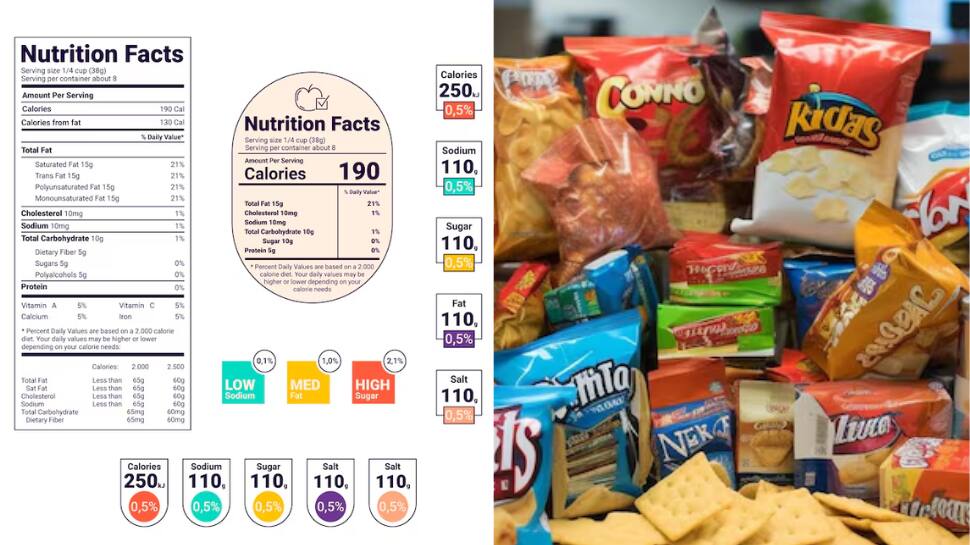
Read food labels like a pro: Do you want to stay healthy and are obsessed with reading the ingredients of every packaged product you buy? While it may be a good habit to check what you are eating, you need to understand the terminology and meaning of various terms that are mentioned in the list. From serving size order to the meaning of various codes, here’s a simple, foolproof guide to decode nutrition labels so you never get tricked by marketing hype again.
Below are five simple, practical ways to understand food labels and take control of your daily nutrition.
1. Always Start With the Serving Size (It’s A Game-Changer)
Add Zee News as a Preferred Source
One of the most misleading tricks on food labels is the serving size. Brands often list calorie counts per tiny serving, even though most people finish the whole pack.
For Snacks & Drinks
If a packet says 90 kcal per serving, 3 servings per pack, and you finish the whole thing → you’re actually consuming 270 kcal, not 90.
If a drink bottle mentions 2 servings, but you chug it all → double the calories, sugar, and sodium.
For Powders & Nutraceuticals
Label: 1 scoop = 10 g, 30 servings per container
Reality: If you take 2 scoops, you must double every value, protein, actives, calories, sugar, sodium.
Bottom line: Count what you actually consume, not what the label assumes.
2. Check the First 3 Ingredients (They Tell the Real Story)
Ingredients are listed from highest to lowest quantity. The first three reveal what the product is truly made of.
For Everyday Foods
If the first ingredients are:
Sugar / jaggery / dates / syrups
Refined flour (maida/wheat flour)
Palm oil or refined oils
→ It’s basically a sugar-refined carb-oil product, regardless of claims like “natural,” “multigrain,” or “wholesome.”
If the first three include:
Whole grains
nuts, seeds
→ It’s more nutrient-dense and genuinely better.
For Protein Powders & Supplements
The top ingredients should reflect the product’s purpose:
1. Protein sources (whey, casein, pea protein)
2. Electrolytes (sodium, potassium, magnesium)
3. Active compounds or plant extracts
If you see maltodextrin, glucose syrup, artificial fillers before actives → it’s mostly fluff.
3. Hunt for Hidden Sugars (They Go By Many Names)
Sugar isn’t always listed as “sugar.” It may appear as:
1. Glucose syrup
2. Corn syrup
3. Maltodextrin
4.Honey
5. Jaggery
6. Dates/date paste
7. Dextrose
8. Invert syrup
Look for these especially in snacks, drinks, gummies, effervescent tablets, and ‘health’ mixes.
Also check sweetener INS numbers:
INS 950, 951, 955 → acesulfame-K, aspartame, sucralose
INS 960, 967 → stevia, xylitol
Not “good” or “bad” by default, just important to know what you are consuming.
4. Trust Clear Numbers, Not Fancy Claims
Good brands provide specific values, not vague promises.
Strong labels say:
Protein 20g
Added sugar 1.5 g
Omega-3 500 mg
Vitamin C 40 mg, Zinc 5 mg
Weak labels say:
“High protein”
“With electrolytes”
“For energy / immunity / skin glow”
Such claims mean nothing without real quantities.
If a brand is confident in its formula, it shows the numbers.
5. The Simple Checklist That Saves You Every Time
Before adding anything to your cart, ask:
1. Did I check the serving size?
2. What are the first 3 ingredients?
3. Where is the sugar hiding?
4. Are there real numbers instead of vague claims?
If the product fails this test, it’s better left on the shelf.
Food labels aren’t as complicated as they look. With these five easy steps, you can cut through marketing tactics, choose genuinely healthy options, and protect your long-term well-being.
(This article is meant for informational purposes only and must not be considered a substitute for advice provided by qualified medical professionals. Always seek the advice of your doctor with any questions about a medical condition.)

Comments are closed.