
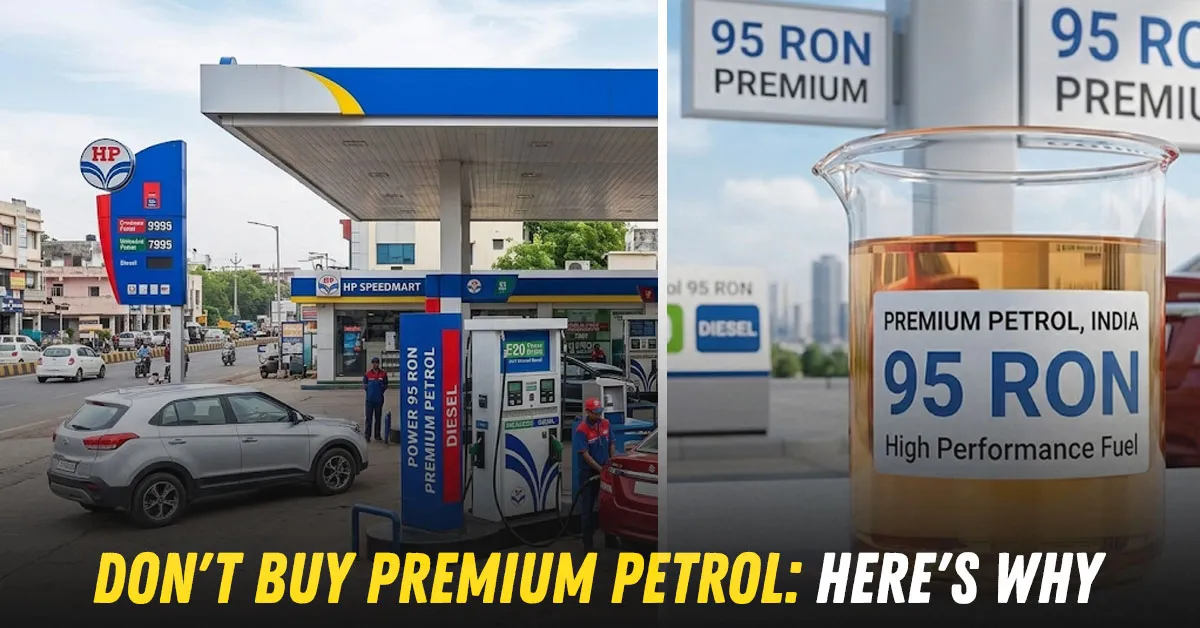

The nation-wide rollout of E20 petrol (20% Ethanol-blended petrol) has brought about a major transformation in India’s energy landscape. It has, in a way, rendered premium petrol meaningless. Premium petrol variants like XP95, Power95, and Speed 97 had their high RON (Research Octane Number) values as the key selling points. Regular petrol used to have a RON value of around 91. E20 blended petrol has a RON value in the ballpark of 95. There’s thus hardly any reason for anyone to spend extra for premium petrol. Let us explain…
Let’s start by explaining what premium petrol is. It is essentially a high-grade fuel, formulated with a higher Octane number and has specialised chemical additives to ensure smooth and efficient engine operation. In India, various oil marketing companies sell premium petrol under three broad sections- Mid-tier (95 RON), Ultra-High Octane (97-100 RON) and additive-only premium petrol.
Companies like Indian Oil (IOCL), Hindustan Petroleum (HP) and Bharat Petroleum (BPCL) are the major players in selling premium petrol. XP95, poWer 95, Speed 97 and poWer 99 have all become familiar names. Indian Oil’s XP100 is, in fact, India’s first 100-Octane fuel. It also happens to be the only petrol that is kept completely Ethanol-free.
India’s blending program has made it pointless to buy 95-Octane and 97-Octane petrol. Most 95-Octane fuels promise cleaner combustion and lower emissions. Both these are also characteristic features of E20 petrol as well. Premium petrol costs more than regular E20 petrol. For most people it would feel like spending more for petrol that remains practically the same, unless they want the special cleansers and detergents that this fuel contains.

Research Octane Number (RON) is a fuel’s ability to resist pre-ignition inside the engine. Petrol with high RON value will withstand greater compression before igniting. This will be particularly beneficial in high-compression and turbocharged engines. These engines deliver better power and fuel efficiency with high RON rated fuels. An even ignition facilitates better combustion and performance. Uneven ignition, on the other hand, can even damage the engine over time.
So, the use of premium petrol is claimed to protect engine components from wear and tear caused by premature ignition. The chemical additives in them further clean the internal of the engine and its ancillaries, and remove Carbon deposits. In performance cars and turbo-engines designed for it, premium fuel can unlock peak power and smoother throttle response. High compression engines may also see 1-2 percent increase in fuel efficiency.

Now, take the case of E20 petrol. It typically has a RON value of 95+. This is because Ethanol itself has a RON value of 108 and blending raises the overall RON of the fuel to 95-97. Except for the performance boost in turbo-engines, E20 fuel delivers almost all other benefits of premium petrol. It prevents engine-knocking and ensures smoother combustion. Ethanol burns cleaner than pure petrol. Blended fuel thus has relatively less emissions.
In modern cars, the use of E20 fuel can deliver sharper throttle sensors. This is because the engine computers (ECUs) in these can detect the higher RON rating of the fuel used and adjust ignition timing accordingly.
Ethanol has a high heat of vaporisation. It cools down the air entering the cylinders, making the air-fuel mixture denser. This makes the engine run smoother even under heavy load.
A possible downside would be fuel efficiency. The use of E20 petrol may cause a drop of 3-7% in real-world fuel efficiency. This is due to the lower energy density of blended petrol. It also needs to be mentioned here that the corrosive nature of Ethanol may cause issues to the engine components and fuel lines over the years, on non-compatible vehicles.
Comments are closed.