
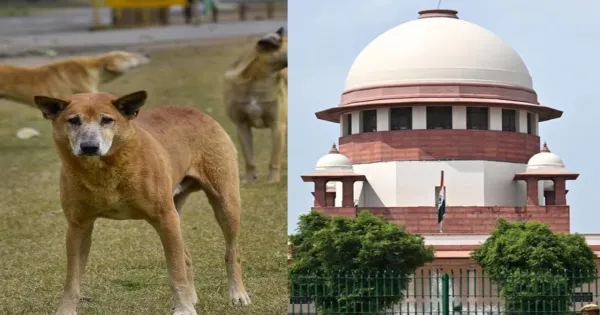
Supreme Court postponed the hearing in stray dog management case till January 13, said- humane solution is necessary

New Delhi. The Supreme Court on Friday considered public safety concerns and humane measures to control the welfare and population of animals in the stray dog management case and adjourned hearing on the case till January 13. A bench of Justices Vikram Nath, Sandeep Mehta and NV Anjaria heard detailed arguments from animal rights activists, NGOs, victims of stray dog attacks and other parties for the second consecutive day.
This hearing took place in the suo motu case started by ‘Swaprerna’ named ‘City surrounded by stray dogs, children pay the price’. During the hearing, various parties sought changes in the previous directions of the Court regarding the management of stray dogs in residential colonies and institutional premises. Animal welfare groups are pushing for strict enforcement of ‘Animal Birth Control’ (ABC) rules. He has advocated sterilization, vaccination of stray dogs and releasing them back into the same area. Also, to reduce the incidents of dog bites, it was suggested to control their population through scientific and humane methods.
At the same time, groups of victims have demanded removal of stray dogs from residential societies. Citing increasing dog attacks and serious safety concerns, he said that children and the elderly are most at risk. Senior advocate Mahalakshmi Pavani, appearing for the animal rights activist, drew the court’s attention to the harassment and attacks on women who feed dogs by vigilante groups.
He said officials have failed to act on complaints or register FIRs. Justice Vikram Nath advised that such complaints should be taken up with the local police or magistrate and reiterated the order to register FIRs in cognizable offenses laid down in the Lalita Kumari case, while making it clear that the Supreme Court cannot oversee private criminal cases.
Senior advocate Shadan Farasat, appearing for animal rights activists Sonia Bose and Avneesh Narayan, said that the issue is not of ‘human versus dog’ but of the failure of the government. He argued that even a single death due to dog attacks violates Article 21, but it is impossible to put the responsibility of administrative lapses on the animals.
He proposed an organized framework involving zoning of public places, designated areas for dog feeding, timelines for strict implementation of ABC rules, accountability of municipal officials and coordination between state and local bodies. Justice Sandeep Mehta appreciated the balanced approach proposed.
Senior advocate Madhavi Divan suggested the creation of a state-level online dashboard to monitor sterilization, vaccination and accountability of nodal officers, to ensure transparency and compliance. The counsel appearing for the other applicants, including actress Sharmila Tagore, opposed the idea of completely culling stray dogs and advocated a scientific approach. This included behavioral assessment, treatment and microchipping of aggressive dogs.
Justice Mehta, however, cautioned against unrealistic international comparisons, stressing that it is important to accept the Indian reality. During the hearing, Justice Mr. Mehta made light remarks on the natural enmity between dogs and cats, which lightened the atmosphere of the court.
However, he again stressed that this problem requires practical and humane solutions. Senior advocate Abhishek Manu Singhvi, appearing for the organization ‘All Creatures Great and Small’, argued that the matter has now become a question of constitutional limits and institutional responsibility.
He argued that the existing legal framework is complete in itself and the court should intervene only when there is a lacuna in the law. Also, he sought to involve scientists and field experts in advisory roles. Supporting this view, senior advocate Raj Shekhar Rao urged judicial intervention to be sensitive and timely and suggested giving a reasonable time limit to the institutions to demonstrate compliance with humanitarian control measures.
Justice Mehta emphasized that while compassion towards animals is important, public safety is of utmost importance and also said that the many incidents of attacks on vulnerable people cannot be ignored. The bench said that the objective is not to pit different views against each other, but to find a solution which is workable, humane and effective. After hearing detailed arguments, the court adjourned the matter to January 13, 2026 for further arguments by the remaining parties.

Comments are closed.