
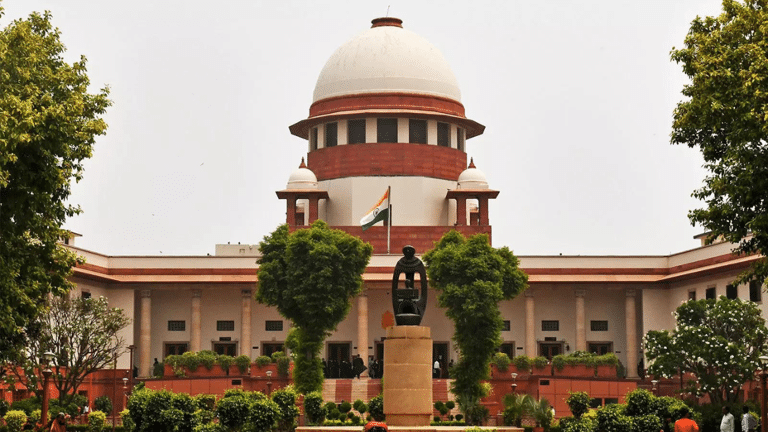

The Supreme Court of India on Monday stayed its November 20 judgment that restricted the definition of the Aravalli range to landforms rising at least 100 metres above the surrounding terrain. The court decided to reopen and comprehensively re-examine the issue, citing the need for expert guidance and a more holistic ecological assessment.
A bench led by Chief Justice of India Surya Kant, along with Justices J.K. Maheshwari and A.G. Masih, placed the earlier ruling “in abeyance” while proposing the formation of a high-powered expert committee. The panel is expected to examine ecological continuity, the scientific basis of the height-based definition, and the regulation of mining activities across the Aravalli region.
The matter was taken up suo motu by the court on December 27, following widespread criticism of the November judgment. During the hearing, the bench noted that a fair, impartial, and independent expert opinion was necessary to clarify unresolved concerns and potential environmental risks.
Solicitor General Tushar Mehta, representing the Union government, welcomed the court’s intervention and said that several misconceptions had arisen from the earlier ruling. He pointed out that the November judgment had relied on a court-appointed expert report and envisaged a detailed mining plan subject to Supreme Court approval, along with public consultations.
The bench raised specific concerns about whether limiting the Aravallis to landforms above 100 metres could shrink conservation areas and create regulatory gaps. It questioned how mining would be regulated in areas lying between two qualifying hill formations, warning that such an approach could fragment a continuous ecological system.
The court also expressed concern about preserving the geological and ecological integrity of the ancient mountain range and indicated that a broader assessment may be required if the current framework risks weakening environmental safeguards.
At the request of the Solicitor General, the court directed the Union government to file its response before finalising the composition of the expert committee. Notices have been issued to the Centre, the concerned states, and the amicus curiae who assisted in earlier proceedings. The matter will be heard next on January 21, 2026.
The interim stay is expected to pause the ongoing mapping and delineation exercise initiated by the Union environment ministry and state governments, which was based on the now-stayed 100-metre elevation criterion. That exercise was intended to guide future mining decisions and the preparation of a Management Plan for Sustainable Mining.
The Aravalli range, one of the world’s oldest fold mountain systems, stretches over 700 kilometres from Gujarat to Delhi through Rajasthan and Haryana. It plays a vital role in preventing desertification, supporting groundwater recharge, and sustaining biodiversity across the region.

Comments are closed.