
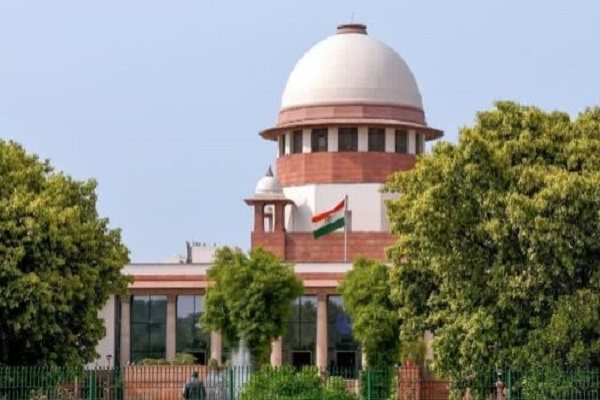

New Delhi21 March. The Supreme Court has expressed serious concern over the growing trend of instant uploading of videos on social media and has warned that such practices may jeopardize the sanctity of fair trial.
The apex court expressed concern during the hearing on Hemendra Patel’s PIL
In fact, this matter came up for hearing on Friday before the bench of Supreme Court Chief Justice (CJI) Surya Kant, Justice Joymalya Bagchi and Justice Vipul M Pancholi. The Supreme Court was hearing a PIL filed by Hemendra Patel alleging that the police upload videos and photographs of the accused on social media, thereby creating prejudice in the minds of people.
Objection to showing the names and faces of the accused on the social media handles of the police
Senior advocate Gopal Sankaranarayanan, representing the petitioner, argued that in this matter the official social media handles of the police are being used to show the names and faces of the people they claim to be accused. He said that this is a gross violation of Article 21 of the rights of the accused anywhere in the country. They have instances where not only are there photographs, but they are being paraded by the police with ropes, handcuffs etc. He has also stored a pen drive containing such photos and videos.
The senior lawyer argued that there are many such cases in which everyone questions why courts grant bail to such people, or why the person was acquitted despite photographs being posted on the official handle of the police. The bench said that the official handle of the police department is a source of information about the functioning of the police for social media platforms.
Today every person with a mobile phone has become a media
It was argued in the petition that the court in another case had asked states to frame guidelines for police media briefings, which should also include social media posts. The bench suggested the petitioner to wait for the outcome of those guidelines and agreed with Sankaranarayanan that today every person having a mobile phone has become a media.
The bench told the counsel that instead of focusing only on the police, who have already got three months to create a standard operating procedure for media briefings, they should insist on a comprehensive framework involving the police, traditional media and social media.
The information given by the police to the media should be responsible and logical.
The bench looked at the matter from the broader perspective of fair trial and said, ‘We consider that the information given by the police to the media should be responsible and logical… so that no bias of any kind is visible because in the criminal justice system the investigating agency is neither in favor of the victim nor in favor of the accused.’
The bench stressed that there should be an independent investigation to find out the truth. The bench said, ‘To maintain the balance, the Rules will prevent the police from making overzealous statements which may lead to an inference of guilt subject to a fair and just decision.’
Justice Bagchi said, ‘What will happen, when such a process… is not able to remove the atmosphere of doubt or contamination created by third parties and biased media, which continue to fabricate stories. “This could lead to a media trial, which completely negates the rule of law.”
Said on making video of an accident CJI – This level of sensitivity
CJI Surya Kant said that even the busiest person in the world will stop the scooter or car and get out of the vehicle to make a video. When a person is pleading for death, no one will help him, people will take out their mobile phones to make videos. On people making videos, the CJI said that people are dying in road accidents…this is the level of sensitivity. Now the question is how to control them.
Sankaranarayanan said that the problem today is that everyone is media and everyone with a mobile phone is a media person. He asked, ‘How do we control this now?’ He stressed that the narrow scope of the petition focuses only on the police.
TV channels are much more restrained – Bench
‘In comparison, TV channels are far more restrained, even if one disagrees with their views,’ the bench said. Sankaranarayanan said that the issue of ‘media trial’ was first raised by the Supreme Court in the 2012 Sahara vs SEBI case. The bench said that the matter of concern is the overactivity of police officers during media briefings and the growing threat of media trials in pending criminal cases.
Some tabloids on social media ‘blackmailer‘ act like
Solicitor General Tushar Mehta argued that there are tabloids on social media which act like ‘blackmailers’. He said, ‘There are some platforms which exist only virtually and they are blackmailers. To call it blackmail would be an understatement.
Fragmented social media is like digital arrest – CJI
The bench remarked that the real problem is fragmented social media. Chief Justice Surya Kant said, ‘It is similar to digital arrest or is an aspect different from it.’ The bench also observed that in towns and cities away from the national capital, a trend is being observed of people pretending to be media persons and openly displaying it on their vehicles, so that they can use it for their own ends.
Some lawyers use their cars to avoid tolls on highways. ‘Supreme Court Advocate‘ put stickers of
Sankaranarayanan said he knows some lawyers who put ‘Supreme Court Advocate’ stickers on their cars to avoid toll on highways. The bench said that since the question of fair trial requires a broader perspective, it would be more appropriate for the petitioner to withdraw the petition for the time being and file it again with an expanded scope after April, when the police guidelines or standard procedure on media briefing would come into force. On this Sankaranarayanan agreed to withdraw the petition.

Comments are closed.