
Symbolism, social arithmetic define Bengal’s first BJP ministry as Suvendu takes oath as CM

Prime Minister Narendra Modi joined a ceremonial procession to Kolkata’s iconic Brigade Parade Ground on Saturday (May 9) in a hoodless makeshift chariot flanked by the new chief minister of the state, Suvendu Adhikari, and the president of the West Bengal unit of the Bharatiya Janata Party (BJP), Samik Bhattacharya.
The symbolism of the arrival mirrored the political messaging embedded in the composition of Bengal’s first BJP ministry, where the saffron party sought to accommodate old organisational loyalists alongside caste, tribal and gender representation.
Also read: BJP govt in Bengal sparks Teesta hope and immigrant ‘push back’ concern in Dhaka
Adhikari was sworn in as Bengal’s ninth chief minister after the BJP’s sweeping election victory earlier this month. Only five ministers took the oath alongside him at the Brigade ground. They are former state BJP president Dilip Ghosh, Agnimitra Paul, Ashok Kirtania, Khudiram Tudu and Nisith Pramanik, a former central minister.
Tudu took the oath in the Santhal language dressed in traditional tribal attire.
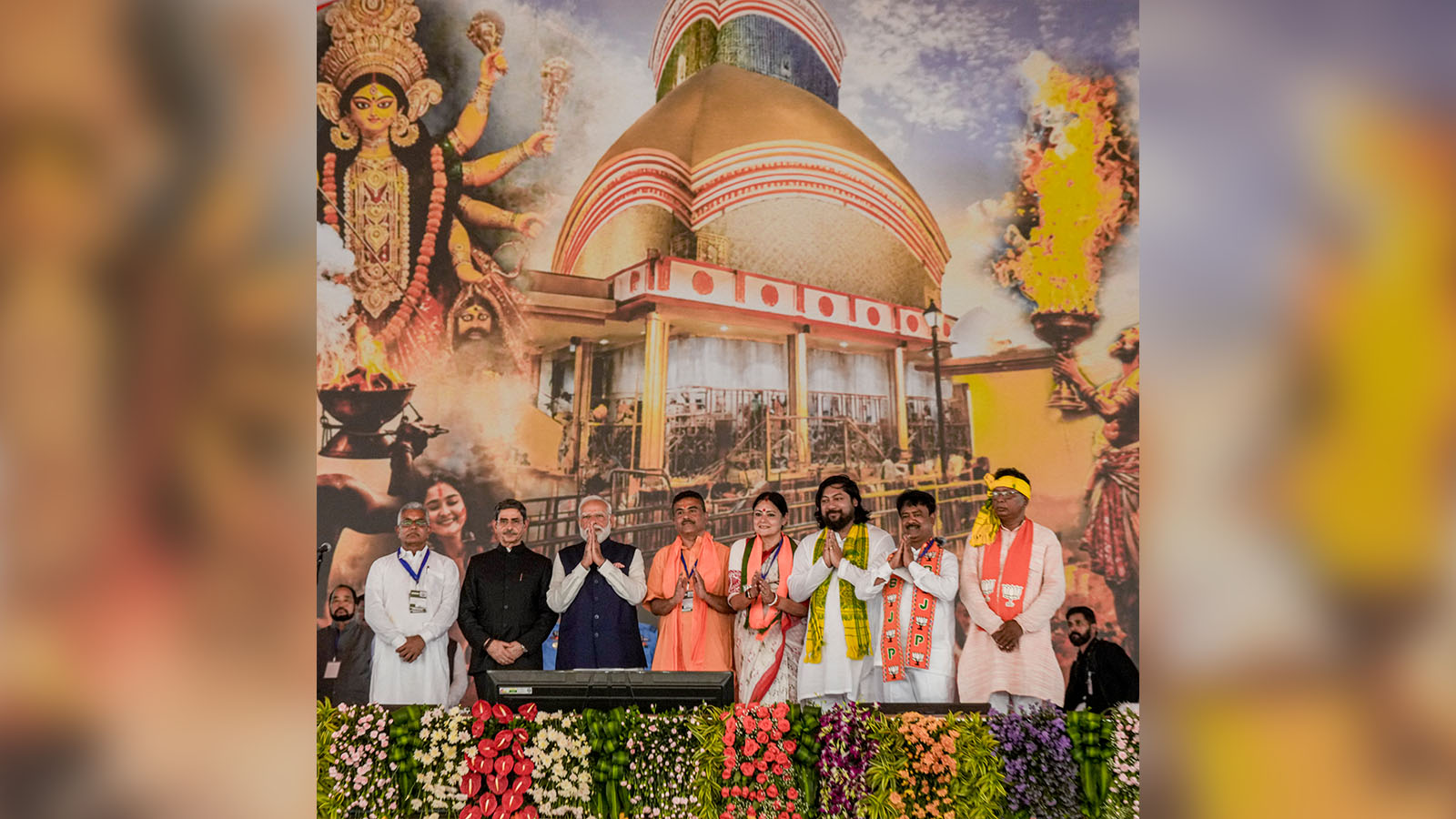
At the swearing-in venue, saffron flags mixed with Bengali cultural symbols on Rabindra Jayanti, marking the birth anniversary of Rabindranath Tagore, as the BJP attempted to blend its nationalist politics with Bengali cultural symbolism in a state where regional identity has long shaped political discourse.
Ten Jhalmuri stalls, Bengali sweet counters and motifs associated with Bengali traditions lined parts of the Maidan venue as thousands gathered for the swearing-in ceremony attended by Modi, Union Home Minister Amit Shah, chief ministers of BJP-ruled states and senior party leaders.
The symbolism extended beyond stagecraft.
Modi bowed in a traditional “sastange pranam” gesture from the stage to greet the people of Bengal and felicitated 97-year-old Jana Sangh veteran Makhan Lal Sarkar, a move seen by party leaders as recognition of the BJP’s long organisational struggle in Bengal when the party remained electorally marginal.
According to state BJP leaders, Sarkar was associated with the Jana Sangh era and played a role in building the organisation in North Bengal long before the BJP emerged as a major political force in the state.
Also read: From CM’s ‘right hand’ to CM: Suvendu Adhikari set to lead Bengal’s first BJP govt
His presence at the ceremony became a symbolic bridge between the party’s old ideological guard and its new generation of leadership.
The ministry announced on Saturday reflected that balancing exercise.
Each of the five inductions appeared politically calibrated as the BJP attempted to consolidate the social coalitions that powered its rise in Bengal.
Dilip Ghosh’s organisational prowess
Ghosh, the former state BJP president and MLA from Kharagpur Sadar, got the ministerial berth largely because of his seniority and organisational importance. He had led the BJP during its aggressive expansion phase in Bengal and remains closely associated with the party’s ideological core.
His inclusion was widely viewed as an attempt by the leadership to reassure long-time cadres and old organisational loyalists at a time when several influential BJP leaders in Bengal, including Adhikari himself, emerged from rival parties.
Agnimitra Paul to strengthen women outreach
In contrast, the induction of Paul reflected the BJP’s effort to strengthen its outreach among women voters, a constituency that played a crucial role in sustaining the previous Trinamool Congress (TMC) government under Mamata Banerjee.
Political analysts said the BJP recognises that its transition from opposition to governance would require competing with the TMC’s welfare-driven support base among women rather than relying solely on ideological mobilisation.
The BJP has promised to replace flagship schemes such as ‘Lakshmir Bhandar’ and ‘Yuva Sathi’ with new programmes carrying higher financial benefits while also introducing the Ayushman Bharat health insurance scheme in Bengal, which had not been implemented earlier because of differences between the state and the Centre.
Also read: Bengal giant killer’s gambit: Suvendu Adhikari and the BJP’s breakthrough
The Centre also announced the release of around Rs 2,700 crore in pending funds under the Jal Jeevan Mission, potentially giving the new administration greater fiscal room as it attempts to establish governance credibility quickly.
Representation of key social blocs also appeared central to the cabinet’s composition.
Ashok Kirtania, a Matua face
Kirtania was inducted as a representative face of the Matua community, a refugee-origin Hindu group concentrated mainly in North 24 Parganas and Nadia districts that has become one of the BJP’s most significant support bases in Bengal.
The Matua vote gained political importance after the BJP linked citizenship politics with promises around the Citizenship Amendment Act.
Although concerns over voter roll revisions and citizenship documentation generated unease among sections of the community during the election campaign, the BJP retained substantial support in Matua-dominated areas.
Kirtania’s inclusion was seen as an effort to reassure the community that it would remain politically important under the new government.
Khudiram Tudu from Jangalmahal
The BJP also retained focus on tribal representation through Tudu, the MLA from Ranibandh in Bankura district, part of the Jangalmahal region, where the party registered sweeping gains in the election.
Also read: Bengal violence raises questions over Election Commission’s accountability | AI With Sanket
Jangalmahal, once associated with Maoist insurgency and later welfare-led stabilisation under the TMC government, has increasingly emerged as a BJP stronghold amid grievances related to employment, local leadership and identity politics among tribal and Kurmi communities.
Nisith Pramanik from North Bengal
North Bengal’s growing strategic importance was reflected in the induction of Pramanik, who represents the Rajbanshi community from Cooch Behar district.
Political observers said Pramanik’s inclusion underlined the BJP’s continuing emphasis on North Bengal, where identity-driven politics around ethnicity, language and regional aspirations have gained prominence in recent years.
The ministry’s regional composition also appeared carefully balanced. Two ministers are from North Bengal, while three are from southern districts, limiting the perception that political power within the new government would become concentrated around Adhikari’s home region in coastal Bengal.
CM Adhikari, the leader
Adhikari’s elevation itself remains politically significant for the BJP.
A former TMC heavyweight who defected in 2020, he brought with him substantial organisational networks and influence in coastal Bengal. BJP leaders believe his familiarity with the TMC’s political machinery and Bengal’s cadre-driven electoral culture could help the party transition more effectively from opposition politics to governance.
Also read: Bengal’s Didi shield cracks: How Mamata Banerjee lost the state she dominated
The BJP’s rise in Bengal has been especially visible in North Bengal, the tribal-dominated Jangalmahal region and sections of southern Bengal, where it consolidated Hindu votes across caste lines while benefiting from fragmented opposition support bases.
At the same time, Bengal’s political discourse has increasingly shifted toward issues such as migration, citizenship, border security and religious identity, themes that previously occupied a less central place in a state whose politics had long revolved around class mobilisation, welfare delivery and regional cultural identity.
‘Saffronisation’ of Bengal politics
Political commentator Debashis Chakrabarti described this as a gradual “saffronisation” of Bengal politics, not merely in religious terms but through the reorganisation of social and political coalitions that transformed the BJP from a marginal force into the state’s principal centre of power.
Yet, he says the BJP’s long-term success in Bengal will depend less on symbolism and more on whether it can govern without intensifying the deep political polarisation that accompanied its rise.
The BJP campaigned heavily on restoring law and order after years of allegations of political violence and partisan policing under the previous regime.
Shortly after being selected chief minister, Adhikari said his government would revisit cases such as the RG Kar hospital rape and murder case and allegations linked to Sandeshkhali, both of which became major political flashpoints during the election campaign.
Beyond immediate governance tests, a larger question now hangs over the state’s political trajectory.
Bengal has historically been shaped by a plural tradition built on cultural diversity and the coexistence of multiple identities within a shared political space. That equilibrium is now being tested by a sharper, more competitive form of identity-driven politics.
At this stage, as reports of post-poll violence and intimidation of minorities emerge, it is more accurate to view Bengal’s pluralism as being under strain and scrutiny.
The key test for the BJP government will be its ability to take all communities along and safeguard Bengal’s pluralistic tradition, a legacy associated with Tagore, whom the party celebrated during its maiden foray into governance in the state on Saturday.

Comments are closed.