
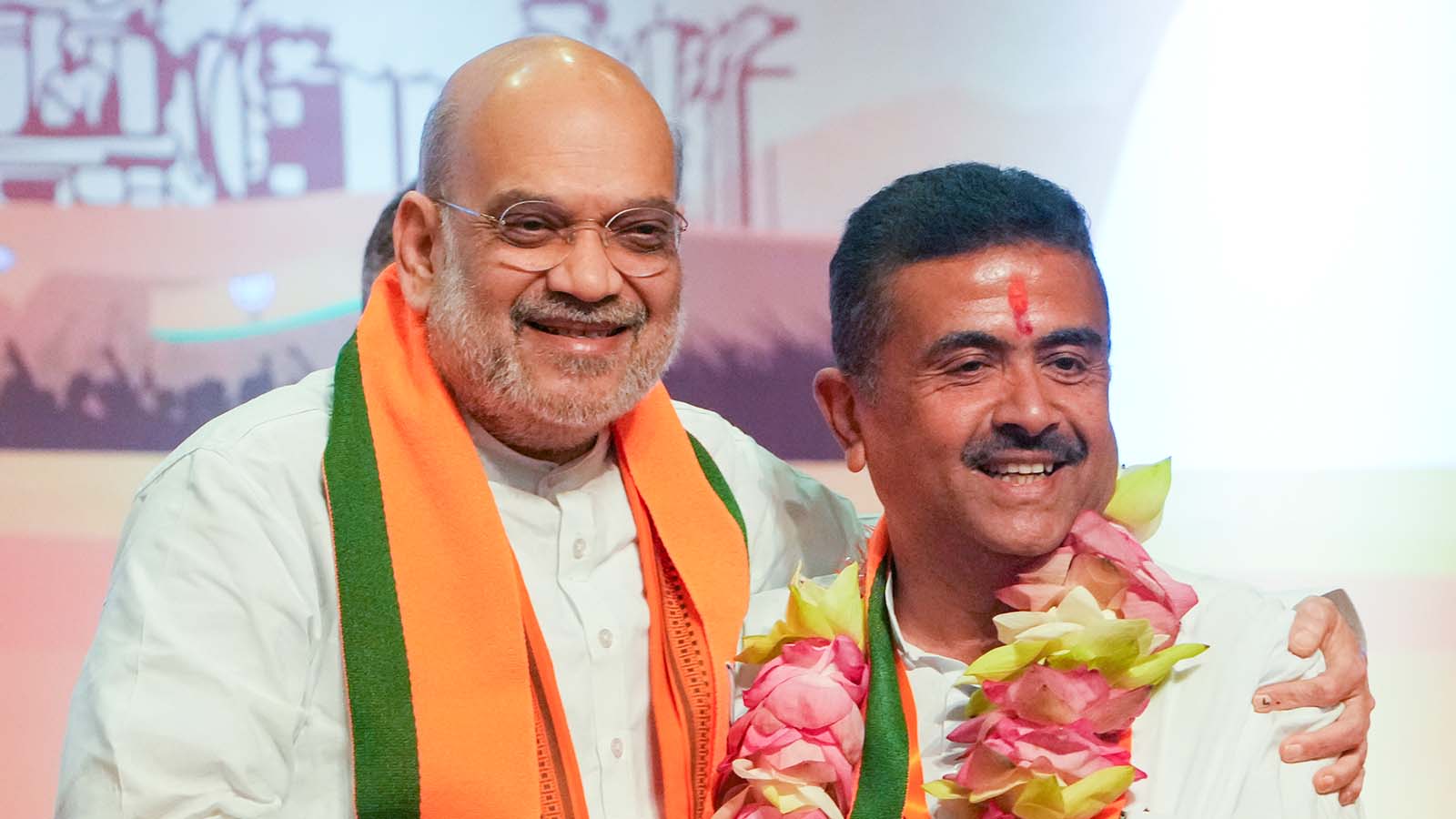

Nineteen years after he helped Mamata Banerjee build the movement that ended the Left Front’s 34-year rule in West Bengal, Suvendu Adhikari is now set to take oath as the chief minister who ended the Trinamool Congress (TMC) supremo’s own reign.
Also read: What is behind West Bengal’s violent turn amid electoral churn?
Four days after scripting a historic win in West Bengal, the Bharatiya Janata Party (BJP) on Friday (May 8) elected Suvendu as leader of its Legislature Party in the state, formally clearing the way for him and his council of ministers to be sworn in at 11 am on Saturday (May 9) as Bengal’s first saffron government. The date is special for the Bengali heart as it marks the 165th birth anniversary of the icon, Rabindranath Tagore.
Suvendu to take oath at mega gathering
The public ceremony at Kolkata’s iconic Brigade Parade Ground is expected to be attended by Prime Minister Narendra Modi, Union Home Minister Amit Shah and chief ministers from other BJP-ruled states, underscoring the symbolic significance the party has attached to its breakthrough in a state that had long resisted its expansion.
Suvendu Adhikari’s golden Assembly election run
♦ In 2006, won from Kanthi Dakshin for TMC against nearest opponent (CPI) by 8,580 votes
♦ In 2016, won from Nandigram for TMC against nearest opponent (CPI) by 81,230 votes
♦ In 2021, won from Nandigram for BJP against nearest opponent (Mamata) by 1,956 votes
♦ In 2026, won from Nandigram for BJP against nearest opponent (TMC) by 9,665 votes
♦ In 2026, won from Bhabanipur for BJP against nearest opponent (Mamata) by 15,105 votes
For Suvendu, the moment marks the culmination of a political journey that has taken him from being one of Mamata’s most trusted lieutenants to becoming the architect of her party’s downfall in Bengal.
The BJP’s rise in Bengal has often been narrated through the prism of Modi and Shah’s aggressive expansionist push into eastern India. But within the state, few leaders were as central to translating that project into electoral reality as Suvendu.
The importance the BJP leadership attached to his role was visible when Shah, on his arrival at Kolkata airport earlier on Friday, specially lauded and congratulated Suvendu as he, along with other BJP state leaders, went to receive the home minister at the airport.
Suvendu: A tireless warrior
A relentless organiser with a reputation for micro-managing booth structures and maintaining deep personal networks across districts, Suvendu gradually emerged as the BJP’s principal political face in Bengal after defecting from the TMC in late 2020.
Also read: SIR didn’t cost Mamata Bengal, women’s anger did, says Yashwant Deshmukh
That shift altered the state’s political landscape.
His defection gave the BJP access not only to an influential regional heavyweight but also to an organisational ecosystem built over nearly two decades inside the TMC.
Killing the giant, not once but twice
Within months of joining the BJP, Suvendu faced Mamata in the 2021 Assembly election from Nandigram and defeated her in one of Bengal’s most closely watched political battles, earning the reputation of a “giant killer”.
Though the BJP lost that election, Suvendu’s stature inside the party continued to grow as he became the face of the opposition campaign against Banerjee’s government over corruption allegations, political violence and governance issues.
VIDEO | Kolkata: Union Home Minister Amit Shah (@AmitShah) felicitates West Bengal BJP Legislature Party leader Suvendu Adhikari (@SuvenduWB).#WestBengalLegislativeAssemblyelection2026
(Full video available on PTI Videos – https://t.co/n147TvrpG7) pic.twitter.com/qT5GiItStF
— Press Trust of India (@PTI_News) May 8, 2026
By the time the 2026 elections came, he had evolved from a regional satrap into the BJP’s undisputed state-level power centre, a position further reinforced by another electoral victory over Mamata, this time in her political bastion of Bhabanipur by more than 15,000 votes.
Suvendu also won from Nandigram this time, humbling his nearest opponent from the TMC by nearly 10,000 votes.
Few political careers in Bengal are as closely intertwined with a single political geography as Suvendu’s association with Nandigram.
Suvendu’s rise during 2007 movement against Left
It was there, during the 2007 anti-land acquisition movement against the then Left Front government, that he first emerged as a prominent mass leader.
The protests against a proposed chemical hub became a turning point in Bengal politics, catapulting the TMC from an opposition force into a serious challenger to the Left Front’s decades-long dominance.
Also read: Bengal giant killer’s gambit: Suvendu Adhikari and the BJP’s breakthrough
Suvendu was among the movement’s most visible organisers, helping mobilise villagers, coordinate resistance networks and convert the agitation into durable political support for the TMC.
In the years that followed, he expanded his influence beyond Purba Medinipur district into politically sensitive regions such as Jangalmahal, where he cultivated local leaders and grassroots networks that later became critical to both the TMC’s expansion and the BJP’s rise.
Like Mamata, Suvendu built his political identity less around ideology than around mobilisation and organisational control.
Both leaders thrived on confrontation, aggressive campaigning and a style of politics rooted in permanent public engagement.
His rise within the BJP coincided with the party’s attempts to deepen Hindu consolidation in Bengal, aggressively raising issues such as alleged border infiltration, citizenship controversies and communal tensions.
Supporters describe Suvendu as disciplined, methodical and unusually attentive to local political detail.
Party workers in Purba Medinipur often recount how he remembers booth-level data, names of local organisers and unresolved constituency grievances with striking precision.
That organisational style helped him retain influence even after his dramatic exit from the TMC.
A leader who only knows to confront?
Critics, however, accuse him of embodying the increasingly confrontational nature of Bengal politics and sharpening religious polarisation between Hindus and Muslims, a factor many political observers believe worked to the BJP’s advantage in this election.
His speeches during the campaign frequently revolved around themes of Hindu consolidation, allegations of minority appeasement, and demographic change. These reflected a marked political transformation for a leader who, during his years in the TMC, was once among the most vocal critics of the BJP’s Hindutva politics.
Also read: Yogendra Yadav flags ‘curated’ elections in Bengal verdict
The shift highlighted both Suvendu’s ideological realignment and the broader hardening of Bengal’s electoral discourse under the BJP’s rise.
Now, as he takes over as the new chief minister, the challenge for him will be to take all communities along while delivering on the BJP’s promise of building a “Sonar Bangla” (Golden Bengal).
In his address to party leaders and legislators after being elected as the Legislature Party leader, Suvendu said his government’s approach would be “Everyone’s support, everyone’s development” (together with all, development for all) a familiar refrain of BJP governments, though one that critics often argue is not consistently reflected in implementation.
Whether Suvendu is able to translate that commitment into practice remains to be seen.

Comments are closed.